
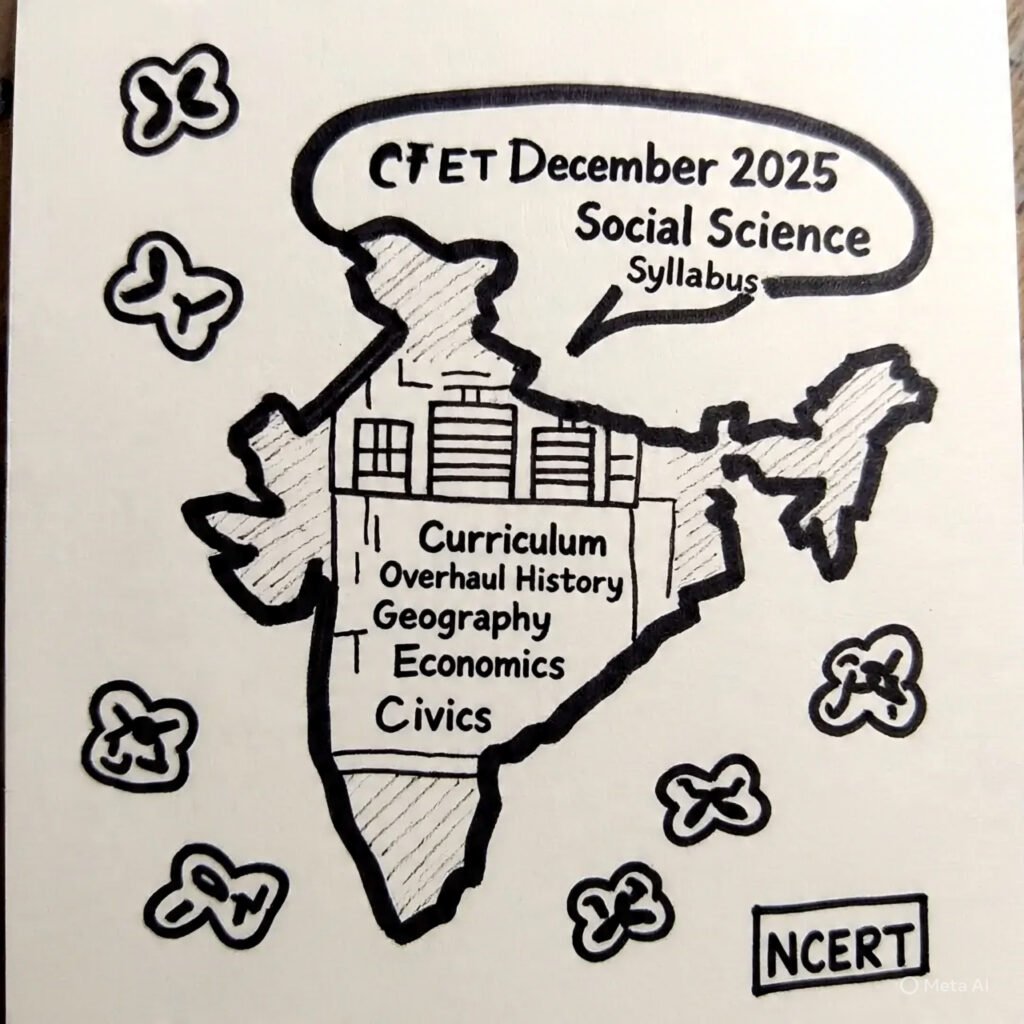
This summary shows how NCERT and CBSE earlier structured Social Science for CTET.
As the CTET December 2025 exam approaches, candidates are grappling with uncertainties surrounding the Social Science syllabus. Recent revisions by the National Council of Educational Research and Training (NCERT) have introduced significant changes, prompting questions about their impact on upcoming examinations.
CTET 2025 Social Science Syllabus Changes & New NCERT
Recent Developments & What They Mean for CTET
NCERT has introduced major changes in the Class 8 Social Science textbook Exploring Society: India and Beyond (Part 1) under the National Curriculum Framework – School Education (NCF-SE) 2023. These changes are causing ripples in CTET aspirant circles because CTET generally follows NCERT’s books. Below are the details, comparisons, and what students should prepare for.
What the Old Syllabus (NCERT + CTET) Looked Like
- NCERT / CBSE Class 8 (old book: Our Pasts – III etc.)
Topics included (among others): How, When and Where, From Trade to Territory: The Company Establishes Power, Tr ibals, Dikus and the Vision of a Golden Age, When People Rebel, Weavers, Iron Smelters and Factory Owners, Women, Caste and Reform, The Making of the National Movement: 1870s–1947. BYJU’S+3GeeksforGeeks+3EduStud+3 - CTET Social Science (Paper 2) syllabus (old / current till recently):
Major divisions: History, Geography, Social and Political Life, plus Pedagogical Issues in Social Science.
History included ancient to modern times: earliest societies, first farmers, Delhi Sultanate, colonialism, freedom struggle. Geography covered environment, human geography, resources, agriculture. Social & Political Life dealt with government, democracy, rights, local governance etc. Shiksha+2Testbook Blog+2
Students could clearly prepare by covering these well-defined topics from NCERT and past CTET papers.
What NCERT Has Changed / Is Changing
Recent updates have altered both content and structure of the Class 8 Social Science curriculum. Key changes are:
- Theme-based Approach & Shift in Class Distribution
The new book organizes Social Science by themes rather than the old structure of separate subjects (History / Geography / Civics). For example, themes like India and the World: Land and the People, Tapestry of the Past — A Note on History’s Darker Periods, Governance and Democracy, Economic Life Around Us. Careers360 Schools - What’s New / Emphasized: “Darker Periods” & Critical Portrayals
The new textbook more frankly describes “darker” aspects of historical periods.- NDTV and Hindustan Times report that NCERT describes Babur as ‘ruthless’, Akbar as ‘a blend of brutality and tolerance’, and Aurangzeb as responsible for the destruction of temples and episodes of religious intolerance. www.ndtv.com+2Hindustan Times+2
- There’s also a “Note on Some Darker Periods in History” included to encourage dispassionate understanding. www.ndtv.com+1
- Omission of Some Topics & Regional Movements Deferred
- The Times of India reports that NCERT has omitted Tipu Sultan, Haidar Ali, and the Anglo-Mysore Wars from the first volume. The newspaper also notes that NCERT plans to include regional resistance movements, such as the Paika Rebellion (Khurda uprising, Odisha) and the Kuka Movement (Punjab), in the second volume, expected around Sept–Oct 2025.
- Change in Chronology and Placement
- The periods of Delhi Sultanate, Mughal Empire etc. that were partially in Class 7 under the old system are now shifted entirely into Class 8. Hindustan Times+1
- Some topics are reorganized under themes so students see connections between geography, politics, economics rather than isolated topics. Careers360 Schools
What This Means for CTET 2025 Social Science Syllabus Changes : Old vs Expected Syllabus
Since CTET draws from NCERT’s class books, here’s how the expected new CTET Social Science syllabus might differ, based on NCERT’s recent changes:
| Component | Old CTET Syllabus (What students needed to study) | Expected Changes / Additions |
|---|---|---|
| History | Ancient India, Delhi Sultanate, Mughals, British colonialism, Indian National Movement, post-independence etc. Shiksha+2GeeksforGeeks+2 | More emphasis on darker periods, religious intolerance, moral complexities of rulers (Babur, Akbar, Aurangzeb). Some topics previously scattered across classes now concentrated in Class 8. ・ Some previously included topics like Tipu Sultan, Anglo-Mysore Wars might not be in first volume. |
| Regional / Resistance movements | These were included (some in older books). Eg. When People Rebel, Tr ibals, Dikus…, Vision of a Golden Age, etc. GeeksforGeeks+1 | Inclusion of the Paika Rebellion, Kuka Movement etc. but only in second volume. So CTET questions might refer to those, depending on the exam date vs release of volume 2. |
| Geography / Environment / Resources | Topics like natural & human environment, resources, agriculture etc. Shiksha+1 | These remain but are more integrated with themes—how land/resources affect politics, economy, life. More real-life examples, sustainability. |
| Governance / Democracy | Government, Constitution, Rights & Duties, Local Government etc. | Probably more focus on universal franchise, electoral systems, deeper understanding of how democracy functions. Themes are likely to stress inquiry, not just definitions. |
| Pedagogical Issues | Teaching methods, critical thinking, sources, evaluation etc. | These likely remain, perhaps more important as CTET will test understanding of how to teach Social Science under new NCERT themes and content. |
Where CTET Might be Uncertain
- Timing of exam vs availability of second volume: If CTET happens before volume 2 is out, questions on topics like Paika Rebellion might be excluded or tested only if officially added in the syllabus notice.
- Syllabus notification: CTET might issue an updated syllabus notice reflecting the new NCERT book; aspirants should watch for this.
- Regional vs national coverage: NCERT gives a national framework; states may supplement with regional history. CTET usually adheres to national framework, so such regional additions may or may not appear.
What Aspirants Should Do
To be on safe side, do this:
- Study both old and new NCERT content for Class 7 & 8 — especially old topics that might get skipped if not included yet in new syllabus.
- Focus on the new NCERT Class 8 book themes: Natural Resources, Reshaping India’s Political Map, Rise of the Marathas, Colonial Era, Universal Franchise, Parliamentary System, Factors of Production. Careers360 Schools
- Keep track of volume 2 release, because that might have additional topics.
- Practice critical style questions: not just what happened, but why, what were consequences, was there tolerance/intolerance, etc.
- Refer to CTET’s latest syllabus notification when released to adjust preparation.
Some related news articles
- “Babur is described as ruthless, Akbar is portrayed as brutal but tolerant, and Aurangzeb is noted for temple destruction and religious intolerance in the new NCERT text. The book adds a ‘Note on Some Darker Periods in History’ explaining that these descriptions are intended for understanding, not blaming.” The Times of India+3www.ndtv.com+3Hindustan Times+3
- “Tipu Sultan, Haidar Ali, and the Anglo-Mysore Wars have been omitted from the first volume of the new Class 8 Social Science book. In response to concerns, NCERT has clarified these topics will appear in the second volume expected by September-October 2025.” The Times of India+1
- “The Paika Rebellion (also called the Khurda uprising) and the Kuka Movement will also be included in Volume 2, addressing criticism that regional resistance movements were missing.” The Times of India
Conclusion
In short:
- The new NCERT book changes how Social Science is taught: more themes, more critical viewpoints, some content shifted or removed (temporarily), regional topics deferred.
- CTET aspirants need to adapt: include new content, keep old topics in view, prepare for subtle / critical questions, watch official syllabus updates.
- It’s not about “memorizing more,” but being ready to think, connect, and explain.