
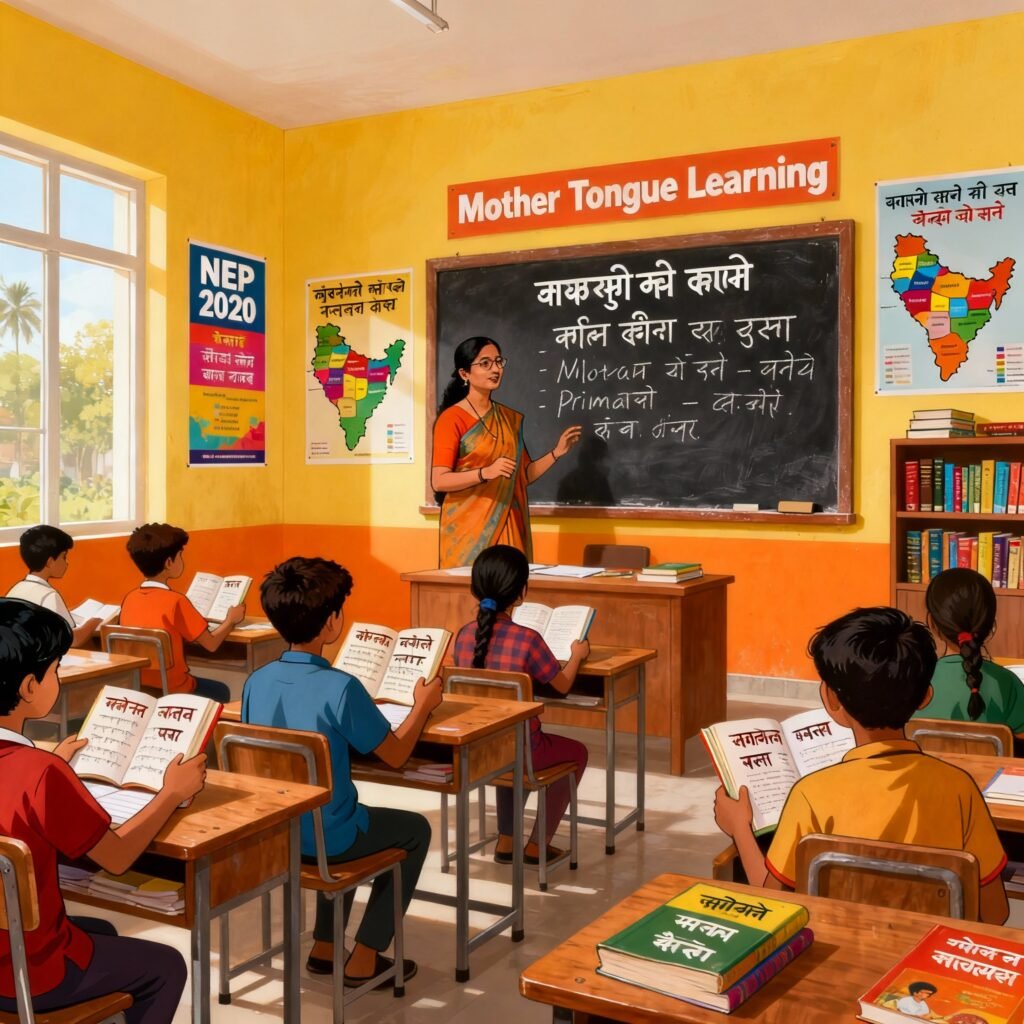
The Indian Cabinet approved the New Education Policy 2020 on July 29, 2020. Under this policy, education up to the fifth grade will be delivered in the mother tongue (मातृ भाषा). Moreover, the government will allocate 6% of the Gross Domestic Product (सकल घरेलू उत्पाद) for education. India’s first education policy was introduced by Indira Gandhi in 1968. Here, we explore the significant points of the New Education Policy 2020.
Just as stagnant water begins to stink, a traditional education system (परंपरागत) based on rote learning or cramming (रट्टू तोता) no longer benefits students effectively. Therefore, India periodically revises its education policies. The first policy appeared in 1968 under Prime Minister Indira Gandhi, followed by the second policy in 1986 under Rajiv Gandhi, which Narasimha Rao’s government modified in 1992.
Meanwhile, before 2020, India operated under a 34-year-old policy that had become ineffective in addressing modern educational needs. In 2019, the Ministry of Human Resource Development prepared a draft for a new policy and invited public feedback.
Highlights of the New Education Policy 2020
The Cabinet, under Prime Minister Narendra Modi, approved the policy on August 29, 2020. Former ISRO chief K. Kasturirangan led the expert committee that prepared the draft. Here are the main points:
Allocation of Funds: The government will spend 6% of GDP on education, an increase from the previous 4.43%.
Mother Tongue Instruction: Schools will teach students up to the fifth grade in their mother tongue (मातृ भाषा).
Ministry Name Change: The Ministry of Human Resource Development is now called the Ministry of Education, and Ramesh Pokhriyal Nishank is referred to as the Minister of Education.
Single Regulatory Body for Higher Education: Except for law and medical education, the government will create the Higher Education Commission of India (HECI) to oversee all higher education institutions. As a result, this will add 3.5 crore new seats.
Vocational Courses from Class VI: Students will access vocational courses starting in the sixth grade and can undertake internships (इंटर्नशिप) early. Furthermore, this will help students gain practical experience from a young age.
Inclusion of Arts and Music: Schools will integrate music and arts into the curriculum and actively promote them.
National Educational Technology Forum (NETF): The policy establishes the NETF to support e-learning and develop virtual labs.
Gross Enrollment Ratio Target: By 2030, the government aims to increase the Gross Enrollment Ratio (GER) in higher education from 26.3% in 2018 to 50%.
Multiple Entry and Exit System: Students can now earn a certificate (सर्टिफ़िकेट) after one year, a diploma (डिप्लोमा) after two years, and a degree (डिग्री) after three to four years in higher education programs. Therefore, this reduces the dropout ratio and allows students to pause and switch courses if needed.
Uniform Rules Across Institutions: The policy standardizes rules for central universities, deemed universities, and standalone institutions.
National Research Foundation (NRF): India will establish the NRF, modeled after the USA’s National Science Foundation, to promote research and development. In addition, the NRF will fund large projects and foster a research culture in universities under the governance of an independent board.