Home » Articles » Creativity and Intelligence (सृजनात्मकता और बुद्धि) in CDP
Relationship Between Creativity and Intelligence (सृजनात्मकता और बुद्धि के बीच संबंध)
Researchers have found that the relationship between creativity and intelligence is positive (सकारात्मक).
However, Terman (1920s) discovered that individuals with a high IQ are not necessarily creative.
This means that not every child with a high IQ is creative (रचनात्मक).
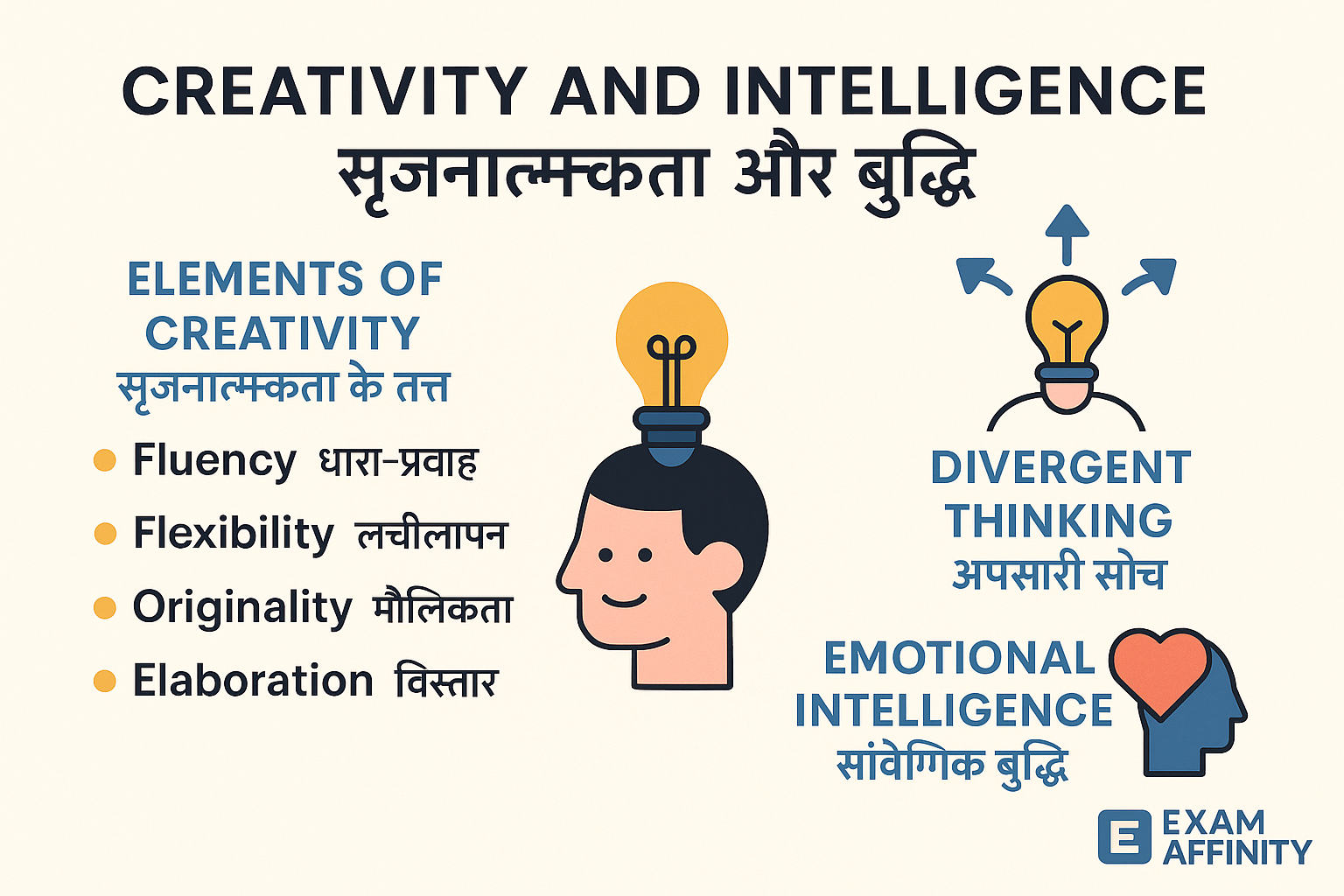
Elements of Creativity (सृजनात्मकता के तत्व)
A simple trick to remember the elements of creativity is F FOE:
Fluency (धारा-प्रवाह) – The ability to generate a large number of ideas smoothly.
Flexibility (लचीलापन) – The ability to think in different ways and adapt to new situations.
Originality (मौलिकता) – The ability to create unique and novel ideas.
Elaboration (विस्तार) – The ability to expand on ideas and add details.
Types of Thinking (सोचने के प्रकार) – J.P. Guilford’s Model
1. Divergent Thinking (अपसारी सोच)
Open-ended thinking with multiple possible solutions.
Encourages creativity and innovation.
“Out-of-the-box” thinking.
2. Convergent Thinking (अभिसारी सोच)
Closed-ended thinking, focused on arriving at a single correct answer.
Related to intelligence and problem-solving.
Used in MCQs and logical reasoning tasks.
Note: Not every person with divergent thinking is creative, but all creative individuals possess divergent thinking skills.
Gifted Children (प्रतिभाशाली बच्चे) – Three Types
Intellectually Bright (बौद्धिक रूप से उज्ज्वल) – IQ 140+, exceptional reasoning skills (e.g., Albert Einstein).
Talented (प्रतिभाशाली) – Extraordinary abilities in specific fields (e.g., Sachin Tendulkar in cricket).
Creative (रचनात्मक) – High originality and innovation in work (e.g., M.F. Hussain in painting).
Gifted children need an enriched curriculum (समृद्ध पाठ्यचर्या) with challenging tasks that match their interests (रुचि). Intellectually bright children benefit from HOTS (Higher Order Thinking Skills) in their learning.
Emotional Intelligence (सांवेगिक बुद्धि)
The concept of Emotional Intelligence was first introduced by Salovey and Mayer.
The book “Emotional Intelligence” was written by Daniel Goleman.
Aristotle’s Quote on Emotional Intelligence (अरस्तू का कथन)
“Anybody can become angry; that is easy. But to be angry with the right person, to the right degree, at the right time, for the right purpose, and in the right way—that is not within everybody’s power, and that is not easy.”
Meaning (अर्थ): Emotional intelligence is the ability to control and use emotions appropriately at the right place, right time, and in the right manner.
Key Features of Emotional Intelligence (सांवेगिक बुद्धि की विशेषताएँ)
Social Skills (सामाजिक कौशल) – Ability to interact effectively with others.
Self-Awareness (आत्म-जागरूकता) – Recognizing one’s own emotions and their impact.
Motivation (अभिप्रेरणा) – Inner drive to achieve goals.
Empathy (समानुभूति) – Understanding and sharing the feelings of others.
Self-Regulation (स्व-नियंत्रण) – Controlling and managing emotions appropriately.
Cognition and Emotion (संज्ञान एवं संवेग)
Cognition (thinking) and emotion (feelings) are bi-directional (द्वि-दिशात्मक) and interrelated (अंतर्संबंधित).
Psychologist Zajonc suggested that emotion and cognition can sometimes function independently (स्वतंत्र रूप से कार्य कर सकते हैं).
However, in most cases, they influence each other significantly.
Giftedness According to Renzulli (रेंजुली के अनुसार प्रतिभाशाली बच्चे)
According to Renzulli’s Three-Ring Model, a gifted child must have a combination of:
High Ability (उच्च क्षमता) – Strong intellectual skills.
High Creativity (उच्च सृजनात्मकता) – Ability to generate unique ideas.
High Commitment (उच्च प्रतिबद्धता) – Dedication and perseverance in tasks.
A child possessing all three traits is considered gifted (प्रतिभाशाली) according to this model.
1 thought on “Creativity and Intelligence (सृजनात्मकता और बुद्धि) in CDP”

Pingback: Howard Gardner’s Theory of Multiple Intelligence in CDP - Exam Affinity