
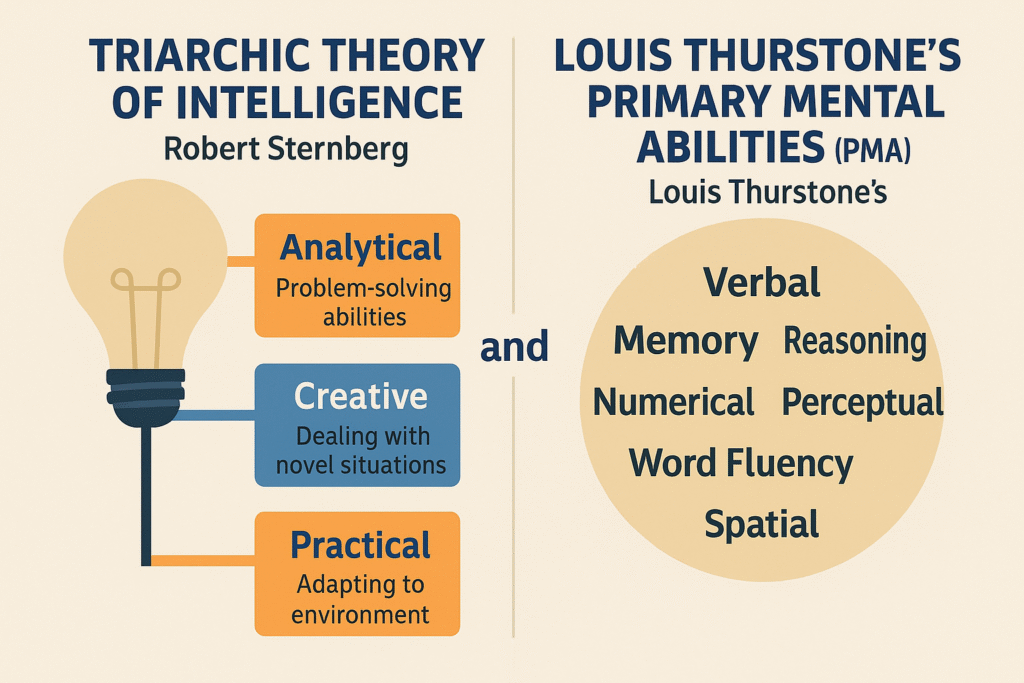
Triarchic Theory of Intelligence(Robert Sternberg) – Key Points:
- Triarchic Theory of Intelligence is Proposed by: Robert Sternberg
- Three Components of Intelligence:
- (A) Analytical/Componential Intelligence:
- Logical thinking, problem-solving, and abstract reasoning.
- Example: Solving math problems, academic test performance.
- (B) Creative/Experiential Intelligence:
- Ability to innovate, combine unrelated ideas, and adapt to novel situations.
- Example: Writing poetry, scientific inventions.
- (C) Practical/Contextual Intelligence (“Street Smarts”):
- Adapting to real-world environments, maximizing strengths, and compensating for weaknesses.
- Example: Navigating social conflicts, resource management.
- (A) Analytical/Componential Intelligence:
- Meta-Components:
- Higher-order processes like planning, decision-making, and cognitive control.
Louis Thurstone’s Primary Mental Abilities (PMA)
Key Points:
- Theory: Group Factor Theory – Intelligence comprises 7 independent abilities (not a single “g-factor”).
- 7 Primary Mental Abilities (SPNV-WMR Trick):
| Abbreviation | Ability | Description |
| S | Spatial Ability | Understanding spatial relationships (e.g., map reading). |
| P | Perceptual Speed | Quickly identifying visual details (e.g., spotting differences). |
| N | Numerical Ability | Performing mathematical calculations efficiently. |
| V | Verbal Comprehension | Understanding language and word meanings (e.g., reading comprehension). |
| W | Word Fluency | Rapidly recalling and using words (e.g., essay writing). |
| M | Memory | Retaining and recalling information. |
| R | Reasoning | Logical problem-solving (e.g., solving puzzles). |
Key Features:- Rejected Spearman’s general intelligence (“g-factor”).
- Argued intelligence is a cluster of 7 distinct abilities.
Comparison of Theories
| Theory | Focus | Key Idea |
| Triarchic (Sternberg) | Three dimensions of intelligence | Analytical, creative, and practical adaptation. |
| Thurstone’s PMA | 7 independent mental abilities | Intelligence as a set of distinct skills. |
Key Takeaways:
- Sternberg emphasizes cognitive processes (how we think), while Thurstone focuses on specific mental abilities (what we can do).
- Both theories reject the idea of a single, unified intelligence.
- Sternberg’s Practical Intelligence aligns with real-world problem-solving (“street smarts”), whereas Thurstone’s PMA breaks down skills like math, language, and reasoning.
Examples to Remember:
- Analytical Intelligence: Solving a physics equation.
- Creative Intelligence: Composing a song.
- Practical Intelligence: Negotiating a job salary.
- Thurstone’s PMA: Using spatial ability to assemble furniture.