
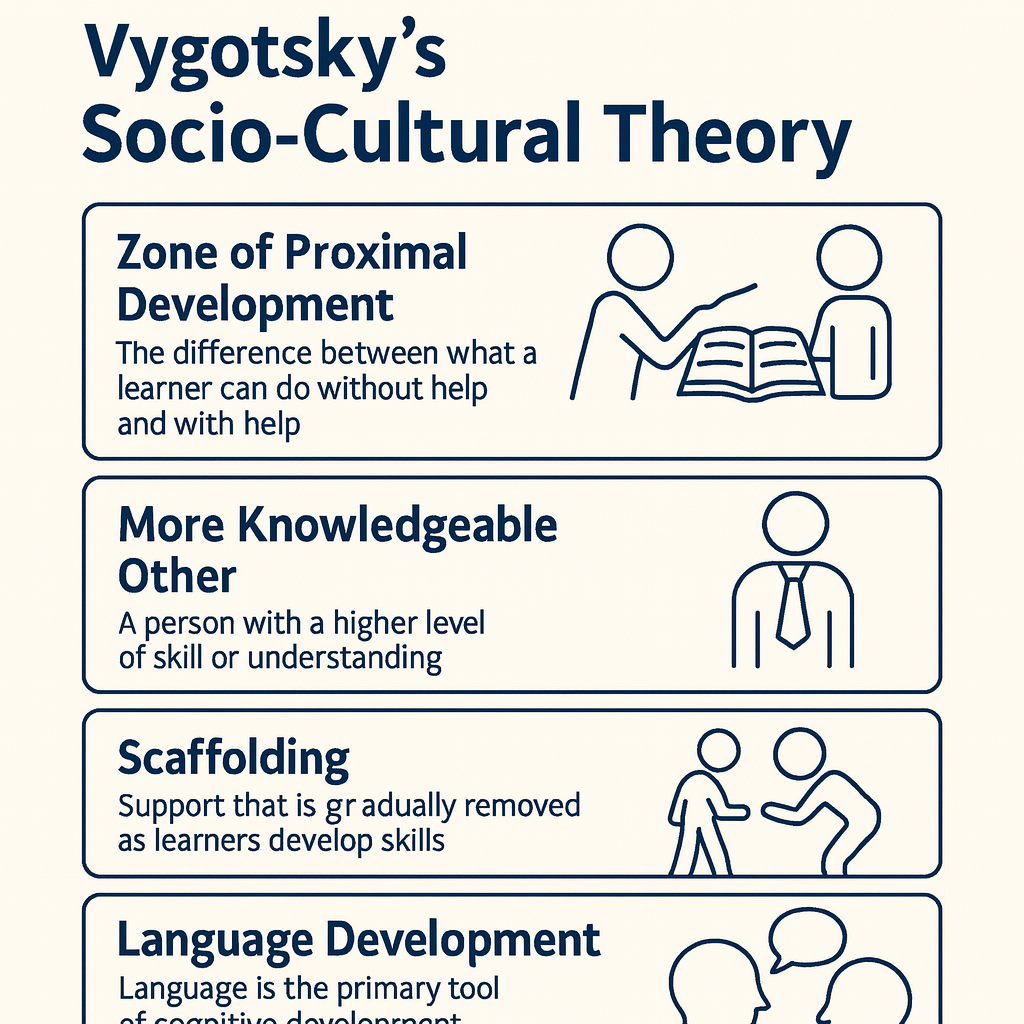
Vygotsky’s socio-cultural approach explains that children learn best through social interaction, guided support, and cultural experiences. Unlike theories that focus only on individual development, Vygotsky highlights the crucial role of language, community, and meaningful collaboration in shaping a child’s thinking. His ideas—such as the Zone of Proximal Development, scaffolding, and the role of a More Knowledgeable Other—form the foundation of modern teaching and learning practices, especially in CTET and teacher training frameworks.
Introduction to Lev Vygotsky
- Lev Vygotsky (1896–1934) was a Russian psychologist known for his socio-cultural theory of cognitive development.
- He was a social constructivist, believing that knowledge is not acquired in isolation but is built through social interaction.
- His theory emphasizes the role of culture, language, and social interaction in learning.
Key Focus of Vygotsky’s Theory
- Learning is a social process – Children learn through interaction with adults, peers, and their environment.
- Culture plays a vital role – A child’s cognitive development is influenced by their cultural context.
- Language is the foundation of thought – Learning and thinking are guided by language.
- Development is continuous – Unlike Piaget, who believed in distinct cognitive stages, Vygotsky viewed development as a lifelong and continuous process.
Key Principles of Vygotsky’s Theory
1. Learning through Social Interaction
- Children learn best when they interact with others rather than working alone.
- Example: A child learning how to solve a puzzle might initially struggle, but with a parent’s guidance (e.g., hints on where to place a piece), they gradually understand the strategy.
2. Cognitive Development is a Social Process
- Development occurs within a social environment where children learn through observation, imitation, and interaction.
- Example: A child learns to speak by imitating parents, siblings, and teachers. The words and grammar they use are shaped by their culture and social surroundings.
3. Process of Internalization
- External interactions become internal thought processes over time.
- Example: A teacher first helps a child with multiplication problems using physical objects (e.g., counters or blocks). Over time, the child internalizes this concept and can solve problems mentally without external aids.
4. Role of Language in Development
- Language is the primary tool for thought and communication.
- It helps structure thinking, solve problems, and interact with others.
- Three Forms of Speech in Development:
- Social Speech (2+ years) – Talking to others to communicate needs and ideas.
- Example: A child asks for food or describes what they see.
- Example: A child asks for food or describes what they see.
- Private Speech (3+ years) – Talking to oneself while performing tasks.
- Example: A child mutters instructions to themselves while tying their shoes.
- Example: A child mutters instructions to themselves while tying their shoes.
- Silent Inner Speech (7+ years) – Thinking internally without vocalizing.
- Example: An older child mentally rehearses steps before answering a math problem.
- Example: An older child mentally rehearses steps before answering a math problem.
- Social Speech (2+ years) – Talking to others to communicate needs and ideas.
Key Concepts in Vygotsky’s Theory
1. Zone of Proximal Development (ZPD)
- ZPD refers to the range between what a child can do independently and what they can achieve with help.
- It represents the potential for learning when given the right support.
- Three Levels of Learning:
- A (What learners can do on their own) – Tasks that a child can complete without help.
- ZPD (What learners can do with support) – Tasks that a child can do with guidance from a teacher, peer, or mentor.
- B (What learners cannot do even with support) – Tasks that are beyond the child’s current abilities.
- A (What learners can do on their own) – Tasks that a child can complete without help.
Example of ZPD:
- A child is learning to ride a bicycle:
- A: They can walk but cannot ride the bike yet.
- ZPD: With an adult holding the bike and guiding them, they start learning.
- B: The child cannot perform advanced tricks like racing, even with help.
- A: They can walk but cannot ride the bike yet.
2. More Knowledgeable Other (MKO)
- An MKO is a person with more knowledge or skill in a particular subject who helps guide learning.
- An MKO can be:
- A teacher
- A parent
- A peer (older sibling, classmate, friend)
- Even technology (educational apps, AI tutors, instructional videos)
- A teacher
Example of MKO:
- A teacher explains a difficult concept (e.g., fractions) to students using a real-life analogy.
- An older sibling teaches their younger sibling how to play chess by giving them strategies.
3. Scaffolding
- Scaffolding is temporary assistance provided to a learner to help them achieve a task they could not do alone.
- The teacher gradually removes support as the learner gains confidence.
- Forms of scaffolding include:
- Giving hints or clues instead of direct answers.
- Breaking tasks into smaller steps.
- Using visual aids or demonstrations.
- Giving hints or clues instead of direct answers.
Example of Scaffolding:
- A teacher helping a student read a difficult word:
- Initially, they sound out each letter together.
- Later, they only remind the child of the first sound.
- Eventually, the child reads independently.
- Initially, they sound out each letter together.
Other Important Concepts
| Concept | Explanation | Example |
| Assistive Learning | Using tools and aids to enhance learning. | Using audiobooks for visually impaired students. |
| Collaborative Learning | Learning in groups to achieve a common goal. | Group science projects where students share ideas. |
| Cooperative Learning | Structured teamwork with assigned roles. | A group of students solving a math problem together. |
| Peer Tutoring | One student helps another student understand concepts. | An older student teaching multiplication to a younger one. |
| Reciprocal Teaching | Students take turns being the teacher and explaining concepts. | A reading group where students take turns summarizing passages. |
Glossary of Key Terms
| Term | Meaning |
| Social Constructivist | The idea that learning happens through social interaction and experience. |
| Zone of Proximal Development (ZPD) | The gap between what a learner can do alone and what they can achieve with guidance. |
| More Knowledgeable Other (MKO) | A person or resource that provides knowledge or skills. |
| Scaffolding | Temporary assistance that helps a learner develop new skills. |
| Internalization | The process of turning external interactions into personal knowledge. |
| Cognitive Development | Growth in thinking, problem-solving, and learning abilities. |
| Private Speech | Talking to oneself while learning or solving problems. |
| Silent Inner Speech | Thinking internally without verbalizing thoughts. |
Conclusion
- Vygotsky’s theory highlights that learning is a social process shaped by culture, language, and interaction.
- The role of teachers, parents, and peers is crucial in guiding children through their ZPD using scaffolding and MKO support.
- The internalization of knowledge through social interaction leads to lifelong cognitive development.
Related Internal Links (Exam Affinity Website)
• Piaget’s Theory of Cognitive Development – Stages & Examples
• CTET Previous Year Question Papers (All Shifts)
Helpful Authoritative Sources
• NCERT Class 11 Psychology Book – Chapter on Vygotsky
• American Psychological Association (APA) – Lev Vygotsky Profile
Pingback: Thorndike’s Trial and Error Theory (1911): Laws & Experiment