
Definition and Philosophy
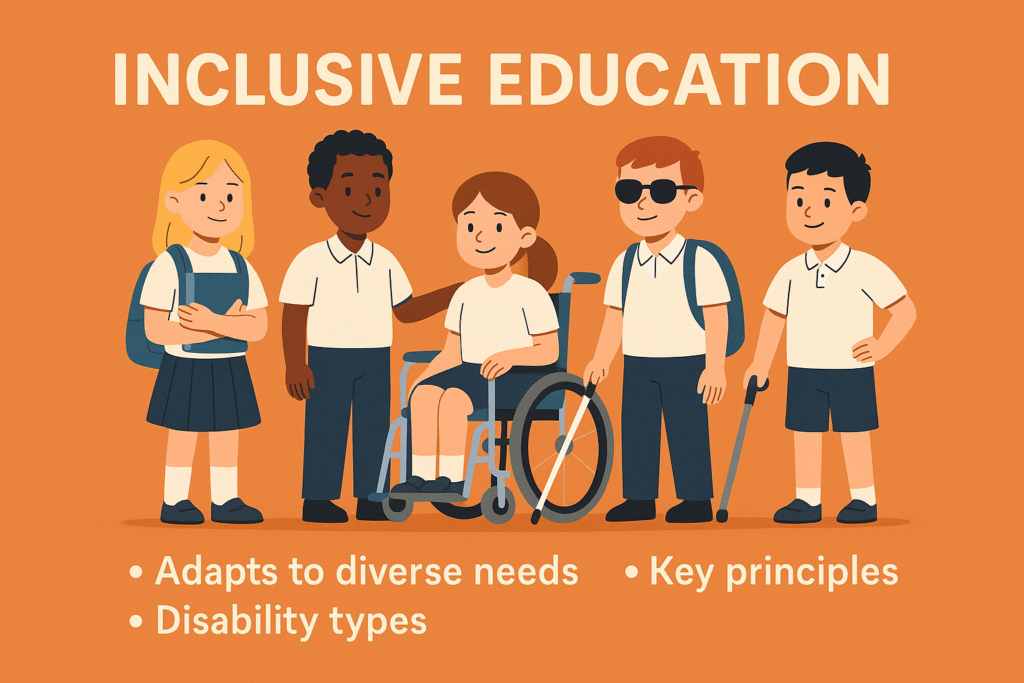
Inclusive education ensures that every child receives education tailored to their needs. Instead of isolating or segregating students based on abilities or disabilities, schools adapt the system to each child. This approach rests on the belief that segregation goes “against the law of nature” and that every individual deserves equal learning opportunities, regardless of background or ability.
International and National Mandates
In 1993, the United Nations directed all states to educate marginalized and deprived groups. These groups include children with physical, sensory, and intellectual disabilities, as well as those who face social, economic, or cultural disadvantages.
In India, the 86th Constitutional Amendment guarantees free education for children aged 6 to 14 years. For children with disabilities, the government extends the age range to 6 to 18 years.
Both mandates emphasize removing barriers linked to gender, disability, and socio-economic status so that every child can grow and develop fully.
Principles of Inclusive Education
Needs-Based Instruction
Teachers provide instruction according to each learner’s needs. They adapt teaching methods, curriculum, and support systems to meet these differences.
Example: A teacher may use assistive technologies for a visually impaired child and multisensory methods for a child with a learning disability.
System Adaptation, Not Child Modification
Schools modify the system to meet the child’s needs rather than trying to change the child to fit a rigid structure.
Example: Instead of sending children with disabilities to separate schools, teachers modify mainstream classrooms and provide support staff.
Equality of Opportunity
All children—regardless of background or disability—receive equal access to quality education. Inclusive classrooms support social integration and holistic growth.
Example: Teachers may use peer tutoring or group projects so that children with different abilities learn together.
Comparison with Integrated Education
Integrated education simply places children with disabilities in mainstream schools without making significant changes.
In contrast, inclusive education transforms the system so that all children benefit.
Mnemonic tools such as BALA (Building As Learning Aid) highlight the idea that the system should adjust to the child, not the opposite.
Special Attention to Gifted Children
Inclusive education also nurtures gifted learners. These children often show creativity, curiosity, excellent memory, high reasoning skills, strong vocabulary, and an IQ above 140.
Types of Disabilities in Inclusive Education
1. Physical Disabilities
Visual Disability: Difficulty related to sight (blindness or low vision).
Auditory Disability: Difficulty hearing.
Locomotor Disability: Limited movement affecting walking or limb use.
2. Intellectual Disability
This disability involves limitations in intellectual functioning and adaptive behavior that affect daily life and learning.
3. Learning Disabilities
Dyslexia:
Children struggle to differentiate letters or sounds, reverse letters, and face reading/writing difficulties.
Apraxia:
Brain damage affects motor planning, making tasks such as writing or speaking difficult.
Dyspraxia:
Children show coordination and balance issues, often linked to sensory integration problems.
Aphasia:
Brain injury affects a child’s ability to understand or express language.
Dysphasia:
Children face partial or complete difficulty communicating.
Alexia:
Brain injury leads to difficulty reading, often along with dysgraphia.
Dysgraphia:
Children face challenges writing legibly due to motor or neurological issues.
Dyscalculia:
Children struggle with numbers and mathematical operations.
Dysthymia:
Chronic mild depression affects learning and daily functioning.
Dysmorphia:
Children view their body negatively, which affects self-esteem and learning.
Legal Framework: PWD and RPWD Acts
PWD Act (1995)
The government defined major disabilities and created basic rights for persons with disabilities.
RPWD Act (2016)
The government revised and expanded the list to 21 disabilities. The Act came into force on June 15, 2017, and includes conditions such as visual impairment, locomotor disability, autism, thalassemia, sickle cell disease, muscular dystrophy, mental illness, and more.
Inclusive Education in Practice
Customized Learning Environments
Schools create flexible classrooms using assistive tools, differentiated instruction, and adaptable curricula.
Teacher Training
Teachers learn inclusive teaching strategies to support students with disabilities and gifted learners.
Systemic Adaptations
Schools adjust teaching methods, classroom layouts, and assessment practices to support every child.
Holistic Development
Inclusive education promotes academic, emotional, social, and physical development for all learners.
Conclusion
Inclusive education builds an adaptive, equitable, and supportive learning environment. It meets the needs of every child—whether they have disabilities or exceptional abilities. By adapting the system to the child, inclusive education ensures complete development and equal opportunities for everyone.