
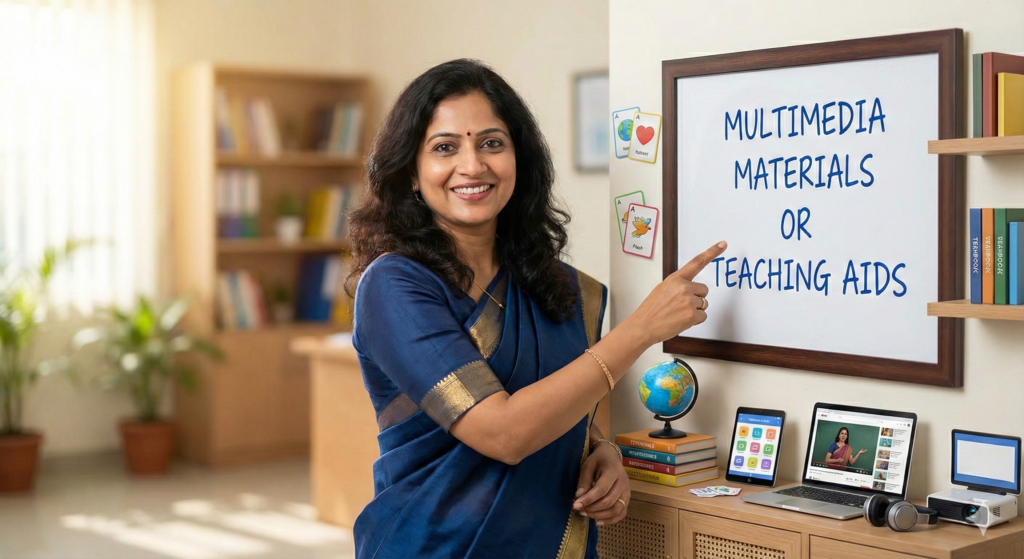
Teaching-Learning Materials – Multimedia Materials (Teaching Aids) – Modern CTET English Pedagogy
Language classrooms work best when students see, hear and engage with ideas rather than only listen to the teacher. For this reason, teachers use multimedia materials, also known as teaching aids or audio-visual aids. These aids turn abstract concepts into concrete learning experiences by appealing to the eye and ear together.
Because English functions as a second language for most Indian learners, exposure through visuals, audio input, interaction and digital resources becomes essential. CTET pedagogy questions regularly test how teachers select materials that support comprehension, pronunciation, vocabulary, confidence and classroom participation.
Multimedia materials are part of instructional technology—the deliberate use of tools, devices and platforms that make learning meaningful. They help teachers organise information, demonstrate concepts and sustain interest among diverse learners.
Types of Multimedia Materials in Today’s Classrooms
1. Visual Aids – Support through Sight
Visual aids present information as images, real objects or written text. They help students build mental associations and retain language for longer. Modern visual aids include:
- Textbooks and workbooks
- Smartboards / Interactive whiteboards
- Flashcards and posters
- Real objects (realia) from daily life
- Maps, charts and diagrams
- Models and classroom displays
- Infographics and slideshows
Visual tools are especially useful for English vocabulary building, picture reading, pre-reading activities and concept introduction.
2. Audio Aids – Support through Hearing
Audio aids expose learners to accent, rhythm, tone, stress, pauses and pronunciation, which are essential for English speaking. These tools encourage natural listening habits. Examples include:
- Classroom radio content and announcements
- Audio lessons and podcasts
- English pronunciation files
- Recorded storytelling or poetry
- Music-based language activities
With audio content, students practise listening comprehension, dictation and oral expression, which are directly tested in CTET pedagogy.
3. Audio-Visual Aids – Eye and Ear Together
These aids provide movement, voice, gesture, expression and storyline. They help students understand meaning without translation. Modern examples include:
- YouTube educational channels
- Short documentary clips
- Video lectures
- Animated learning content
- Dramatization and role-play
- Teacher-created classroom videos
These materials simulate real-life communication, a core requirement of the CTET Communicative Approach.
4. Digital and Computer-Assisted Language Learning
Digital tools turn language learning into interactive practice. They offer feedback, repetition and self-correction. Examples include:
- Language learning apps (Duolingo, Memrise, BBC Learning English, Hello English)
- Tablets and mobile-assisted language learning
- Classroom laptops and Chromebooks
- Online quizzes and English games
- Learning Management Systems (Google Classroom, Moodle)
Such tools personalise learning and support mixed-ability classrooms, a topic highlighted repeatedly in CTET papers.
Why Multimedia Teaching Aids Matter?
Teaching aids matter because they change classroom participation. They:
- make explanations clearer by replacing verbal talk with concrete demonstrations
- hold attention and increase curiosity, especially for young learners
- create variety and break monotony, which prevents fatigue
- offer direct or simulated experiences when real objects are unavailable
- strengthen long-term memory because learners associate sound, sight and meaning
- help teachers reach visual, auditory and kinesthetic learners in a single lesson
- support multilingual classrooms, where students need English exposure through context, not translation
- reduce fear of English by creating natural settings that encourage risk-free speaking
- allow teachers to save time when demonstrating complex events or cultural references
- encourage active participation through games, responses, and collaborative tasks
- differentiate instruction so slow learners and advanced learners receive support at their level
- promote scientific habits such as observing, comparing, predicting and verifying
These functions directly support CTET English Pedagogy questions about constructivism, communicative competence, child-centred learning and multiple intelligences.
How Teaching Aids Help in English as a Second Language (CTET Context)
In India, English learning happens in multilingual environments. Multimedia aids:
- give auditory models of pronunciation, which the CTET exam expects teachers to teach without rote phonetics
- provide contextual vocabulary, replacing word-lists
- prepare students for listening and speaking tasks, linked to LSRW
- help children understand English without depending on Hindi translation
- create a natural environment, which supports the Communicative Language Teaching (CLT) approach
Therefore, multimedia is not an accessory—it is central to second language pedagogy, especially in CTET Paper 1 and 2.
Characteristics of Effective Teaching Aids (Modern Version)
Good aids must:
- be accurate and up-to-date
- be meaningful and linked to lesson objectives
- match the age, interest and cognitive level of learners
- be large and clear enough for group viewing
- be affordable or teacher-developed when resources are limited
- stimulate curiosity and motivation
- provide learning, not entertainment
- adapt easily to differentiated instruction
FAQ – Teaching-Learning Materials & Multimedia Aids (CTET English Pedagogy)
Multimedia materials are classroom resources that use visuals, sound, movement or digital interaction to support language learning. They include textbooks, flashcards, audio recordings, videos, apps and interactive boards. These aids help students see, hear and engage with English, instead of only listening to the teacher.
They make learning meaningful by offering concrete experiences, building comprehension, improving pronunciation, and encouraging participation. CTET tests how teachers use aids to support clarity, confidence, vocabulary growth and communicative competence.
Visual aids include flashcards, charts, posters, real objects (realia), smartboards, slideshows, maps, and classroom displays. They support vocabulary building, picture reading and concept introduction, especially for young learners.
Audio aids such as pronunciation files, podcasts, recorded stories and radio content expose students to accent, rhythm, stress and tone. They build listening comprehension, oral fluency, and natural speech patterns, which are directly assessed in CTET.
Audio-visual aids combine sound and visuals, such as YouTube lessons, short films, documentaries, animation, video lectures and dramatization. They help students understand meaning through expression, gesture, and context without translation.
Because aids increase attention, remove monotony, build comprehension through demonstration, support diverse learners, improve retention, and create real-world communication experiences. This leads to better learning outcomes and aligns with modern pedagogy standards.
CTET expects teachers to improvise materials—using local objects, classroom material and digital options based on availability.
- समास क्या है? हिंदी व्याकरण समास के भेद, परिभाषा और उदाहरण – PDF Notes

- BPSC TRE 3.0 Question Paper PDF डाउनलोड करें – TRE 4.0 की तैयारी के लिए महत्वपूर्ण प्रश्न
- CTET Paper 1 Previous Year Question Papers with Answer Key PDF – 2018 to 2026
- CCSU B.Ed 1st Year Question Papers 2026 – Download June 2026 Exam Papers PDF
- CTET 2026: 22वें संस्करण के लिए आवेदन का फिर से मौका, 25 अगस्त से 1 सितंबर तक खुला पोर्टल
Pingback: Pedagogy of English Language – (CTET English Pedagogy)