Home » Articles » Remedial Teaching – English language Pedagogy
Remedial Teaching: Meaning & Purpose
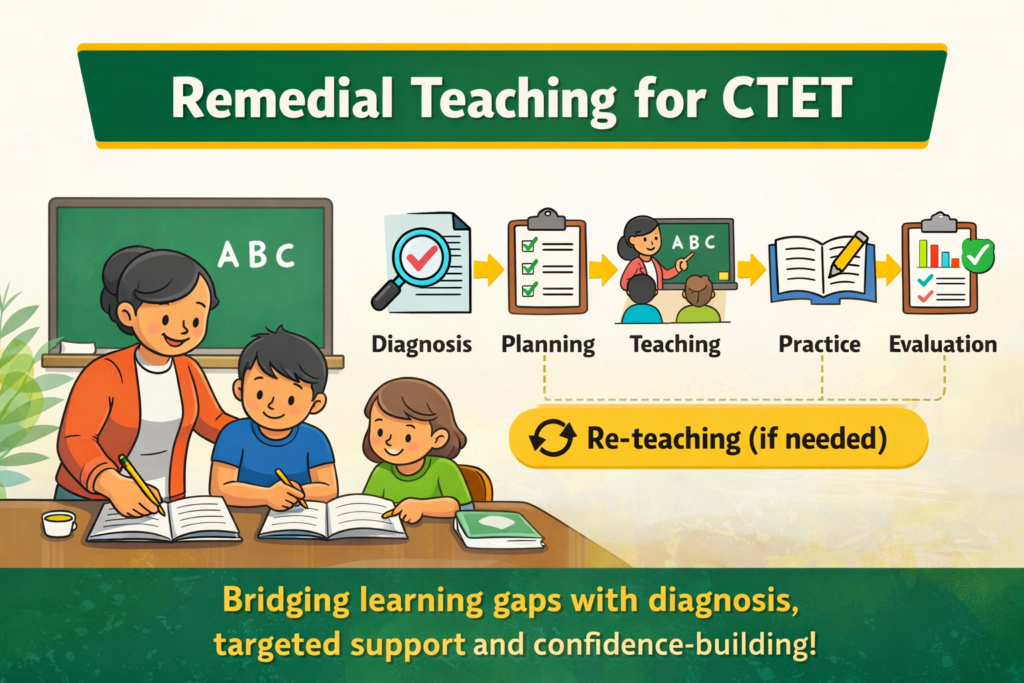
Remedial teaching is planned support provided to students who face learning difficulties. It focuses on correcting errors, closing learning gaps and rebuilding confidence. The aim is not to introduce new topics. Instead, it teaches again what the learner could not understand earlier, using simpler and individualized methods.
In CTET English pedagogy, remedial teaching is used to:
Analyse mistakes
Identify the reason behind them
Provide targeted help
Check improvement again
This approach helps slow learners, hesitant readers and students with pronunciation and comprehension issues. Hindi: सुधारात्मक शिक्षण उन छात्रों के लिए होता है जिन्हें सीखने में कठिनाई हो रही हो। इसका उद्देश्य उनकी त्रुटियों को दूर करना और बुनियादी कौशल मजबूत करना है।
Practice Questions: Remedial Teaching & Diagnostic Testing
Q1. If a student is in the habit of speaking the word “Ma’am” like “Maem”, what will you do?
A) Nothing, because she has not been corrected since her childhood
B) It may be heredity as per Dalton’s experiment
C) She is not a willing learner
D) The teacher will arrange remedial classes for her
Click to Check Answer
Correct Answer: D) The teacher will arrange remedial classes for her Reason: Persistent pronunciation errors require specific remedial intervention to correct the habit.
Q2. The purpose of remedial teaching is to:
A) Introduce new language items
B) Test recently taught items
C) Teach again the language items not properly learnt
D) Teach again language items already learnt
Click to Check Answer
Correct Answer: C) Teach again the language items not properly learnt Reason: Remedial teaching focuses on filling the learning gaps identified during assessment.
Q3. Which of the following is NOT a strategy of remedial teaching?
A) Advance learning strategy
B) Action research
C) Mastery learning strategy
D) Branching programme
Click to Check Answer
Correct Answer: A) Advance learning strategy Reason: “Advance learning” implies moving ahead or enrichment, whereas remedial teaching focuses on fixing past difficulties.
Q4. Diagnostic tests are administered to:
A) Find out deficiencies of the students with a view to planning remedies
B) Assess the suitability of a candidate for a specific programme
C) Test the language proficiency of students for providing them jobs
D) Judge the students’ capabilities
Click to Check Answer
Correct Answer: A) Find out deficiencies of the students with a view to planning remedies Reason: Diagnosis (identifying the problem) is the first step before providing a remedy (teaching).
Q5. Remedial teaching is a:
A) Preparation of teaching
B) Systematic process
C) Pre-teaching program
D) Random process
Click to Check Answer
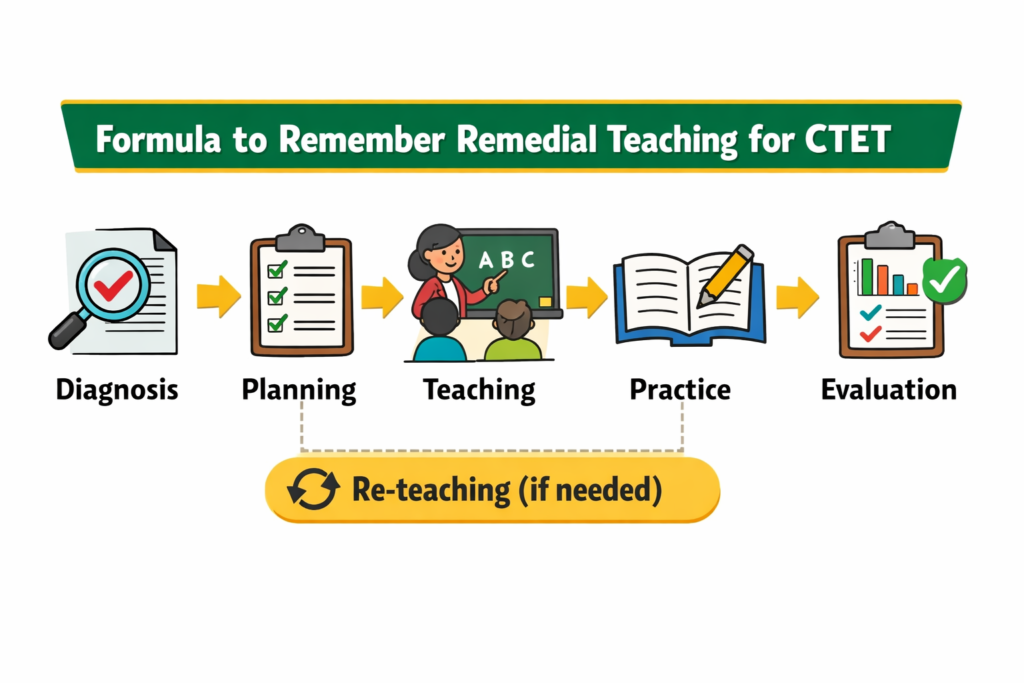
Correct Answer: B) Systematic process Reason: It involves planned steps: Diagnosis -> Planning -> Teaching -> Re-evaluation.
Q6. Remedial teaching involves:
A) Improvement of learning skills
B) Rectifying a particular problem area
C) Both A and B
D) Neither A nor B
Click to Check Answer
Correct Answer: C) Both A and B Reason: It aims to fix specific errors (rectifying) which ultimately leads to overall skill improvement.
Q7. Remedial Teaching syllabus should be based on:
A) The teacher’s impression of language difficulties
B) Students’ interest in learning language
C) An analysis of errors made by the learner
D) An analysis of future needs of the learners
Click to Check Answer
Correct Answer: C) An analysis of errors made by the learner Reason: You cannot create a remedy without first analyzing the specific errors (symptoms).
Q8. Which strategy can be used to train students for good speech?
A) Demonstration of correct pronunciation
B) Group practice to ensure the correct position of the tongue and lips
C) Both A and B
D) Proper training for eye movement
Click to Check Answer
Correct Answer: C) Both A and B Reason: Modeling (demonstration) and Drill (practice) are the two pillars of teaching pronunciation.
Q9. A student of class-V while reading a chapter finds some difficult and unfamiliar words and is not able to get the meaning. He should:
A) Ignore or skip the word and keep reading
B) Guess the meaning in context
C) Ask his classmate every time to help
D) Ask the teacher
Click to Check Answer
Correct Answer: B) Guess the meaning in context Reason: This is a key reading strategy known as “inferencing,” which helps maintain reading flow and comprehension.
Q10. A remedial program is designed keeping in mind:
A) Each student’s strength
B) Each student’s weakness
C) Each student’s strength and weakness
D) None of the above
Click to Check Answer
Correct Answer: C) Each student’s strength and weakness Reason: A good teacher uses a student’s strengths to help them overcome their weaknesses.
More Questions
Part 3: Advanced Application-Based Scenarios on Remedial Teaching
Q1. Ms. Riya observes that one of her students, Amit, consistently confuses ‘b’ and ‘d’ while writing, despite repeated corrections in the main class. As a remedial teacher, what should be her best approach?
A) Ask Amit to write ‘b’ and ‘d’ 100 times each as punishment.
B) Ignore the error as he will grow out of it.
C) Use tactile methods (like sandpaper letters or clay) and auditory association to re-teach the distinction.
D) Send a complaint note to Amit’s parents.
Click to Check Answer
Correct Answer: C) Use tactile methods and auditory association Reason: Remedial teaching demands “alternative strategies”. If visual teaching failed, multisensory approaches (touch/sound) often help students with dyslexia or confusion.
Q2. After conducting a diagnostic test, a teacher realizes that 60% of the class has not understood the concept of ‘Subject-Verb Agreement’. The remaining 40% have understood it perfectly. How should she plan her remedial class?
A) She should re-teach the entire topic to the whole class using the same lecture method.
B) She should move to the next chapter to save time.
C) She should use peer-tutoring, where the 40% who understood assist the 60% in small groups, supervised by her.
D) She should ask the 60% to stay back after school while the others go home.
Click to Check Answer
Correct Answer: C) She should use peer-tutoring Reason: In a large gap scenario, peer tutoring is an effective remedial strategy. It reinforces learning for the “tutors” (the 40%) and provides comfortable, student-friendly explanations for the “learners” (the 60%).
Q3. A bright student who usually scores high marks has missed two weeks of school due to illness and is now struggling with the current English grammar topic. Does this student need remedial teaching?
A) No, remedial teaching is only for slow learners.
B) Yes, remedial teaching is for any student with a learning gap, regardless of their intelligence.
C) No, he is smart enough to study on his own.
D) Yes, but only if he fails the final exam.
Click to Check Answer
Correct Answer: B) Yes, remedial teaching is for any student with a learning gap Reason: Remedial teaching aims to rectify specific gaps. Even a gifted child may need remedial support to cover missed content or specific misunderstandings.
Q4. During a remedial session for students with poor vocabulary, the teacher decides to use “Realilies” (Real Objects). Why is this a good decision?
A) It is less work for the teacher than writing on the board.
B) Students can play with the objects and waste time.
C) It bridges the gap between abstract words and concrete meaning, aiding memory retention.
D) It is the only method prescribed by the NCF 2005.
Click to Check Answer
Correct Answer: C) It bridges the gap between abstract words and concrete meaning Reason: Remedial students often struggle with abstract concepts. Concrete objects (Realia) make the learning experience tangible and easier to grasp.
Q5. You have identified a student with severe anxiety who freezes when asked to speak English. Which remedial strategy would be most effective?
A) Force the student to speak in front of the assembly to conquer fear.
B) Correct every grammar mistake immediately so they learn faster.
C) Create a non-threatening environment (Affective Humanistic Approach) and start with one-on-one conversations.
D) Advise the student to switch to a vernacular medium school.
Click to Check Answer
Correct Answer: C) Create a non-threatening environment and start with one-on-one conversations Reason: Remedial teaching involves emotional support. Lowering the “Affective Filter” (anxiety) is the first step before any language learning can occur.
FAQs
What is the purpose of remedial teaching?
It removes learning difficulties by reteaching concepts, correcting errors and strengthening basic skills.
How does a teacher start remedial teaching?
The teacher diagnoses errors, plans activities based on weaknesses and evaluates improvement regularly.





Pingback: Pedagogy of English Language – (CTET English Pedagogy)