
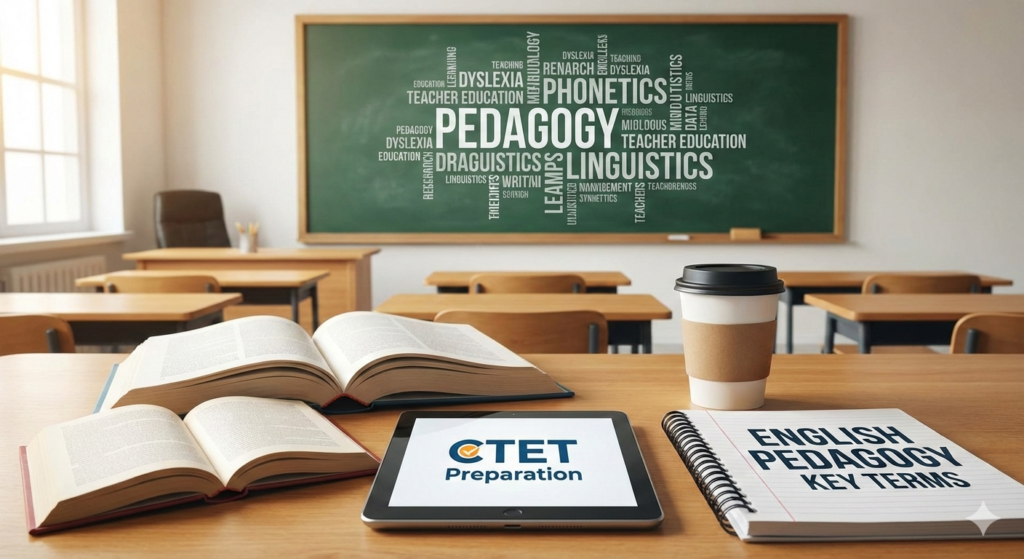
This section introduces key terms used in English pedagogy for teacher education and CTET preparation. These terms help teachers understand learning disorders, reading and writing subskills, phonetic concepts, pronunciation features, and essential linguistic ideas that support language teaching in the classroom. The aim is to build clear academic understanding and practical classroom awareness.
Learning Disorders (सीखने में कठिनाइयाँ)
Learning disorders refer to conditions that affect a person’s ability to learn in a typical manner. These difficulties may affect reading, writing, spelling, speaking, listening or processing information.
Dyslexia (डिस्लेक्सिया)
Dyslexia affects reading fluency and comprehension.
Example: A learner may struggle to recognise words. Reading becomes slow and meaning becomes unclear.
Dyscalculia (डिस्कैल्कुलिया)
Dyscalculia affects understanding of numbers and mathematical concepts.
Example: A child may find it difficult to perform basic arithmetic or understand quantity and time.
Dysgraphia (डिस्ग्राफिया)
Dysgraphia affects writing, fine-motor control and handwriting.
Example: Learners may write illegibly, struggle to organise thoughts or feel pain while writing.
Aphasia (अफेजिया)
Aphasia affects spoken communication and language comprehension.
Example: A person may be unable to find the right words, form sentences or understand speech.
Auditory Processing Disorder – APD (श्रवण प्रसंस्करण विकार)
APD affects the brain’s ability to process sounds.
Example: A child hears sounds clearly but cannot make sense of them. This affects listening and following verbal instructions.
Subskills of Writing (लेखन उप-कौशल)
Writing is more than handwriting. It includes skills like thinking, organising ideas and presenting language.
Transcribing (ट्रांसक्राइबिंग)
Transcribing means converting spoken words into written text.
Example: Writing what a teacher says during a lecture.
Paraphrasing (पैराफ्रेजिंग)
Paraphrasing means restating ideas in one’s own words.
Example: Instead of “The sun rises in the east,” a learner writes, “The sun appears in the eastern sky every morning.”
Subskills of Reading (पढ़ने के उप-कौशल)
Prediction (भविष्यवाणी)
Prediction means guessing what may happen next in a text.
Example: Looking at chapter headings and predicting content.
Inferring (निष्कर्ष निकालना)
Inferring means understanding information that is not directly written.
Example: If a character shivers, readers infer that the weather is cold.
Types of Reading (पढ़ने के प्रकार)
Loud Reading (उच्च स्वर में पढ़ना)
Loud reading improves pronunciation, fluency and expression.
Example: Reading a play in pairs.
Silent Reading (मौन पढ़ना)
Silent reading focuses on comprehension.
Example: Students read individually before group discussion.
Intensive Reading (गहन पढ़ाई)
Intensive reading aims at detailed comprehension.
Example: Analysing a poem for meaning and imagery.
Extensive Reading (व्यापक पढ़ाई)
Extensive reading develops reading for pleasure and fluency.
Example: Reading a chosen novel outside class.
Dictation (वर्णन)
Dictation improves spelling, writing accuracy and punctuation.
Example: Writing sentences spoken by the teacher:
“The dog barked loudly at the mailman.”
Overgeneralisation (अधिक सामान्यीकरण)
Overgeneralisation means applying grammar rules inappropriately.
Example: Saying goed instead of went.
Sight Words (दृश्य शब्द)
Sight words are common words recognised instantly.
Example: the, and, is, was.
Scanning (स्कैनिंग)
Scanning means quick reading to find specific information.
Example: Searching a recipe for cooking time.
Skimming (स्किमिंग)
Skimming means fast reading for main ideas.
Example: Looking at headlines and summaries.
Lexical Words (शब्दार्थ संबंधी शब्द)
Lexical words carry independent meaning.
Example: tree, friend, school.
Minimal Pairs (न्यूनतम जोड़ी)
Minimal pairs are word pairs differing by one sound.
Example: hit–heat, sip–zip.
They support pronunciation practice.
Intonation (स्वर विन्यास)
Intonation means pitch variation in speech.
Example: Rising tone at the end of a question:
“Are you ready?”
Phonetics and Sounds (ध्वनिविज्ञान और ध्वनियाँ)
English has 44 sounds: 20 vowel sounds and 24 consonant sounds.
Example: /ɪ/ in sit vs /i:/ in seat.
Diphthongs (डिप्थॉन्ग)
Diphthongs are two vowel sounds blended in one syllable.
Example: out, boil, play.
Articulators (उच्चारण अंग)
Articulators help produce speech.
Examples include tongue, lips and palate.
Syntax (वाक्य विन्यास)
Syntax studies sentence structure and word order.
Example: English follows Subject + Verb + Object.
Semantics (अर्थविज्ञान)
Semantics is the study of meaning in language.
Example: Bank may mean a financial institution or a river’s edge.
Phoneme (ध्वनि इकाई)
A phoneme is the smallest sound unit.
Example: cat = /k/ /æ/ /t/.
Morpheme (सूचना इकाई)
A morpheme is the smallest meaning unit.
Example: Dogs = dog + s.
Homograph (होमोग्राफ)
Homographs look the same but have different meanings.
Example: bow (bend) vs bow (weapon).
Homophone (होमोफ़ोन)
Homophones sound the same but differ in spelling and meaning.
Example: flower vs flour.
Homonym (होमोनिम)
Homonyms share spelling and sound but mean different things.
Example: bark (dog sound) and bark (tree covering).
Note-Taking (नोट्स लेना)
Note-taking means recording important points while listening or reading.
It improves memory and attention.
Tips for Note-Taking (नोट्स लेने के सुझाव)
- Record key points
- Use abbreviations
- Use bullet points or diagrams
Note-Making (नोट्स बनाना)
Note-making means organising ideas from multiple sources into a new format.
Example: Making a mind map after reading many articles.
Phonology (ध्वनिविज्ञान)
Phonology studies sound patterns in a language.
Phonics (फ़ॉनिक्स)
Phonics links letters with sounds to support reading.
Blending and Segmenting
Blending joins sounds to read a word.
Segmenting breaks a word into sounds.
Fluency Features
Fluency combines speed, accuracy and expression.
Schemata Activation
Learners connect new text to prior knowledge.
BICS – Basic Interpersonal Communicative Skills
- This refers to everyday social English.
- It is used in daily conversation, greetings, casual interaction, playground talk and simple communication.
- Children acquire BICS quickly (1–2 years) because it depends on context, gestures and familiar situations.
Example:
“Give me water,” “Come here,” “What is your name?”
CALP – Cognitive Academic Language Proficiency
- This refers to academic English needed for learning in school.
- It includes abstract vocabulary, reasoning, problem-solving, comprehension of textbooks, subject-specific terms and writing skills.
- CALP takes longer to develop (5–7 years).
Example:
“Analyze the character,” “Interpret the graph,” “Justify your answer.”
Code-Switching and Code-Mixing
Learners shift between languages and registers.
They are key concepts that help teachers understand language learning, literacy development, phonetics, linguistics, and classroom teaching strategies.
CTET candidates need these terms to answer pedagogy questions and to apply language-teaching strategies in primary and upper-primary classrooms.
Learning disorders affect a learner’s ability to read, write, calculate, process sounds, or understand language in a typical manner.
- समास क्या है? हिंदी व्याकरण समास के भेद, परिभाषा और उदाहरण – PDF Notes

- BPSC TRE 3.0 Question Paper PDF डाउनलोड करें – TRE 4.0 की तैयारी के लिए महत्वपूर्ण प्रश्न
- CTET Paper 1 Previous Year Question Papers with Answer Key PDF – 2018 to 2026
- CCSU B.Ed 1st Year Question Papers 2026 – Download June 2026 Exam Papers PDF
- CTET 2026: 22वें संस्करण के लिए आवेदन का फिर से मौका, 25 अगस्त से 1 सितंबर तक खुला पोर्टल


Pingback: Pedagogy of English Language – (CTET English Pedagogy)