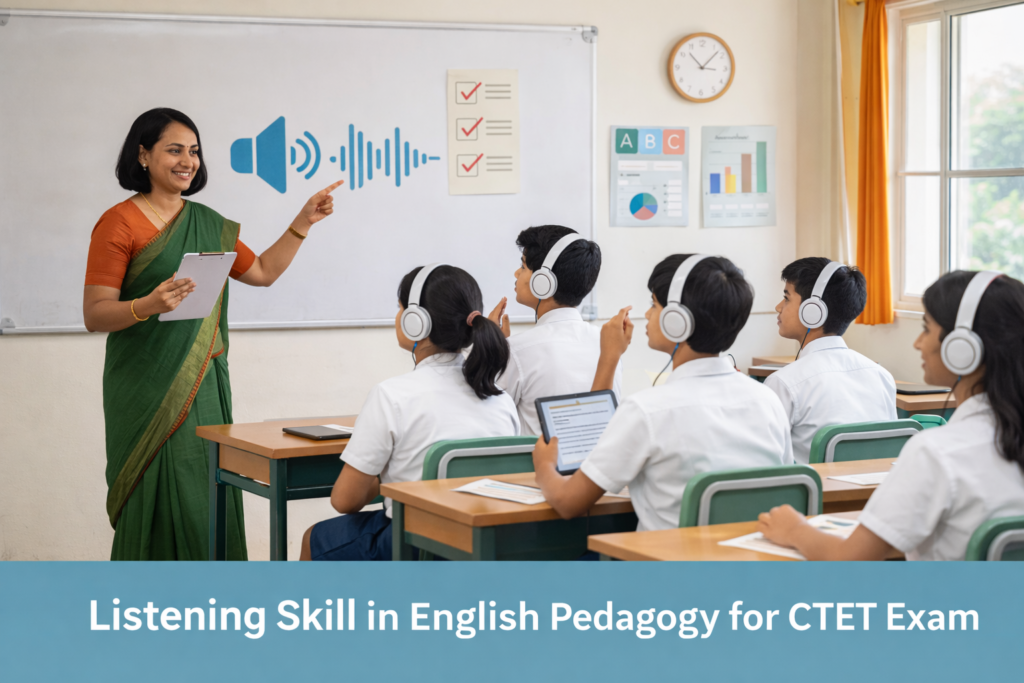
Listening is the first and most essential language skill. It forms the foundation on which speaking, reading and writing are developed. In language learning, listening is not a passive act; instead, it is an active and purposeful process that involves understanding, processing and evaluating spoken language.
Meaning and Nature of Listening Skill
Listening is an aural skill, which means it is related to hearing. However, hearing and listening are not the same. Hearing is a natural process, whereas listening requires attention, intention and comprehension.
Listening involves:
- a sender, who produces the message
- a message, which is spoken language
- a receiver, who actively processes meaning
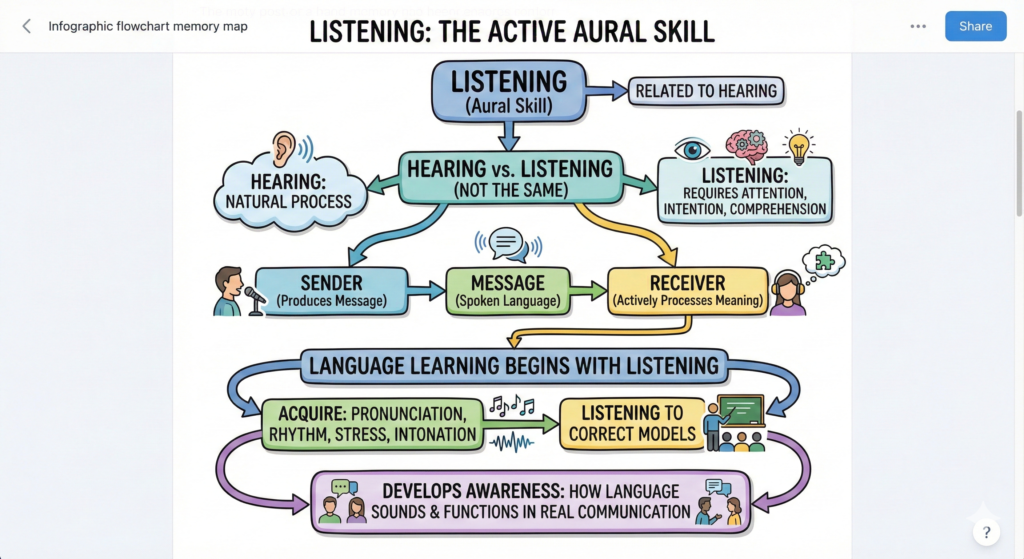
Language learning begins with listening. Learners acquire pronunciation, rhythm, stress and intonation by listening to correct language models. Therefore, listening develops awareness of how language sounds and functions in real communication.
Listening is a receptive skill. It includes three processes:
- receiving spoken input
- understanding and interpreting meaning
- evaluating the message
Because of this, listening forms the base of communicative competence in a new language.
Micro-Skills Involved in Listening
Listening involves several micro-skills that help learners understand spoken language effectively. These include:
- recognising stress, rhythm and intonation patterns
- distinguishing between different sounds
- identifying word boundaries in continuous speech
- recognising key words and important information
- understanding meaning from context
- maintaining attention and concentration
- avoiding distractions while listening
In transactional listening, learners focus on information transfer, such as listening to instructions, directions or announcements.
Listening Situations
Listening situations can be broadly classified into two types:
1. Interactive (Active) Listening
Interactive listening occurs when communication is two-way. Both the speaker and the listener participate actively.
Features of interactive listening:
- face-to-face or live interaction
- feedback is possible
- clarification and repetition are allowed
- understanding improves through response
Examples include:
- face-to-face conversations
- telephone calls
- online classes and discussions
2. Non-Interactive Listening
Non-interactive listening involves one-way communication. The listener cannot respond immediately.
Features of non-interactive listening:
- no direct feedback
- no scope for clarification
- listener must understand independently
Examples include:
- radio and television programmes
- films
- public announcements
- speeches, lectures and webinars
Both types of listening are important in developing real-life language competence.
Listening Strategies
Different listening purposes require different strategies. These strategies help learners construct meaning effectively.
Top-Down Listening Strategies
Top-down strategies are listener-based. The listener uses background knowledge, context and prior experience to understand meaning.
These strategies include:
- listening for the main idea
- predicting content
- drawing inferences
- summarising information
This approach supports extensive listening, where overall meaning is more important than individual words.
Bottom-Up Listening Strategies
Bottom-up strategies are text-based. The listener focuses on language forms to build meaning step by step.
These strategies include:
- listening for specific details
- recognising sounds and word patterns
- identifying grammatical structures
- understanding word order
Bottom-up listening supports intensive listening, where accuracy and detail are important.
Metacognitive Listening Strategies
Metacognitive strategies involve thinking about listening.
They help learners:
- plan how to listen
- choose suitable strategies
- monitor comprehension
- evaluate understanding after listening
Effective listeners often combine top-down and bottom-up strategies simultaneously. This combination increases comprehension and confidence.
Listening Activities in the Classroom
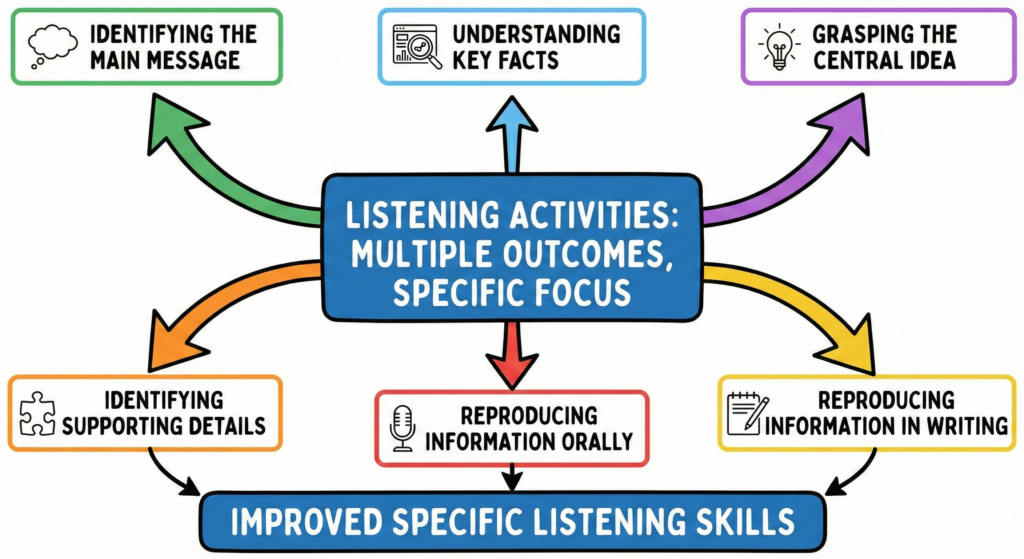
Listening activities may have more than one learning outcome. However, each activity focuses on improving specific listening skills, such as:
- identifying the main message
- understanding key facts
- grasping the central idea
- identifying supporting details
- reproducing information orally or in writing
Stages of Listening Activities
Pre-Listening Activities
Pre-listening activities prepare learners for the task.
They include:
- activating background knowledge
- introducing key vocabulary
- explaining the purpose of listening
- encouraging prediction
While-Listening Activities
While-listening activities help learners stay focused on the text.
Examples include:
- listening with visuals
- filling tables, charts or graphs
- completing cloze exercises
- checking items from a list
- listening for gist or specific information
Post-Listening Activities
Post-listening activities help assess comprehension and reinforce learning.
Examples include:
- summarising the content
- answering questions
- drawing or visualising the message
- role-play or discussion
Assessing Listening Proficiency
Listening proficiency should be assessed through authentic assessment. This means learners should respond to listening tasks as they would in real life.
Examples include:
- responding to announcements
- following spoken instructions
- reacting to conversations or speeches
A good listener is not one who remembers every word, but one who responds appropriately and accurately. Visualisation can also be used to assess comprehension.
Functions and Role of Listening
Listening plays a vital role in language learning.
It:
- supports permanent learning
- forms the foundation of language mastery
- helps understand the speaker’s emotions and intentions
- guides appropriate action
- enables effective communication
Listening is the starting point of language use and the stepping stone towards meaningful interaction.
Conclusion
Listening is not merely hearing sounds. It is a structured, active and strategic process that supports language acquisition. In English language teaching, especially in multilingual classrooms, listening builds confidence, comprehension and communication skills. For CTET English Pedagogy, understanding listening skills, strategies and assessment is essential for both classroom teaching and exam success.
- समास क्या है? हिंदी व्याकरण समास के भेद, परिभाषा और उदाहरण – PDF Notes

- BPSC TRE 3.0 Question Paper PDF डाउनलोड करें – TRE 4.0 की तैयारी के लिए महत्वपूर्ण प्रश्न
- CTET Paper 1 Previous Year Question Papers with Answer Key PDF – 2018 to 2026
- CCSU B.Ed 1st Year Question Papers 2026 – Download June 2026 Exam Papers PDF
- CTET 2026: 22वें संस्करण के लिए आवेदन का फिर से मौका, 25 अगस्त से 1 सितंबर तक खुला पोर्टल