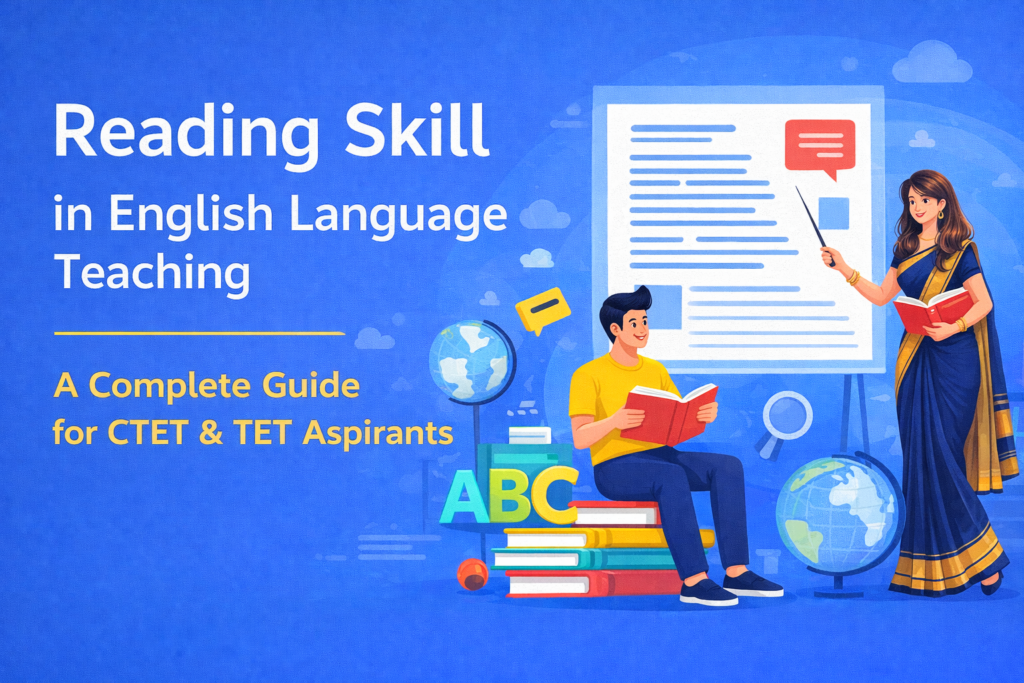
A Complete Guide for CTET and TET Aspirants
Reading is one of the most important language skills. In fact, it plays a vital role in academic learning, communication, and lifelong knowledge development. In English language teaching, reading is not limited to pronouncing words aloud. Rather, it is a meaningful process of understanding written symbols and interpreting ideas.
Therefore, this article explains the reading skill, its meaning, objectives, components, methods, types, stages, strategies, activities, and assessment. Overall, it is especially useful for CTET, STET, and other teaching eligibility examinations.
Meaning of Reading Skill
Reading is a receptive skill. This means that learners receive information through written language. At the same time, it is a decoding process. Through this process, learners extract ideas, facts, and information from printed symbols.
In other words, decoding refers to identifying written symbols and linking them with their sounds and meanings. Therefore, reading is always done with a clear purpose. For example, the purpose may be to gain information, enjoy a text, or understand ideas.
According to educational views, reading involves accurate word recognition, understanding meaning, and interpreting ideas expressed in written or printed language.
Nature of Reading
Reading is an interactive process between the reader and the text. However, meaning does not exist only in the text. Instead, meaning is created when the reader actively interacts with the text using prior knowledge and language experience. As a result, reading becomes meaningful and purposeful.
Objectives of Teaching Reading
Teaching reading helps learners in many ways. For this reason, it enables them to:
- Firstly, develop vocabulary, grammar, and sentence structure
- Secondly, pronounce words correctly
- Additionally, understand meanings of words and expressions
- Moreover, gain information and knowledge
- At the same time, develop cultural awareness
- Consequently, improve speed and accuracy in real-life reading situations
- Finally, broaden mental horizon and general knowledge
Components of Reading
Reading consists of three essential components. Together, these components make reading meaningful.
Recognition of Graphic Symbols
Firstly, learners identify printed letters, words, and symbols.
Correlation of Symbols with Sounds
Secondly, learners connect written symbols with spoken sounds.
Association of Sound with Meaning
Finally, learners understand ideas, concepts, and sense.
Methods of Teaching Reading
Methods of teaching reading are divided into letter methods and non-letter methods. Both approaches are used at different stages of learning.
Letter Methods
Alphabetic Method
In this method, letters are taught in alphabetical order. As a result, it becomes the most commonly used method. However, learning often becomes slow and monotonous.
Phonic Method
In contrast, the phonic method teaches sounds of letters instead of letter names. Therefore, learners understand sound–symbol relationships. However, confusion may occur due to similar sounds of letters.
Non-Letter Methods
Word Method
In this method, words are taught with the help of pictures. Thus, meaning is conveyed, but sentence sense is missing. Moreover, all words cannot be shown through pictures.
Phrase Method
Similarly, complete phrases are taught. As a result, learners understand usage. However, complete ideas are still not expressed.
Sentence Method
In this method, complete sentences are taught first. Therefore, learners easily understand meaning and context. For this reason, this method is considered the best method for teaching reading.
Story Method
Furthermore, stories are used for teaching reading. As a result, this method creates interest and conveys a complete unit of thought. However, it also puts a heavy load on memory.
Stages of Reading
Reading develops through different stages. Each stage has its own importance.
Preparatory Reading
Initially, this is the pre-reading stage. At this stage, vocabulary and language structures are introduced.
Productive Reading
Next, focus is given to letters and words. Consequently, the habit of reading is developed.
Imagination Realisation
Finally, reading becomes fluent and vigorous. As a result, learners become comfortable using books independently.
Types of Reading
Loud Reading
Loud reading is also known as oral or aloud reading. Generally, it is used at the initial stages.
Objectives
- Firstly, improve pronunciation, stress, rhythm, and intonation
- Secondly, help in conveying ideas
- Lastly, prepare learners for silent reading
Advantages
- For example, it develops confidence
- Additionally, it helps in correct pronunciation
- Therefore, it is useful for beginners
Disadvantages
- However, it is not useful in later life
- Moreover, it creates barriers to extensive reading
Silent Reading
Silent reading is the most common form of reading in real life. In fact, most academic reading is silent.
Objectives
- Firstly, improve speed and fluency
- Additionally, enhance vocabulary
- Moreover, develop comprehension
- Finally, gain pleasure and information
Advantages
- As a result, it saves time and energy
- Furthermore, it helps imagination and thinking
- Consequently, vocabulary and structure are strengthened
Disadvantages
- However, it is not suitable for beginners
- Therefore, pronunciation errors cannot be corrected
Intensive Reading
Intensive reading means reading the text in parts for detailed understanding. Thus, it focuses on accuracy.
Objectives
- Firstly, increase active vocabulary
- Secondly, improve command over English
- Finally, understand each detail clearly
Advantages
- For instance, it explains meanings of new words
- Additionally, it helps in learning grammar
- As a result, expression improves
Disadvantages
- However, it is time-consuming
- Moreover, it is less enjoyable
Extensive Reading
Extensive reading focuses on general understanding rather than details. In contrast, it is relaxed and enjoyable.
Characteristics
- Firstly, it is done for pleasure
- Secondly, it focuses on main ideas
- Additionally, it includes newspapers, articles, and stories
- As a result, fluency and vocabulary develop
Reading Strategies
Reading strategies help learners read more effectively and quickly. Therefore, teachers should encourage their use.
Previewing
Before reading, learners review titles, headings, and captions to understand structure and content.
Predicting
Based on prior knowledge, learners guess meaning and content.
Skimming
For example, quick reading is done to get the main idea.
Scanning
In contrast, careful reading is done to find specific information.
Synthesizing
As a result, learners combine information and draw conclusions.
Paraphrasing
Finally, learners restate ideas in their own words to check comprehension.
Reading Activities
Reading activities should focus on comprehension from the beginning. Therefore, teachers should plan them carefully.
- For example, stories should be used at the primary level
- Moreover, learners should be encouraged to read more
- Additionally, vocabulary can be taught through context, synonyms, and antonyms
- At the same time, guided reading should be provided to beginners
- Consequently, prediction questions improve comprehension
- Furthermore, guessing meaning from context develops vocabulary
- Finally, silent reading helps learners infer meaning
Assessment of Reading Skill
Reading skill can be assessed in several ways. For instance, teachers may use:
- Firstly, loud reading to check pronunciation and rhythm
- Secondly, comprehension questions
- Additionally, discussion to evaluate prior knowledge
- Finally, observation of accuracy, fluency, and understanding
Conclusion
Reading is not a mechanical skill. Rather, it is a meaningful, purposeful, and interactive process. Therefore, effective teaching of reading helps learners become independent readers, confident language users, and lifelong learners. Overall, a balanced approach using suitable methods, strategies, and activities ensures successful development of reading skills.
- समास क्या है? हिंदी व्याकरण समास के भेद, परिभाषा और उदाहरण – PDF Notes

- BPSC TRE 3.0 Question Paper PDF डाउनलोड करें – TRE 4.0 की तैयारी के लिए महत्वपूर्ण प्रश्न
- CTET Paper 1 Previous Year Question Papers with Answer Key PDF – 2018 to 2026
- CCSU B.Ed 1st Year Question Papers 2026 – Download June 2026 Exam Papers PDF
- CTET 2026: 22वें संस्करण के लिए आवेदन का फिर से मौका, 25 अगस्त से 1 सितंबर तक खुला पोर्टल