

Complete English Pedagogy Notes for CTET/TET Aspirants
Introduction
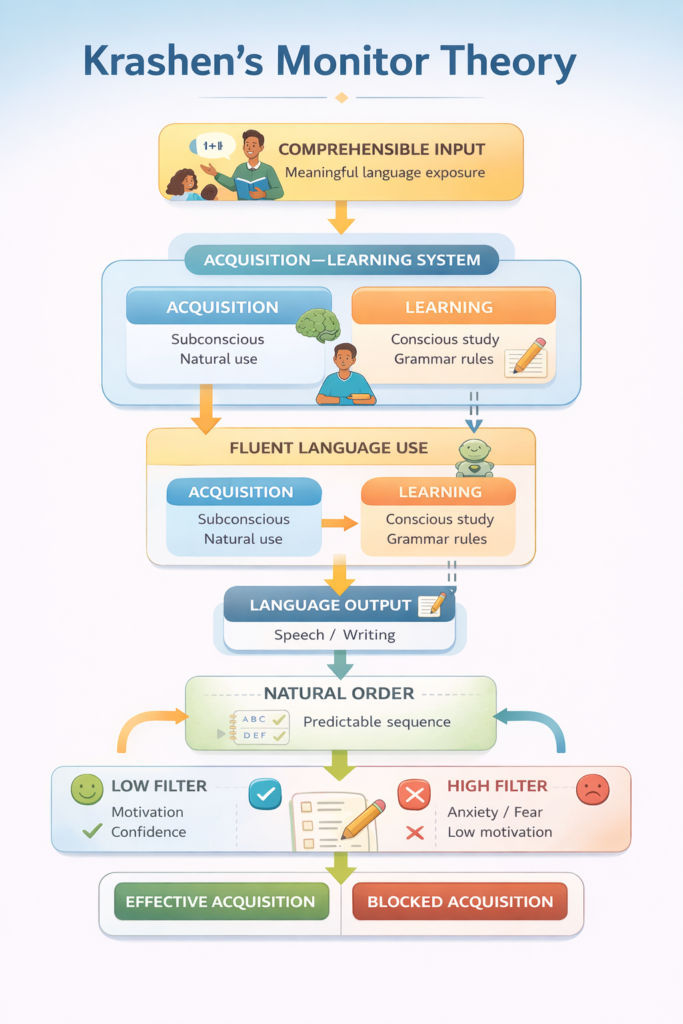
Stephen Krashen’s Monitor Theory is one of the most influential theories in second language acquisition. It explains how learners acquire and learn a language and highlights the role of meaningful communication, input, and emotional factors in language learning. This theory has significant implications for English language teaching, especially in classroom pedagogy.
Krashen proposed five hypotheses to explain the process of language acquisition. These hypotheses together form the Monitor Theory and provide a scientific framework for understanding how languages are learned.
1. Acquisition–Learning Hypothesis
According to Krashen, there is a fundamental difference between acquisition and learning.
Acquisition refers to the subconscious process of language development. It occurs naturally through meaningful interaction in the target language. Learners focus on communication rather than grammatical rules.
Learning, on the other hand, is a conscious process. It involves studying grammar rules and language forms through formal instruction.
Krashen argues that acquisition is more important than learning because real communication skills develop mainly through acquisition, not through memorization of rules.
2. Monitor Hypothesis
The Monitor Hypothesis explains the relationship between acquired and learned knowledge.
The acquired system helps learners use language fluently and spontaneously.
The learned system acts as a monitor or editor that checks and corrects language output.
In other words, grammar rules learned consciously are used to polish and correct language, but they cannot create fluent speech. Therefore, excessive focus on grammar may slow down communication.
3. Natural Order Hypothesis
The Natural Order Hypothesis states that language structures are acquired in a predictable sequence.
Learners do not acquire grammatical rules in the order in which they are taught in schools. Instead, they follow a natural internal order of language development.
This means that teachers should not expect learners to master all grammatical rules immediately. Language acquisition is a gradual and systematic process.
4. Input Hypothesis
The Input Hypothesis is the core of Krashen’s theory.
Krashen states that language acquisition occurs only when learners receive comprehensible input. This input should be slightly above the learner’s current level of competence.
He explains this concept using the formula i + 1, where:
- i = current level of language competence
- +1 = next level of language development
When learners understand messages that are a little more advanced than their current level, language acquisition takes place naturally.
Therefore, meaningful communication and exposure to language are essential for effective language learning.
5. Affective Filter Hypothesis
The Affective Filter Hypothesis highlights the role of emotional factors in language learning.
Krashen argues that factors such as motivation, confidence, anxiety, and attitude influence language acquisition.
When learners are relaxed, motivated, and confident, the affective filter is low, and language acquisition becomes easier.
However, when learners feel fear, stress, or lack motivation, the affective filter becomes high, which blocks language input and slows down learning.
Thus, a supportive and encouraging classroom environment is crucial for successful language teaching.
Educational Implications of Krashen’s Monitor Theory
Krashen’s theory has several important implications for English language teaching.
- Teachers should emphasize meaningful communication rather than rote learning of grammar.
- Students should be exposed to rich and comprehensible language input.
- Errors should be treated as a natural part of language learning.
- A positive and stress-free classroom environment should be created.
- Grammar should be taught as a supportive tool, not as the main focus of teaching.
These principles help learners develop real communicative competence in English.
Importance of Krashen’s Theory in English Pedagogy
Krashen’s Monitor Theory has transformed the approach to language teaching. It shifted the focus from grammar-centered teaching to communication-based learning.
The theory is highly relevant for modern classrooms, where the aim is to develop learners’ speaking, listening, reading, and writing skills in an integrated manner.
For CTET, TET, and other teaching exams, understanding Krashen’s theory is essential because it forms the theoretical foundation of communicative language teaching.
Short Exam-Oriented Summary
Krashen’s Monitor Theory explains language acquisition through five hypotheses: Acquisition–Learning, Monitor, Natural Order, Input, and Affective Filter. It emphasizes the importance of comprehensible input, natural communication, and emotional factors in language learning. The theory supports communicative and learner-centered teaching in English pedagogy.