A Complete Guide for CTET & TET English Language and Pedagogy
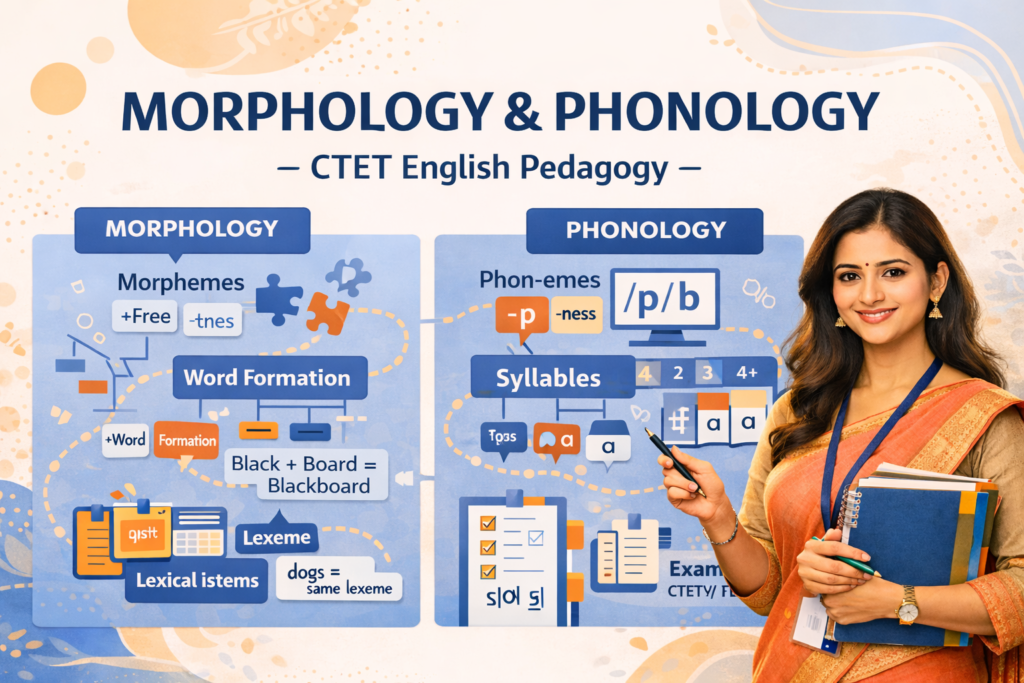
Understanding Morphology and Phonology is essential for language teachers and competitive exam aspirants. These two branches of linguistics explain how words are formed and how speech sounds are organized and produced. This chapter plays a crucial role in CTET, STET, and other TET exams, especially in questions related to word formation, vocabulary, pronunciation, and phonetics.
Morphology
Meaning of Morphology
Morphology is the study of the internal structure of words. It examines how words are formed using smaller meaningful units and how these units function grammatically.
A word can be divided into parts if:
- The parts occur independently in other words
- The parts carry meaning
- The parts perform a grammatical function
Morphemes
Definition
A morpheme is the smallest meaningful unit of language that has grammatical significance.
Types of Morphemes
| Type | Description | Examples |
|---|---|---|
| Free Morpheme | Can stand alone as a word | boy, work, help |
| Bound Morpheme | Cannot stand alone; must be attached | un-, -ness, -ed |
Words and Their Structure
Types of Words
| Word Type | Description | Examples |
|---|---|---|
| Simple Word | Single free morpheme | wise, short, work |
| Complex Word | One free + one or more bound morphemes | disallow, kindness |
| Compound Word | Two or more free morphemes | bathroom, darkroom |
Affixes: Stem and Root
Root
The root is the core meaning-bearing unit of a word.
Stem
The stem is the form to which affixes are added.
Types of Affixes
| Affix Type | Position | Examples |
|---|---|---|
| Prefix | Before the root | un-, dis-, inter- |
| Suffix | After the root | -ness, -able, -al |
Inflectional and Derivational Affixes
Inflectional Affixes
- Do not change the part of speech
- Always suffixes
Examples:
-s (plural), -ed (past), -ing (continuous)
Derivational Affixes
- May change meaning or part of speech
- Can be prefixes or suffixes
| Base Word | Affix | New Word | Part of Speech |
|---|---|---|---|
| kind | un | unkind | adjective |
| happy | ness | happiness | noun |
| talk | ive | talkative | adjective |
Word Formation Processes
Compounding
Combining two or more words to form a new word with independent meaning.
Examples:
- greenhouse
- blackboard
- white-collar
Difference Between Compound and Phrase
| Compound | Phrase |
|---|---|
| New word is formed | No new word |
| Has independent meaning | Meaning is literal |
| Example: blackboard | Example: black board |
Abbreviations
Shortened forms of words or phrases.
Examples:
B.A., M.A., Mr., Dr., Can’t
Acronyms
Formed from initial letters and pronounced as words.
Examples:
SAARC, WHO, RADAR
Clipping
Shortening of an existing word.
Examples:
Prof., Lab, Fax, Plane
Blending
Combining parts of two words.
| Blended Word | Source Words |
|---|---|
| Motel | Motor + Hotel |
| Brunch | Breakfast + Lunch |
| Smog | Smoke + Fog |
Lexical Items / Content Words
Lexical items form the core vocabulary of a language.
Examples:
- Words: dog, tree, love
- Phrasal verbs: put off, bring up
- Idioms: break a leg
- Sayings: do or die
Lexeme
A lexeme is the basic vocabulary unit.
Example:
- dog / dogs → same lexeme
- dog / dog-catcher → different lexemes
Colloquialism, Slang, and Jargon
Colloquialism
Informal words used in daily conversation.
Slang
Informal language used by specific social groups.
Jargon
Technical language used by professionals.
Examples:
- Medical: OT, BD
- Teaching: TTS, MWF
Phonology
Meaning
Phonology studies how a language organizes speech sounds into meaningful units called phonemes and how these sounds form patterns of stress, rhythm, and intonation.
Vowels and Consonants
Vowels
Produced when air flows freely through the mouth.
Types:
- Front vowels: sheep, bed
- Back vowels: calm, boot
- Central vowels: bird, father
Monophthongs (Pure Vowels)
Single vowel sounds.
Diphthongs
Double vowel sounds or glide vowels.
Examples:
/ai/, /au/, /oi/
Consonants
Classification by Place of Articulation
| Type | Description |
|---|---|
| Bilabial | Both lips (/p/, /b/) |
| Dental | Tongue and teeth (/θ/) |
| Alveolar | Tongue and ridge (/t/, /d/) |
| Velar | Tongue and soft palate (/k/, /g/) |
| Glottal | Vocal cords (/h/) |
Classification by Manner of Articulation
| Type | Description |
|---|---|
| Plosive | Complete closure |
| Fricative | Narrow passage |
| Nasal | Air through nose |
| Lateral | Air from sides |
| Affricate | Stop + friction |
Phonemes
The smallest sound units that can change meaning.
Example:
- pin / bin
Allophones
Different pronunciations of the same phoneme.
Example:
- /s/ in this
- /z/ in these
Syllable and Stress
Types of Words
| Type | Syllables |
|---|---|
| Monosyllabic | One |
| Disyllabic | Two |
| Trisyllabic | Three |
| Polysyllabic | More than three |
Stress
The syllable pronounced more prominently.
Rhythm
English is a stress-timed language where stressed syllables occur at regular intervals.
Homophones, Homographs, and Homonymy
Homophones
Same sound, different meaning and spelling.
Examples:
sea – see, beach – beech
Homographs
Same spelling, different meaning.
Examples:
lead (metal), lead (guide)
Homonymy
Same sound, same or different spelling, different meaning.
Polysemy
One word with multiple related meanings.
Example:
- get – obtain, become, understand
Paronyms
Words similar in form but different in meaning.
Examples:
- memorable – memorial
- forceful – forcible
Palindrome
Words spelled the same forwards and backwards.
Examples:
- mom, dad, noon, wow
Vocabulary
Types of Vocabulary (Based on Skills)
| Type | Description |
|---|---|
| Listening | Words we hear |
| Speaking | Words we use |
| Reading | Words we understand |
| Writing | Words we retrieve |
Types of Vocabulary (Based on Use)
| Type | Description |
|---|---|
| Active Vocabulary | Words we use |
| Passive Vocabulary | Words we understand |
Importance of Morphology and Phonology for CTET & TET
- Direct MCQs from morpheme, phoneme, suffix, prefix
- Vocabulary-based pedagogy questions
- Pronunciation and phonetics concepts
- Word formation techniques
Conclusion
Morphology and phonology together provide a strong foundation for understanding how language works structurally and orally. For English teachers and CTET/TET aspirants, mastering these concepts ensures accuracy in vocabulary teaching, pronunciation, and grammar instruction.
👉 Exam Affinity’s CTET preparation support
Exercise – Morphology and Phonology (MCQs)
-
______ cannot be divided into further grammatically meaningful components.
(a) Phonology
(b) A diphthong
(c) Morpheme
(d) A phonemeView Answer & Explanation
Correct Answer: Morpheme
Explanation: A morpheme is the smallest unit of meaning in a language and cannot be divided further.
-
Small tree, lazy boy, wise man etc. are
(a) Collocations
(b) Diphthongs
(c) Sight words
(d) SyntaxView Answer & Explanation
Correct Answer: Collocations
Explanation: Collocations are words that commonly occur together in natural language.
-
The number of double vowel sounds (diphthongs) in English is
(a) 2
(b) 5
(c) 8
(d) 11View Answer & Explanation
Correct Answer: 8
Explanation: English has eight diphthongs, also called vowel glides.
-
A compound word consists of
(a) Single free morpheme
(b) One free morpheme and one bound morpheme
(c) Two bound morphemes
(d) Two or more free morphemesView Answer & Explanation
Correct Answer: Two or more free morphemes
Explanation: Compound words are formed by combining two or more independent (free) morphemes.
-
Words or phrases used in informal conversational language are called
(a) Lexical items
(b) Acronyms
(c) Jargon
(d) ColloquialismView Answer & Explanation
Correct Answer: Colloquialism
Explanation: Colloquialisms are informal words or expressions used in everyday speech.
-
Which of the following is an example of polysemy?
(a) Get
(b) See, sea
(c) Lead, led
(d) Dye, dieView Answer & Explanation
Correct Answer: Get
Explanation: Polysemy refers to a single word having multiple related meanings. ‘Get’ has many related meanings.
-
In the pronunciation of which consonant is there a complete closure of air passage?
(a) Plosive
(b) Nasal
(c) Lateral
(d) FricativeView Answer & Explanation
Correct Answer: Plosive
Explanation: Plosives are produced by a complete blockage of airflow followed by a sudden release.
-
In the word ‘seat’, the phonetic transcription for ‘ea’ is
(a) ae
(b) e
(c) ɪ
(d) iːView Answer & Explanation
Correct Answer: iː
Explanation: The vowel sound in ‘seat’ is a long vowel represented as /iː/.
Previous Years’ CTET & TET Questions
-
The study of the formation of words is known as
(a) Phonology
(b) Morphology
(c) Syntax
(d) SemanticsView Answer & Explanation
Correct Answer: Morphology
Explanation: Morphology deals with word formation and internal structure of words.
-
A sound formed by the combination of two vowels in a single syllable is called
(a) Diphthong
(b) Bilabial
(c) Intonation
(d) StressView Answer & Explanation
Correct Answer: Diphthong
Explanation: A diphthong is a glide from one vowel sound to another within the same syllable.
-
Which word forms its plural by adding the suffix ‘-en’?
(a) Max
(b) Box
(c) Tax
(d) OxView Answer & Explanation
Correct Answer: Ox
Explanation: ‘Ox’ forms its plural as ‘oxen’, which is an irregular plural form.
-
When a part of a word is spoken emphatically, it is called
(a) Pause
(b) Stress
(c) Intonation
(d) PronunciationView Answer & Explanation
Correct Answer: Stress
Explanation: Stress refers to emphasis placed on a syllable or word during pronunciation.
- समास क्या है? हिंदी व्याकरण समास के भेद, परिभाषा और उदाहरण – PDF Notes

- BPSC TRE 3.0 Question Paper PDF डाउनलोड करें – TRE 4.0 की तैयारी के लिए महत्वपूर्ण प्रश्न
- CTET Paper 1 Previous Year Question Papers with Answer Key PDF – 2018 to 2026
- CCSU B.Ed 1st Year Question Papers 2026 – Download June 2026 Exam Papers PDF
- CTET 2026: 22वें संस्करण के लिए आवेदन का फिर से मौका, 25 अगस्त से 1 सितंबर तक खुला पोर्टल