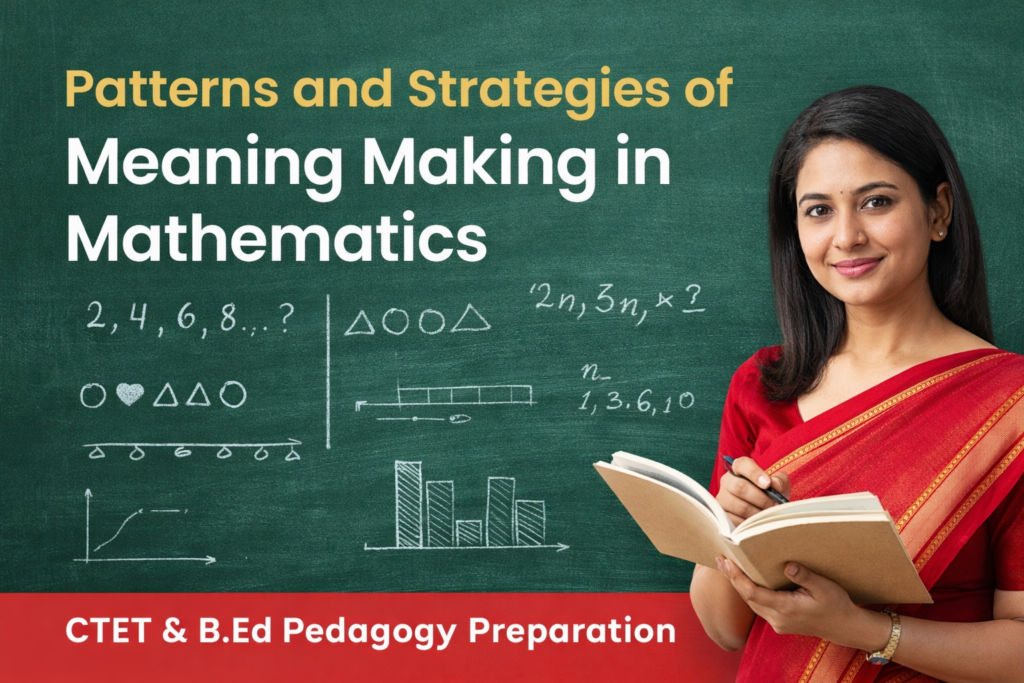
Patterns and Strategies for Making Meaning in Mathematics
Understanding mathematics is not only about learning formulas or procedures; it is about making meaning. One of the most powerful ways through which learners construct meaning in mathematics is by recognizing patterns and using appropriate strategies of meaning making. Patterns help learners see order, predict outcomes, and understand relationships, while strategies support deep conceptual understanding rather than rote learning.
Meaning of Pattern in Mathematics
A pattern is a regular and predictable arrangement of numbers, shapes, symbols, or objects that follows a particular rule or sequence. Patterns are fundamental to mathematics because they help learners observe regularity and structure.
Patterns help children:
- Recognise order and repetition
- Make predictions
- Understand mathematical relationships
- Develop logical and analytical thinking
Types of Patterns
Number Patterns
Number patterns involve sequences of numbers that follow a fixed rule.
Examples:
- 2, 4, 6, 8, 10 → +2 pattern
- 5, 10, 15, 20 → multiples of 5
- 1, 4, 9, 16 → square number pattern
- 100, 90, 80, 70 → –10 pattern
These patterns help learners understand operations such as addition, subtraction, multiplication, and powers.
Shape / Geometric Patterns
These patterns involve shapes arranged in a repeated or symmetrical manner.
Examples:
- ○ △ ○ △ ○ △
- Patterns with symmetry
Such patterns develop spatial sense, visual reasoning, and understanding of geometry.
Growing Patterns
Growing patterns change by increasing or decreasing according to a rule.
Example:
- 1, 3, 6, 10
These patterns support early algebraic thinking.
Visual Patterns
Visual patterns are patterns that can be seen in everyday life.
Examples:
- Tile flooring patterns
- Rangoli designs
- Brick wall patterns
- Tessellation
They help connect mathematics with real life and art.
Algebraic Patterns
Algebraic patterns use symbols and variables.
Examples:
- n, 2n, 3n
These patterns form the foundation of algebraic expressions and generalisation.
Patterns of Meaning Making in Mathematics
Pattern Recognition
Pattern recognition is the foundation of mathematical understanding. Students look for:
- Order
- Repetition
- Symmetry
- Changing rules
This skill helps learners move from concrete examples to abstract thinking.
Conceptual Patterns
Conceptual patterns involve linking ideas.
Examples:
- Addition related to multiplication
- Shape related to properties
This helps learners see mathematics as a connected system, not isolated topics.
Relational Patterns
Relational patterns focus on understanding relationships between concepts.
Examples:
- Fractions → part–whole relationship
- Ratio → comparison
- Area and perimeter → related but different concepts
This promotes relational understanding rather than procedural memorization.
Structural Patterns
Structural patterns help learners understand the structure of mathematics.
Examples:
- Place value system
- Number system
Understanding structure strengthens number sense and logical reasoning.
Visual / Spatial Patterns
Visual and spatial patterns involve the use of:
- Diagrams
- Models
- Charts
- Number lines
These representations make abstract ideas more concrete and understandable.
Strategies of Meaning Making in Mathematics
CPA Approach (Concrete–Pictorial–Abstract)
In this approach:
- Concrete: Using real objects
- Pictorial: Using diagrams and pictures
- Abstract: Using symbols and numbers
This approach supports gradual conceptual development.
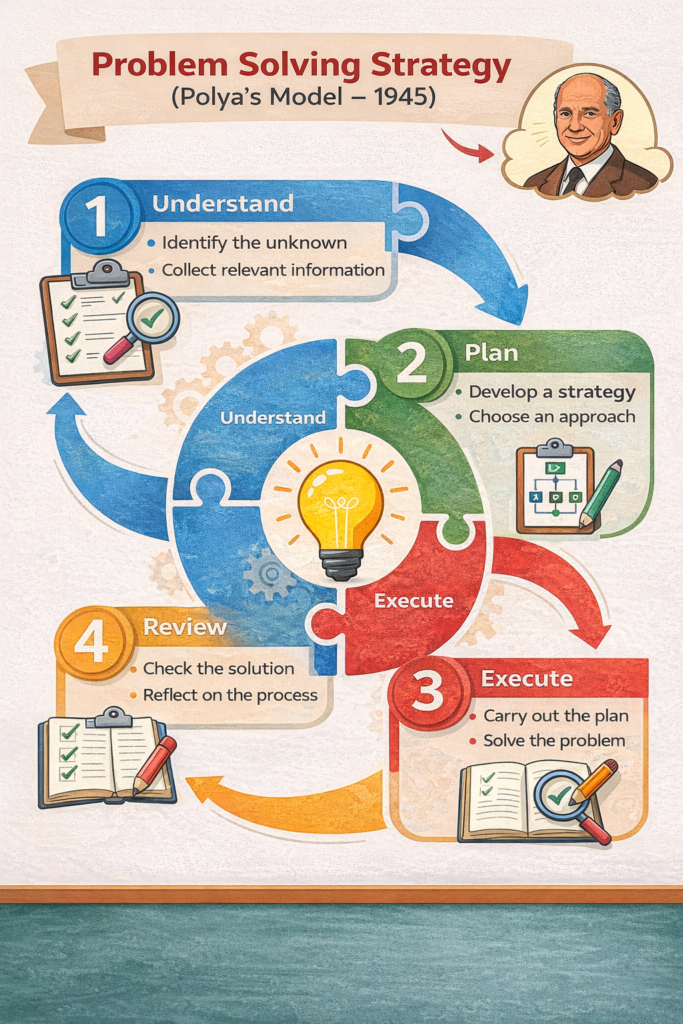
Problem Solving Strategy (Polya’s Model – 1945)
George Polya proposed a four-step problem-solving model:
- Understand the problem
- Plan
- Do / Execute
- Review
This strategy develops critical thinking and reflection.
Discovery Learning
In discovery learning, students discover rules and patterns by themselves through exploration and activities. The teacher acts as a facilitator.
Guided Reinvention
Here, the teacher guides learners step by step so that students can re-invent mathematical ideas on their own.
Scaffolding
Scaffolding involves:
- Providing hints and prompts
- Gradually reducing support
This helps learners become independent problem solvers.
Use of Manipulatives
Concrete materials help learners understand abstract ideas.
Examples:
- Abacus
- Geoboard
- Fraction strips
Manipulatives enhance engagement and conceptual clarity.
Representation Strategy
Using:
- Diagrams
- Tables
- Graphs
- Symbols
Representation allows learners to view concepts from multiple perspectives.
Real Life / Contextual Strategy
Connecting mathematics to real-life contexts such as:
- Money
- Time
- Measurement
This makes learning meaningful and relevant.
Pattern-Based Strategy
Teaching mathematics through patterns helps learners:
- Generalise rules
- Predict outcomes
- Develop algebraic thinking
Educational Importance
Patterns and meaning-making strategies:
- Promote conceptual understanding
- Reduce fear of mathematics
- Encourage logical reasoning
- Align with constructivist learning theory
- Are highly relevant for CTET and B.Ed exams.
- समास क्या है? हिंदी व्याकरण समास के भेद, परिभाषा और उदाहरण – PDF Notes

- BPSC TRE 3.0 Question Paper PDF डाउनलोड करें – TRE 4.0 की तैयारी के लिए महत्वपूर्ण प्रश्न
- CTET Paper 1 Previous Year Question Papers with Answer Key PDF – 2018 to 2026
- CCSU B.Ed 1st Year Question Papers 2026 – Download June 2026 Exam Papers PDF
- CTET 2026: 22वें संस्करण के लिए आवेदन का फिर से मौका, 25 अगस्त से 1 सितंबर तक खुला पोर्टल