
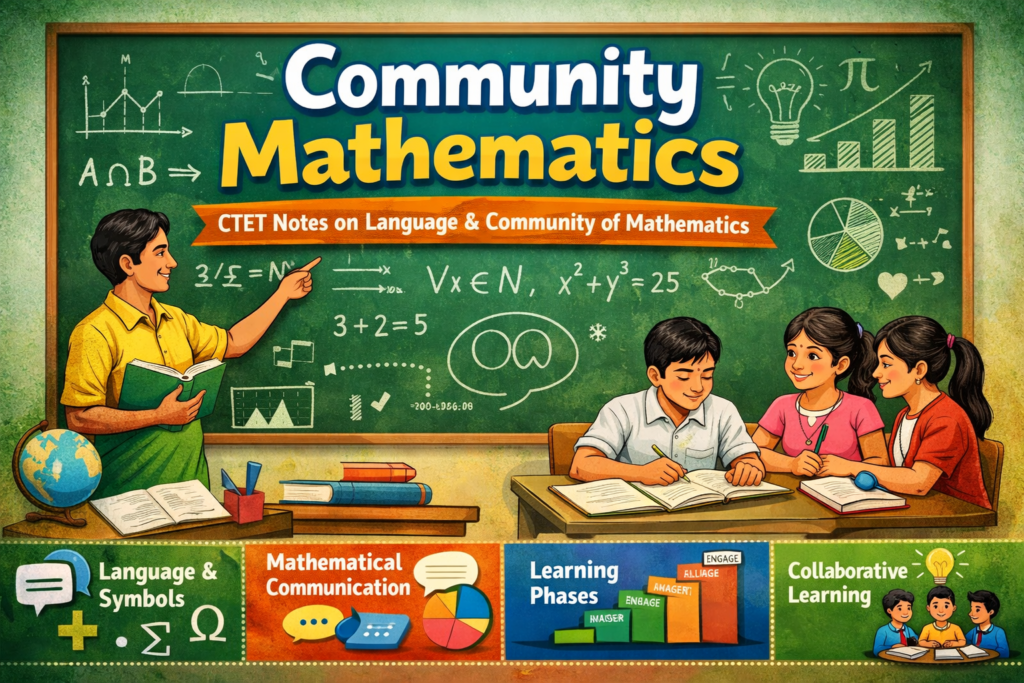
Community Mathematics – CTET Notes (Language and Community of Mathematics)

Introduction: Education, Language, and Community Mathematics
Education acts as a powerful instrument of social transformation. It brings desirable changes in learners’ behaviour, strengthens character, and nurtures independent thinking and sound decision-making abilities. At the heart of this process lies language, which functions as the primary medium for gaining, storing, and transmitting knowledge.
In mathematics education, language plays a decisive role. Mathematical ideas are not only expressed through symbols and numbers but are also constructed, discussed, interpreted, and justified through language. Understanding mathematics, therefore, requires an understanding of its language and the community in which it is learned and practiced.
Language as the Foundation of Mathematical Learning
Language performs multiple functions depending on the context. In mathematics, it helps learners interpret symbols, understand relationships, and communicate reasoning. Linguistic theories can be applied to mathematical texts to make learning more meaningful, engaging, and comprehensible for students.
Mathematics learning becomes effective when learners can read, listen, speak, and write mathematically, using appropriate terms and structures. This highlights the inseparable relationship between language and mathematics.
Relationship Between Language and Mathematics
Language is a systematic and scientific process used to exchange ideas, emotions, and symbols. Mathematics, as an academic discipline, has its own linguistic structure consisting of:
Syntax and Grammar
Mathematical grammar is often expressed through independent clauses such as greater than, less than, or equal to. Statements usually follow a left-to-right structure, similar to sentence formation in language.
Vocabulary
Mathematical vocabulary differs significantly from everyday vocabulary. Many words used in mathematics have meanings that are different from their common usage. Examples include face, root, place, limit, and shape. Such differences often confuse learners, especially at the elementary level.
Discourse and Meaning
Mathematical discourse includes both formal and informal styles. Teachers and students often use the first-person plural form such as we solve, we observe, and we conclude, which promotes collective reasoning and participation.
Voice and Listening Skills
Students generally prefer the active voice while explaining mathematical ideas. Poor listening, however, leads to weak understanding. Learners grasp mathematical concepts more effectively when instruction is delivered in their mother tongue. Learning mathematics in a second language may create comprehension and expression barriers.
Logical Language and Quantifiers in Mathematics
Logical conjunctions such as AND and IF–THEN are fundamental to mathematical reasoning. These are often used alongside quantifiers like for all and there exists. Confusion arises when existential and universal quantifiers are used interchangeably.
For example:
Can anyone solve this problem? (existential meaning)
Anyone can solve this problem. (universal meaning)
Accurate use of such terms is essential for clarity and logical correctness in mathematics.
Mathematical Symbols and Their Language
Mathematics relies heavily on symbols to convey meaning efficiently. Understanding mathematics requires learners to establish strong connections between symbols and text.
Some commonly used symbols include:
Equal sign (=)
Not equal to (≠)
Addition (+)
Ohm sign (Ω)
For instance, the expression 3 + 2 symbolically represents the idea of adding two to three, while its verbal explanation follows a different pattern. This difference between symbolic representation and spoken language must be explicitly taught.
Reading Mathematics as a Meaning-Making Process
Reading skills are as important in mathematics as they are in language subjects. Mathematical texts require interpretation, analysis, and logical linking of ideas. The transactional theory of reading is particularly useful in mathematics learning as it helps students connect prior knowledge with new concepts.
Students can develop three important types of connections:
Text-to-Self
Text-to-Text
Text-to-World
Such connections strengthen reasoning abilities and deepen conceptual understanding through guided practice and model exercises.
Interaction, Language, and Mathematical Literacy
Mathematics is learned best when learners are active participants and meaningful interactions occur between teachers and students. The concept of a Literacy Club provides an experiential learning space where language is used to simplify mathematical ideas and meet learners’ needs.
Regular discussions, timely feedback, and respectful communication build confidence and motivation among learners. Language thus becomes a powerful tool to identify learning gaps, suggest improvements, and create multiple learning opportunities without discouraging students.
Community of Mathematics
The community of mathematics refers to the shared space where teachers and students communicate mathematical ideas, justify reasoning, and explore multiple problem-solving strategies. Mathematical communication within this community strengthens understanding and collaboration.
Resources that encourage writing and speaking about mathematics help learners articulate their thinking and learn from others’ perspectives.
Students typically progress through four phases in their mathematical journey:
Imagination Phase
Learners begin to see mathematics as part of daily life and develop curiosity about its applications.
Engagement Phase
Students start viewing mathematics as a possible academic or career path and show deeper involvement.
Alignment Phase
Learners work on increasingly complex problems, developing strong logical and reasoning skills.
Mastery Phase
At this stage, individuals contribute to mathematics as teachers, researchers, academics, curriculum designers, or professionals.
Conclusion
The discussion clearly shows that language and mathematics are deeply interconnected. Though they are distinct disciplines, they function as two sides of the same coin, complementing each other at every stage of learning and application. Modern technology, software development, and computational systems demonstrate how language and mathematics work together to achieve efficiency and precision.
A strong mathematical community, supported by effective language use, transforms mathematics from a subject of fear into a meaningful, collaborative, and empowering learning experience—an insight of great relevance for CTET aspirants and future teachers.