
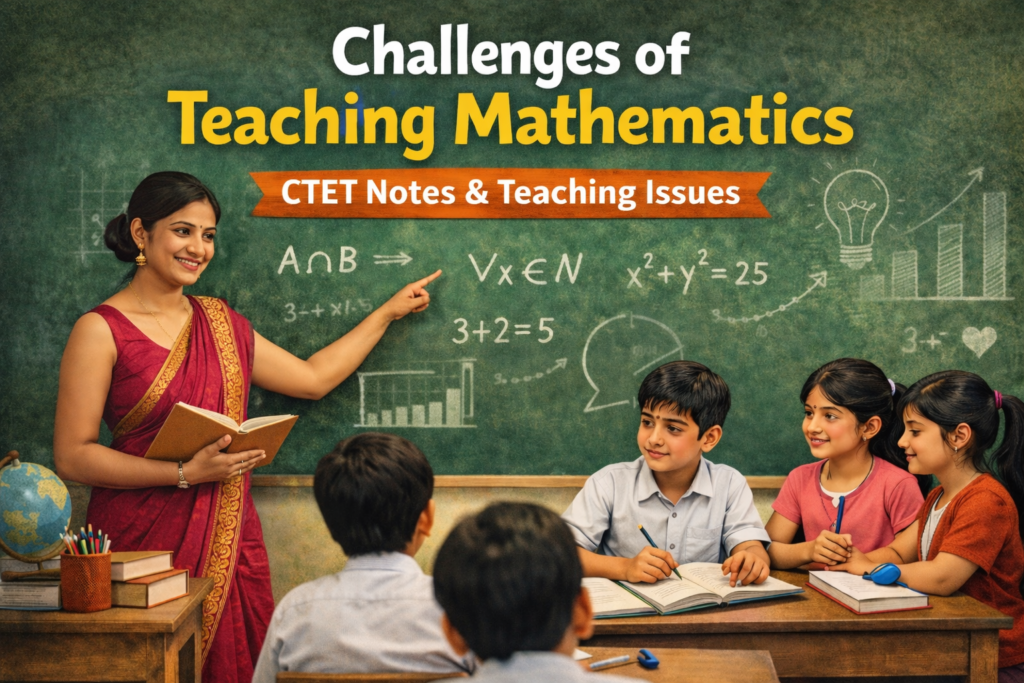
Challenges of Teaching Mathematics
A Comprehensive and Illustrative Guide for Teachers and CTET Aspirants
Introduction
Challenges of Teaching Mathematics: Teaching mathematics is both intellectually demanding and pedagogically complex. Mathematics is a foundational subject that develops logical reasoning, analytical thinking, and problem-solving skills, yet it often becomes a source of fear and disengagement for learners. Across Indian classrooms, teachers frequently encounter difficulties in sustaining students’ interest, addressing anxiety, and adapting to changing curricular expectations.
Understanding the challenges of teaching mathematics is essential for teachers, teacher educators, and CTET aspirants, as it enables them to plan effective strategies and create meaningful learning experiences.
Lack of Interest in Mathematics
One of the most visible challenges in teaching mathematics is the lack of student interest. Mathematics requires concentration, practice, and the ability to deal with abstract ideas. When students fail to understand the purpose or relevance of mathematical concepts, they often disengage from learning.
Excessive emphasis on rote calculations, repetitive exercises, and examination-oriented teaching makes mathematics appear mechanical. As a result, learners perceive the subject as difficult and boring, which negatively affects their performance and confidence.


Mathematics Anxiety
Mathematics anxiety is a serious emotional barrier that interferes with learning. Many students experience fear, stress, or nervousness while solving mathematical problems, especially during tests or oral questioning.
This anxiety often develops due to early failures, fear of making mistakes, or rigid classroom practices where only correct answers are valued. Mathematics anxiety lowers self-esteem and discourages students from participating actively, leading to long-term learning gaps.
Curriculum-Related Challenges
The existing mathematics curriculum presents several difficulties for teachers. Often, the syllabus is overloaded and leaves little scope for exploration, reasoning, and problem-solving. Teachers are forced to focus on syllabus completion rather than conceptual understanding.
Another major issue is the lack of culturally relevant content. When mathematical problems are disconnected from students’ everyday experiences and social contexts, learners find it difficult to relate to them. This weakens engagement and understanding, particularly in diverse Indian classrooms.

Inadequate Teacher Preparation
Effective mathematics teaching requires strong subject knowledge and appropriate pedagogical skills. However, many teachers feel inadequately prepared to teach mathematics, especially at the upper primary and secondary levels.
Due to limited training and professional support, teachers often rely heavily on textbooks and traditional methods. This reduces classroom interaction, limits questioning, and restricts students’ opportunities to develop reasoning and conceptual clarity.
Traditional Methods and Changing Curriculum
In many secondary schools, mathematics is still taught through traditional, teacher-centred methods that emphasize memorization and fixed procedures. While these methods may help students score marks, they do not promote deep understanding or creativity.
Modern educational reforms encourage a constructivist approach, where learners actively construct knowledge through discussion, exploration, and reflection. Adapting to this shift requires continuous professional development, which many teachers find challenging due to time constraints and lack of institutional support.


Difficulties in Teaching Problem-Solving
Problem-solving is the core of mathematics, yet it remains one of the most difficult aspects to teach. Students often struggle to understand word problems, identify relevant information, and apply suitable strategies.
Teachers, on the other hand, may find it difficult to design tasks that encourage logical reasoning, multiple approaches, and justification, especially within limited classroom time. Consequently, problem-solving is sometimes reduced to following set steps rather than developing flexible thinking.
Limited Use of Mathematical Tools
The effective use of mathematical tools and resources is another challenge. Manipulatives, models, graphs, calculators, and digital tools can greatly enhance understanding, but many classrooms lack adequate resources.
Even when tools are available, teachers may not be sufficiently trained to integrate them meaningfully into lessons. This restricts hands-on learning and prevents students from visualising abstract mathematical concepts.
Challenges in Implementing a New Curriculum
Implementing a new mathematics curriculum is a complex process. Teachers often face confusion regarding new objectives, assessment patterns, and instructional methods.
Insufficient orientation programmes, lack of mentoring, and limited planning time make the transition difficult. As a result, there may be inconsistency in classroom practices and reduced effectiveness of curriculum reforms.
Teacher Competence and Professional Issues
The quality of mathematics teaching largely depends on the competence and confidence of teachers. Inadequate subject mastery, ineffective classroom management, or lack of motivation can negatively influence students’ attitudes toward mathematics.
Continuous professional development, reflective practice, and collaboration among teachers are essential to overcome these issues. Without proper institutional support, however, teachers may struggle to improve their teaching practices.
Conclusion
Teaching mathematics involves addressing cognitive, emotional, and pedagogical challenges simultaneously. Issues such as lack of interest, mathematics anxiety, curriculum limitations, inadequate teacher preparation, and traditional teaching methods continue to affect mathematics learning in Indian classrooms.
By recognising these challenges and adopting learner-centred strategies, integrating real-life contexts, strengthening teacher training, and creating supportive classroom environments, mathematics can be transformed from a subject of fear into one of curiosity and confidence. This understanding is especially crucial for CTET aspirants, who will play a vital role in shaping the mathematical thinking of future generations.
The major challenges of teaching mathematics include lack of student interest, mathematics anxiety, an overloaded curriculum, inadequate teacher preparation, and overuse of traditional teaching methods. These challenges often affect students’ conceptual understanding and performance.
Mathematics anxiety creates fear and stress in learners, which reduces concentration and confidence. It prevents students from actively participating in classroom activities and negatively impacts problem-solving and achievement in mathematics.
Teaching mathematics is considered difficult because it requires strong subject knowledge, effective pedagogy, and the ability to address diverse learner needs. Curriculum pressure, lack of resources, and the need to shift towards constructivist methods further increase the difficulty.