
Overview of Child-Centred and Progressive Education
Child-centred and progressive education places the child’s needs and interests at the center of learning. It builds on children’s natural curiosity and abilities, adapting teaching to their individual needs rather than treating every learner the same. As a result, learning becomes active, meaningful, and connected to real experiences. Students are encouraged to explore, discover, and reflect instead of relying on rote memorization.
Features of Child-Centred Education
Child-centred education treats every child as a unique learner. It focuses on the child’s interests, abilities, and natural curiosity. Learning becomes meaningful because the child takes an active part in the process. Below are the main features explained in simple and easy words:
1. Learning Based on the Child’s Needs
Each child learns in a different way. In child-centered education, the teacher adjusts the lessons to match the child’s pace and level. This helps children learn without pressure.
2. Learning by Doing
Children understand better when they work with real objects, activities, and situations. They learn through projects, experiments, stories, and simple tasks that connect to their life.
3. Teacher as a Guide
The teacher does not only give answers. Instead, the teacher guides the child, encourages questions, and helps them think on their own. The teacher supports learning rather than controlling it.
4. Space for Curiosity and Creativity
Children are free to explore, ask questions, and try new ideas. Mistakes are not punished. They are seen as a natural part of learning and help the child improve.
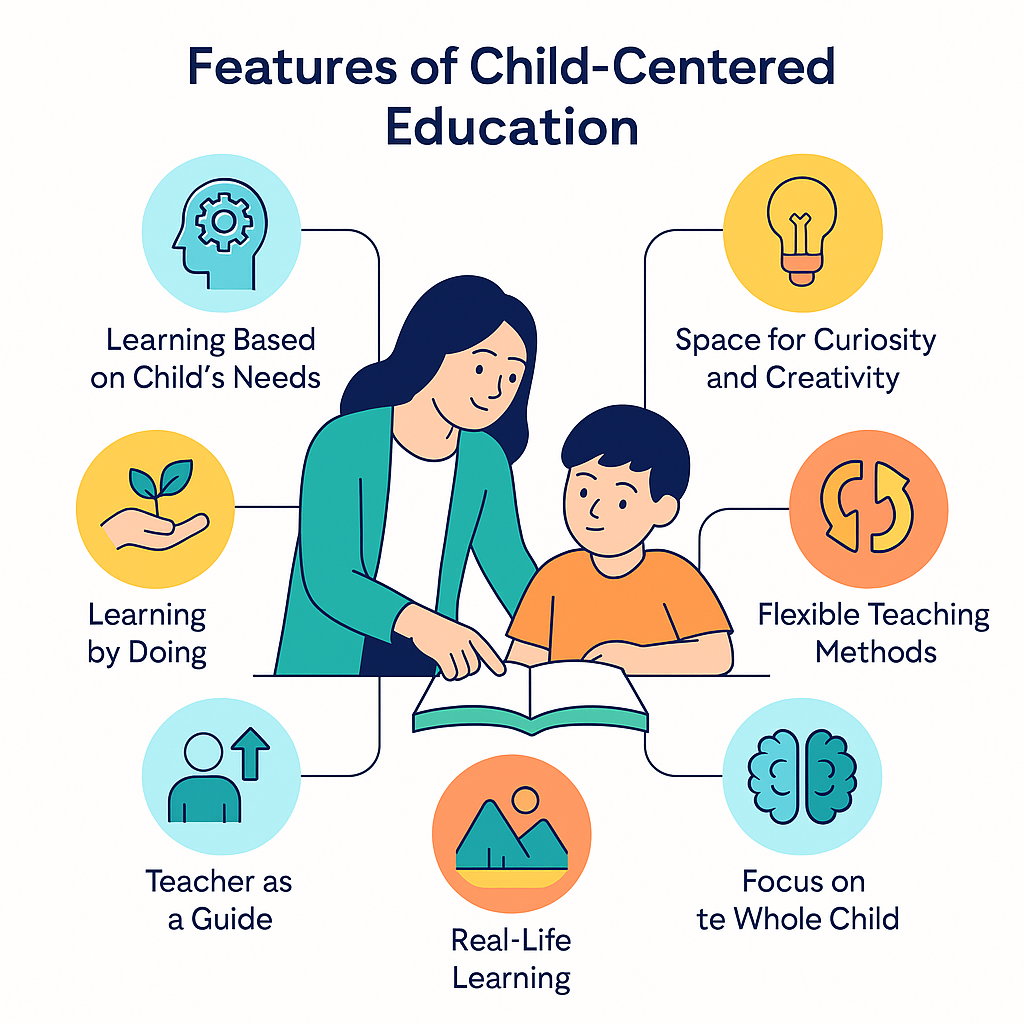
5. Flexible Teaching Methods
Lessons are not fixed or rigid. The teacher uses different methods—discussion, play, activities, group work, stories—based on what the child needs at that moment.
6. Focus on the Whole Child
Child-centred education cares about the child’s full growth. It supports physical, emotional, social, and moral development along with academics. Children learn confidence, cooperation, and problem-solving.
7. Real-Life Learning
Ideas are linked to real life. Children learn through examples from home, school, nature, and daily experiences. This makes learning simple, useful, and easy to remember.
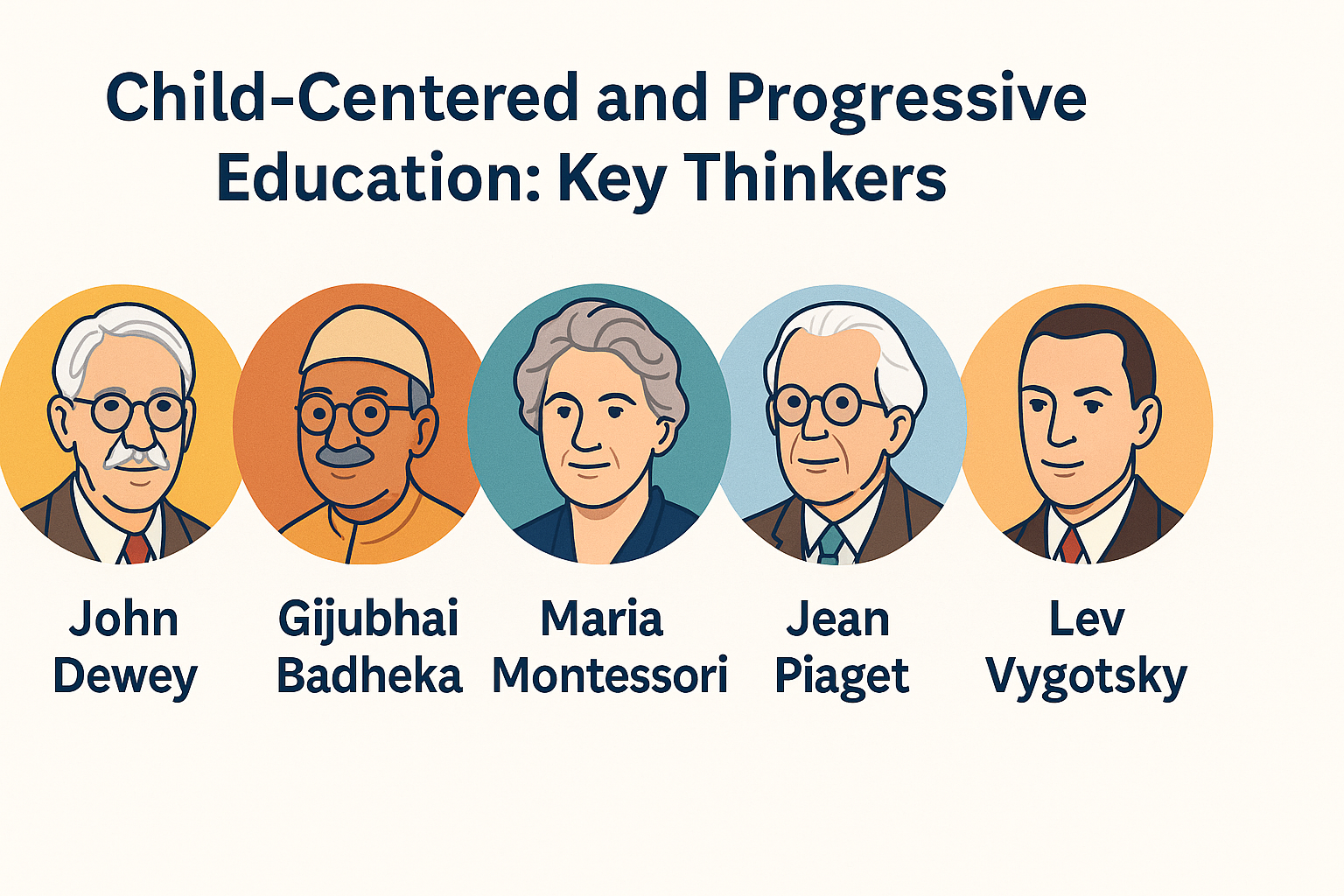
Child-Centred and Progressive Education: Key Thinkers
Child-centred and progressive education grew out of a simple but powerful idea: children learn best when the learning process respects their interests, experiences, and natural curiosity. Instead of forcing all children to learn in the same way, these approaches allow them to explore, question, and build knowledge through meaningful activities.
Several educational thinkers shaped these ideas over many decades. Their observations, classroom experiences, and research continue to guide modern teaching practices, especially in primary classrooms.
To explore more related pedagogy topics, visit our
👉 Child Development & Pedagogy Notes
John Dewey: Learning as a Social and Active Experience
John Dewey is often called the father of progressive education. He believed that schools should prepare children for real life, not just train them to memorise facts. Dewey observed that children understand concepts more clearly when they engage in hands-on experiences like experiments, discussions, group tasks, or real-world problem-solving.
He famously argued that:
- Learning happens through doing, not passive listening in child-centred and progressive education.
- Classrooms should function like small communities, where children learn from one another.
- Teachers should use children’s experiences as starting points for new learning.
- Mistakes should be treated as windows into the child’s thinking, not as failures.
Dewey also gave the tripolar model — teacher, student, and curriculum — which explains how learning becomes meaningful when all three work together.
Gijubhai Badheka: An Indian Voice for the Child’s Freedom
Gijubhai Badheka brought a fresh and deeply human view of education in India. Working closely with young children, he realised that love, freedom, and trust were more powerful than fear or punishment. He strongly opposed rigid school routines and rote memorisation, which dominated Indian classrooms during his time.
Badheka’s approach focused on:
- Creating a happy and free learning environment, especially for young children.
- Using stories, songs, play, and everyday experiences as natural learning tools.
- Treating the teacher as a friend, supporter, and guide, not as a strict authority figure.
- Allowing children to learn at their own pace without pressure.
His ideas continue to influence pre-primary and primary education in India.
Maria Montessori: Respect for the Child’s Inner Development
Maria Montessori brought a scientific and child-friendly approach to early education. Her work with children showed that they learn best when the environment is calm, orderly, and filled with materials they can explore independently. She believed that children have an inner drive to learn, and the teacher’s role is to support this natural growth.
Key elements of Montessori’s method include:
- A prepared environment with materials designed for self-learning.
- Emphasis on independence, concentration, and responsibility.
- Learning through activities that require movement, touch, and exploration.
- Allowing children to choose tasks based on their own interests.
Her method blends child-centred and progressive ideas beautifully.
Jean Piaget: Understanding How Children Think
Jean Piaget changed the way teachers understand children’s thinking. Through years of observation, he concluded that children are active builders of knowledge. They do not copy ideas; they construct understanding by interacting with objects and people.
Piaget introduced stages of cognitive development, showing that:
- Children at different ages think differently.
- Learning activities must match the child’s developmental stage.
- Real learning happens when children explore, experiment, and solve problems.
His theory encourages teachers to design activities that help children discover concepts instead of memorising them.
Lev Vygotsky: Learning Through Interaction and Support
Lev Vygotsky emphasised the importance of social interaction in learning. According to him, children understand ideas better when they talk, ask questions, share, and work with others — especially with someone more experienced.
Two of his major contributions are:
1. Zone of Proximal Development (ZPD)
The ZPD explains the gap between what a child can do alone and what they can do with help. This is the space where the richest learning takes place.
2. Scaffolding
Teachers provide support — hints, clues, examples — and gradually reduce this help as the child becomes confident.
Vygotsky’s ideas strongly support group work, peer learning, and guided activities in classrooms.
Why These Thinkers Matter Today
Although these thinkers lived in different places and times, they shared one belief:
Children learn best in a supportive, active, and engaging environment.
Modern primary classrooms, especially those preparing students for CTET/STET exams, still use their ideas:
- Learning by doing
- Project-based tasks
- Group discussions
- Independent exploration
- Connecting lessons to real life
- Respecting each child’s pace and needs
Their philosophies continue to shape child-friendly and democratic classrooms all over the world.
According to John Dewey, learning becomes meaningful when children take part in real activities. More about his educational philosophy can be read here: https://plato.stanford.edu/entries/dewey/
Summary of Key Thinkers
| Thinker | Key Contribution |
|---|---|
| John Dewey | Learning by doing, democratic classrooms, Tripolar Model |
| Gijubhai Badheka | Child-friendly, loving environment; learning through experience |
| Maria Montessori | Prepared environment, independence, self-paced learning |
| Jean Piaget | Stages of cognitive development, discovery learning |
| Lev Vygotsky | Social learning, ZPD, scaffolding |
Progressive Schools and Learning by Doing
Historical Background
Progressive schools began to spread around 1896. Unlike traditional schools, they relied on learning by doing. Through experimentation and observation, children developed confidence and practical abilities.
Educational Aims in Progressive Schools
Progressive schools aim to help children grow in several ways. First, they nurture practical skills required for real-life situations. Second, they treat mistakes as normal and valuable sources of information. Additionally, discussions, reflection, and group work help correct misconceptions. Overall, these schools create an environment where reasoning and creativity can flourish.
Dewey’s Tripolar Model of Progressive Education
John Dewey described education as a tripolar process that includes the teacher, the student, and the curriculum.
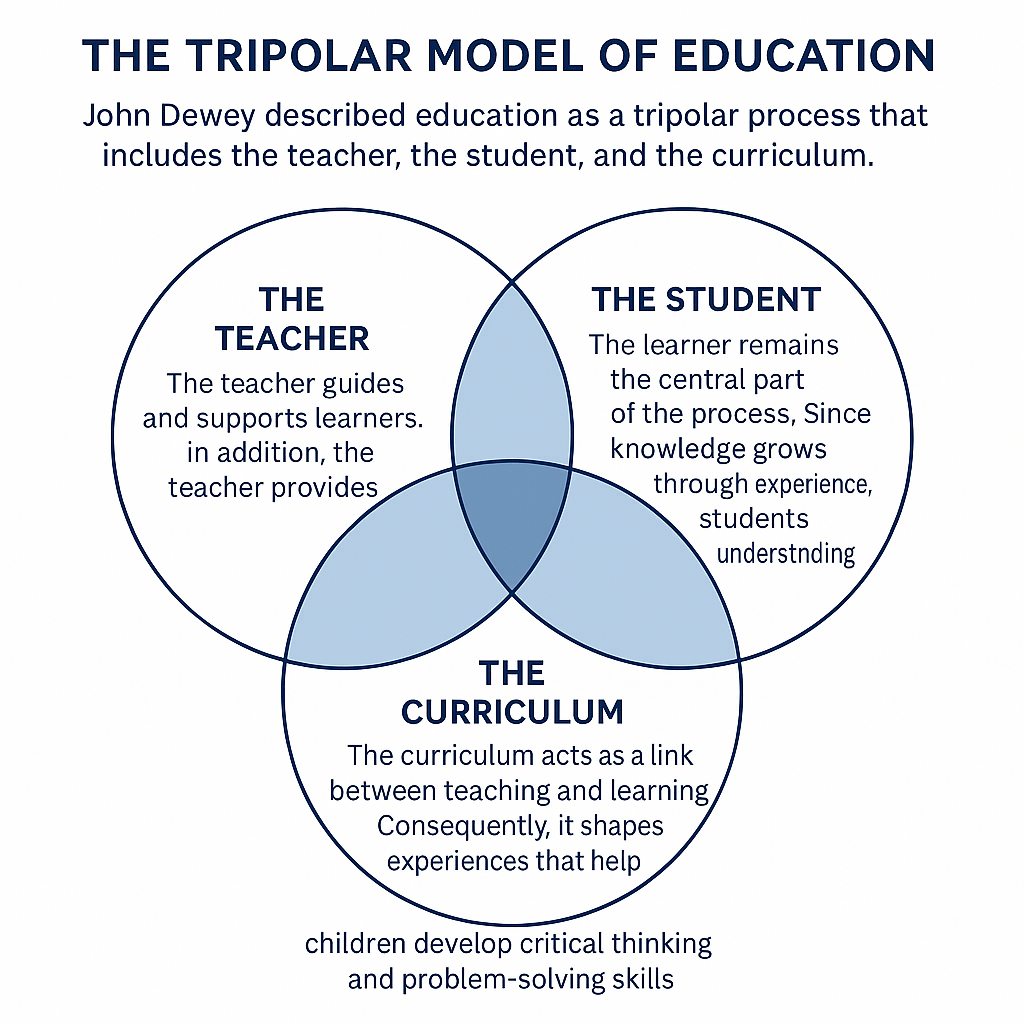
The Teacher
The teacher guides and supports learners. In addition, the teacher provides opportunities for exploration and meaningful engagement.
The Student
The learner remains the central part of the process. Since knowledge grows through experience, students construct understanding by interacting with their environment.
The Curriculum
The curriculum acts as a link between teaching and learning. Consequently, it shapes experiences that help children develop critical thinking and problem-solving skills.
Language and Its Structure
Learning and Acquisition
Language is an innate human ability as well as a communication tool. Scholars such as Noam Chomsky proposed that children are born with a natural capacity for language. Because of this, they pick up language patterns even without direct instruction.
Language develops in a sequence. Psychological order (LSRW) begins with Listening, followed by Speaking, Reading, and Writing. Montessori order starts with Listening and Speaking, but Writing comes before Reading. Although the orders differ, both highlight the importance of early listening and interaction.
Parts of Language
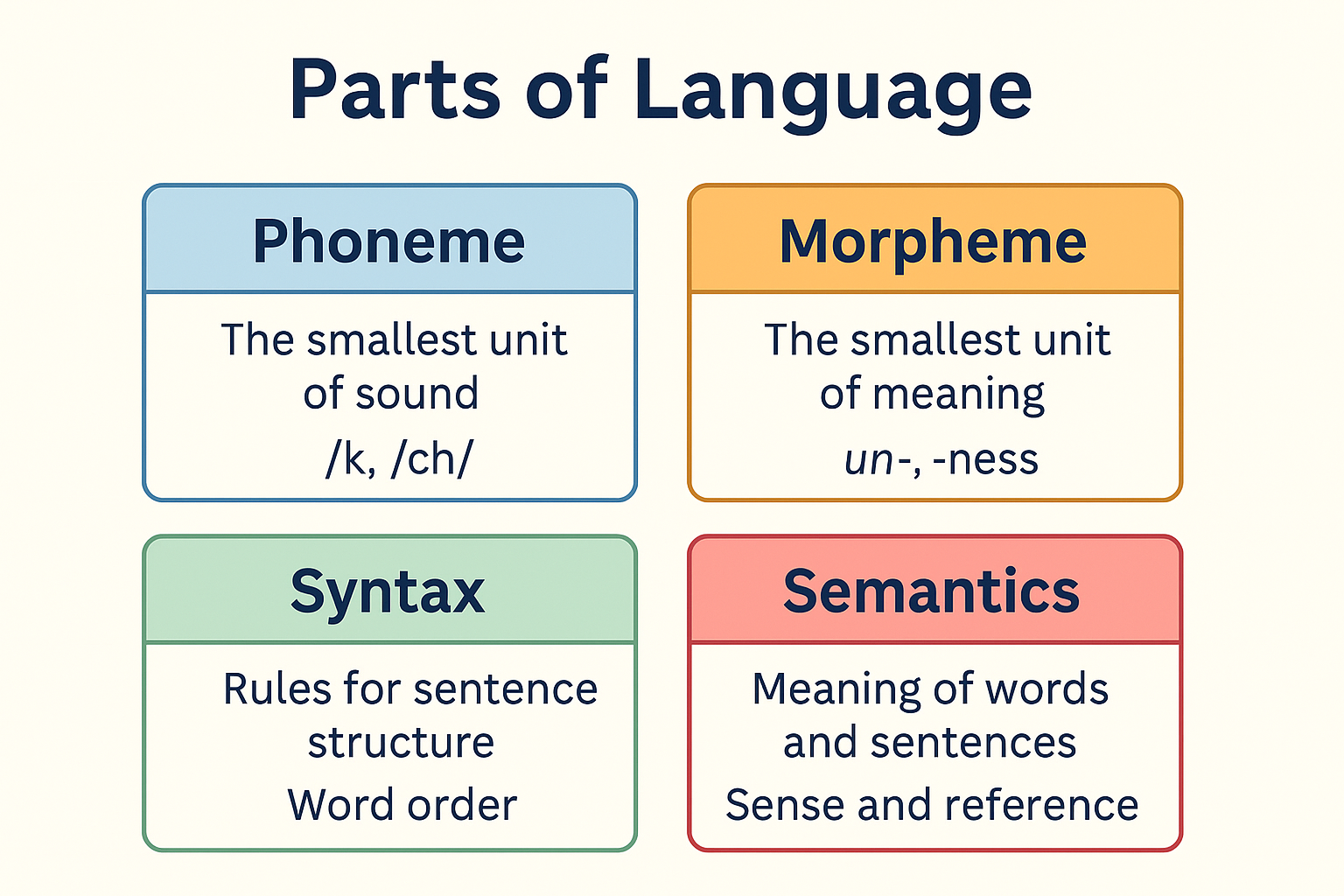
Language is made up of several building blocks. Just like a house is built from bricks, cement, and wood, language is built from sounds, meaningful units, and sentence rules. Understanding these parts helps teachers know how children learn language naturally.
1. Phoneme (स्वनिम)
A phoneme is the smallest unit of sound in a language.
Think of it like the sounds that make up words.
- In the word “cat”, the sounds /k/ /a/ /t/ are phonemes.
- Changing one phoneme changes the word: cat → bat → fat.
👉 Children first learn to hear and produce phonemes before reading and writing.
👉 Phonemic awareness is the base of reading skills.
2. Morpheme (रूपिम)
A morpheme is the smallest unit of meaning.
While phonemes are sounds, morphemes carry meaning.
Examples:
- help (one morpheme)
- helpful = help + ful (two morphemes)
- unhappiness = un + happy + ness (three morphemes)
Each part adds meaning:
- “un” = not
- “ness” = state of
👉 Morphemes help children understand how words are formed and how meaning changes.
3. Syntax (वाक्य विन्यास)
Syntax refers to the rules of sentence structure — the correct arrangement of words.
It tells us:
- What order to use words in
- How to make correct sentences
- How meaning changes when order changes
Examples:
- Correct: The boy is reading a book.
- Incorrect: Reading book is boy a the.
👉 Children slowly learn syntax by listening to adults and forming their own sentences.
👉 Syntax helps them express thoughts clearly.
4. Semantics (अर्थ विन्यास)
Semantics deals with meaning — how words and sentences convey ideas.
For example:
- “Light” can mean not heavy or brightness.
- “Bank” can mean river bank or a financial bank.
Understanding semantics means understanding:
- Word meanings
- Sentence meanings
- Context
👉 Children learn semantics by connecting words with real-life experiences.
Why These Parts Matter in Teaching?
- Phonemes → reading readiness
- Morphemes → word-building and vocabulary
- Syntax → sentence formation and grammar
- Semantics → meaningful communication
A teacher who understands these parts can support language development more effectively.
GLOSSARY:
Phoneme (स्वनिम)
The smallest unit of sound in a language.
Morpheme (रूपिम)
The smallest meaningful unit in a language, such as a word, prefix, or suffix.
Syntax (वाक्य विन्यास)
Rules that determine how words are arranged to form sentences.
Semantics (अर्थ विन्यास)
The study of meaning in words, phrases, and sentences.
Assessment Approaches in Education
Criterion-Referenced Tests (CRT)
CRT evaluates a student’s performance against a fixed standard. For example, a pass mark might be 33% in one exam and 60% in another. Because the criteria are predetermined, each student is judged individually.
Norm-Referenced Tests (NRT)
NRT compares a student’s performance with that of other students. As a result, selection decisions rely on relative ranking. Admissions, scholarships, and merit lists often use this method.
Final Insights
Child-centered and progressive education place learners at the heart of the process. Through exploration and guided experiences, children develop confidence and clarity. Additionally, flexible curricula and open discussion make classrooms more democratic and interactive. Ultimately, these approaches shape independent, reflective, and creative thinkers.

Pingback: Thorndike’s Trial and Error Theory (1911): Laws & Experiment