
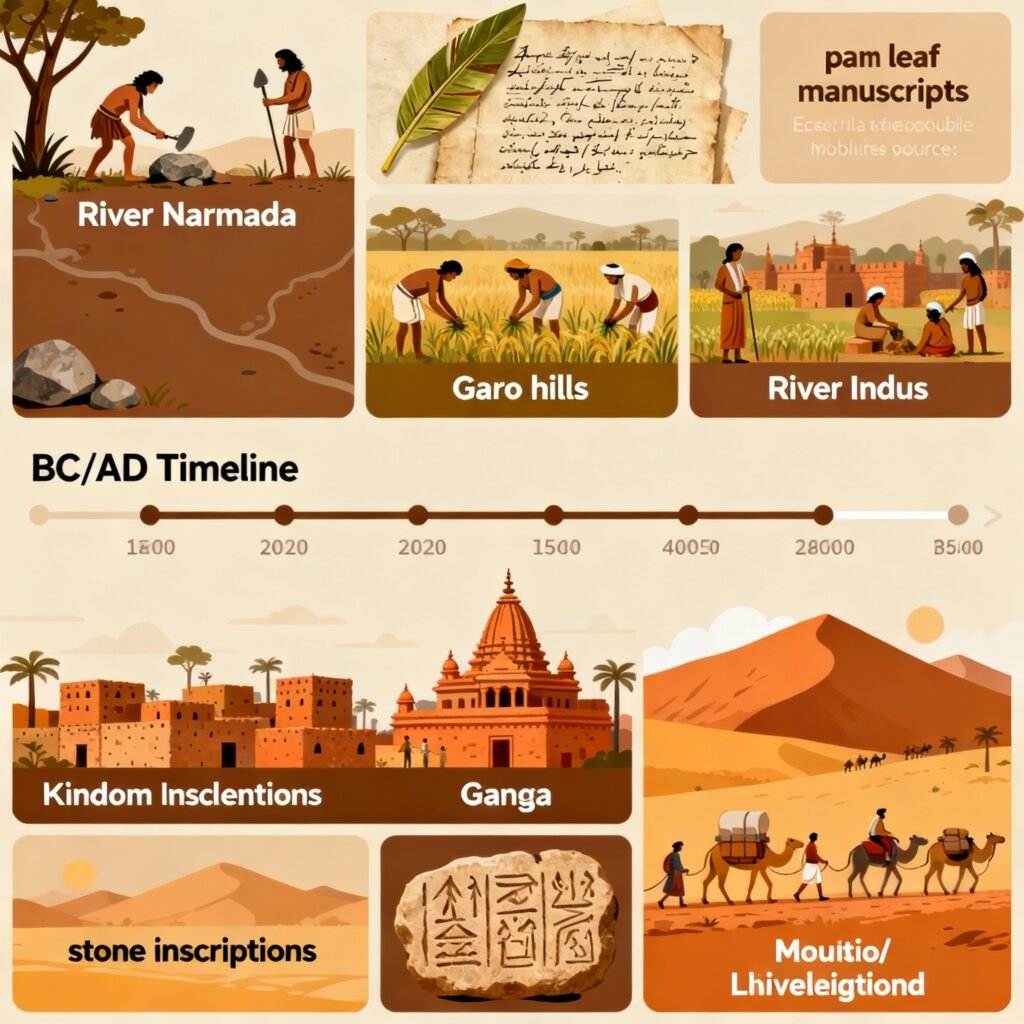
Class 6 History Chapter 1 Notes
Chapter 1: what, where how and when?
WHAT, WHERE, HOW AND WHEN?
Importance of Studying History
History is the systematic study of past events.Historians construct it based on the study of available material remains and records. Historians are the people who study the past. Historians study the past with the help of many written and unwritten sources.

Importance of Studying History
We study history for the following reasons:
- History helps us to find out the ways in which people lived in the past. For example, it tells us about the food people ate and the clothes they wore.
- It also throws light on the places where people lived and the various activities in which they were engaged.
- History tells us the story of the development of human kind and the progress of various civilisations. Reasons Why People Travelled in the Past
- In the past, people travelled across mountains, rivers, deserts and countries in the Indian subcontinent due to the following reasons:
- To search for better sources of livelihood
- To escape from natural disasters such as floods, droughts etc.
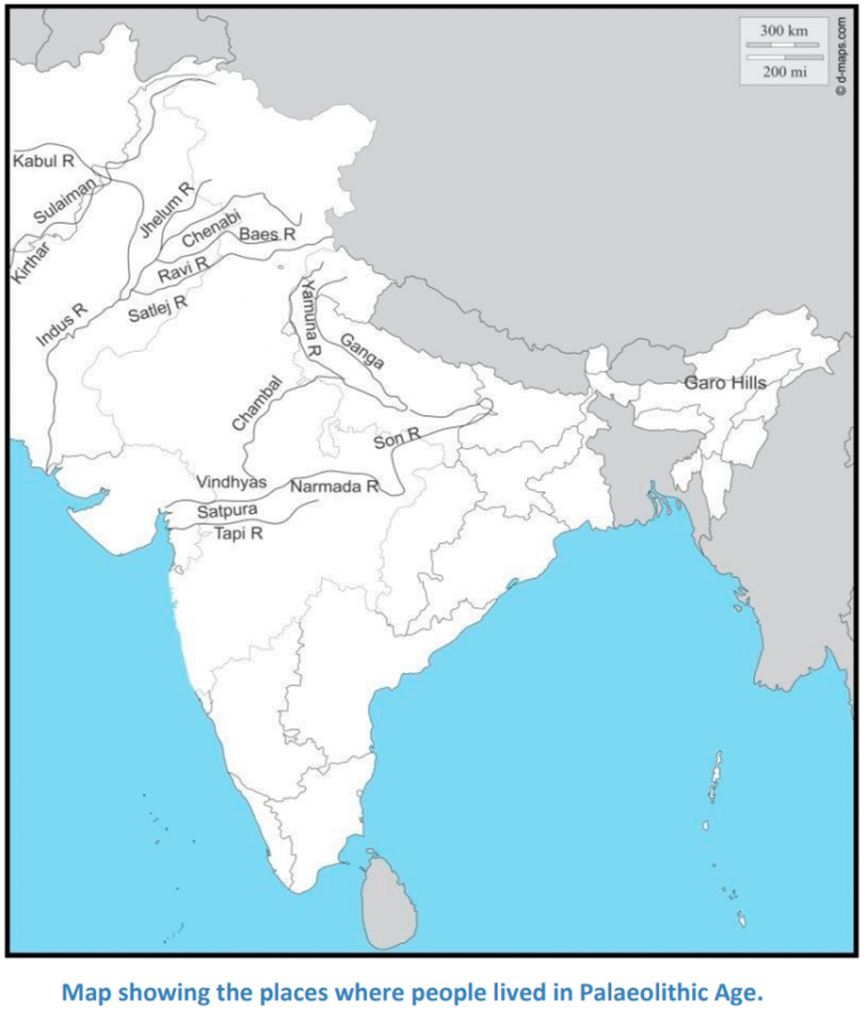
The Places Where People Lived in India
Some of the places where people in the past lived are:
River Indus and its tributaries: About 4,700 years ago, some of the earliest cities flourished alongside the River Indus and its tributaries.
River Ganga and its tributaries: In ancient times many kingdoms developed on the banks of the River Ganga and its tributaries. Magadha was the most powerful kingdom among these.
River Narmada: The River Narmada was the home of some of the earliest people. These people were basically hunters and gatherers who hunted animals and gathered fruits and forest produce. They had vast knowledge about the plant and animal world.
Sulaiman and Kirthar hills: It is in these hills, in the north west of the country about 8,000 years ago, that men and women first began to cultivate crops such as wheat and barley.
Garo Hills in the North-East and the Vindhyas in Central India: Agriculture developed rapidly in these areas. Rice was cultivated for the first time in the areas to the north of the Vindhyas.
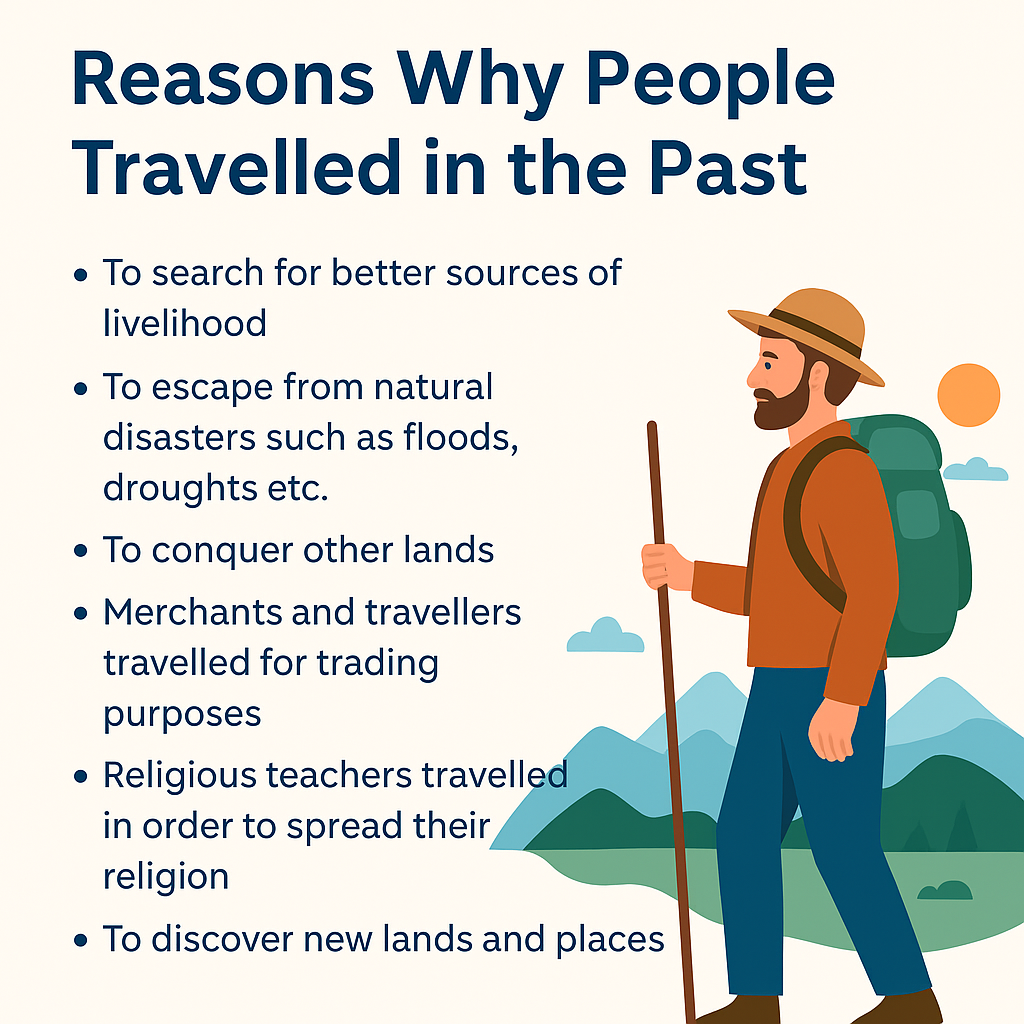
Reasons Why People Travelled in the Past
- In the past, people travelled across mountains, rivers, deserts and countries in the Indian subcontinent
- due to the following reasons:
- To search for better sources of livelihood
- To escape from natural disasters such as floods, droughts etc.
- To conquer other lands
- Merchants and travellors travelled for trading purposes
- Religious teachers travelled in order to spread their religion
- To discover new lands and places
India and Bharat
India derived its name from the River Indus which is called Sindhu in Sanskrita. The Iranians and the Greeks who came to the Indian subcontinent, called the River Indus Hindos or Indos, and subsequently the land to the east of the river came to be known as India.
India is also known as Bharat. Earlier, Bharat was a tribe (a group of people) who lived in the northwest. This tribe is mentioned in the Rigveda- the oldest wirtten text in Sanskrita. It was from this tribe that India also came to be known as Bharat.

Sources of the Past
India has had a glorious past since ancient times. The world’s first civilization, the glorious Sanskrit language, the epics and the other manuscripts are evidence, that is proof, of the amazing and rich history that India has.
Sources of the past can be broadly divided into two categories- written and archaeological sources. They are: Written Sources and Unwritten Sources.
Written Sources
- Manuscripts: Manuscripts are hand written books. Earlier, accounts were generally written on a palm leaf and on the prepared bark of the birch trees, which are commonly found in the Himalayan regions. Some of these accounts have survived and have been preserved in temples and monastries.
Manuscripts give us information about the religion, medicines, science, kings etc. of the earlier era.

Manuscripts written on a palm leaf
- Inscriptions: Inscriptions are a piece of writing which are written on hard surfaces such as stone or metal. Inscriptions were generally written on the orders of the king. They tell us about the policies which were followed by the king. The process of reading unknown written languages is known as decipherment.

Inscription written on the surface of a rock
Unwritten Sources
Archaeological sources
Archaeological sources are the remains of materials that people used in the past. Remains of pottery, tools, weapons, ornaments, buildings and sculpture are some examples of archaeological sources. Archaeologists are the people who study these sources. Archaeologists excavate (dig up) the earth in order to find archaeological remains. Archaeological sources tell us about the way people lived in the past. For example, excavated bones of animals tell us about the food people ate in the past.
All People were not Equal in the Past
People were not equal in the past. They did some different occupations. While few were kings, some were slaves, some were farmers and some others were merchants. They all lived differently. The kings and queens lived a life of luxuries, while farmers faced many hardships. The merchants travelled from place to place with the purpose of trading. Many people were hunters and gatherers. Today, many people in the Andaman and Nicobar Islands still hunt animals and collect forest produce to survive.
Therefore, we can say that human history does not have just one past but many pasts.
What do dates mean?
To study history, we must understand the measurement of time. The past is measured in years. The birth of Christ is taken as a reference point. The years before Christ was born are written as BC or before the birth of Christ.
For example, 3000 BC means 3000 years before Christ was born. Nowadays, BC is also written as BCE which means Before the Common era. AD stands for Anno Domini meaning ‘in the year of the Lord”. Any event that occurred after the birth of Christ is written as AD e.g. India gained independence in 1947 AD, meaning 1947 years after the birth of Christ. It can also be written as CE or Common Era.
Around the World
In ancient Egypt, the people used a kind of picture writing. This writing is called hieroglyphics meaning “holy carving?. At first, the writings represented things such as a bird, sun or water. Later, each small drawing represented a letter.
The Egyptians wrote on a kind of paper called papyrus made from reeds which grew near the Nile River. Many pieces of papyrus were stuck together to form a scroll. The hot and dry weather of Egypt has preserved many old Egyptian scrolls. Earlier, no one could understand the writing. However, it has been deciphered and now we know a lot about the ancient Egyptian civilisation from the scrolls.
Important Questions
MULTIPLE CHOICE QUESTIONS
- Multiple Choice Questions:
- Garo hills are located in:
- North-East of India
- South of India
- Central India
- West of India
- ___________ is the tributary of the river Ganga.
- Bhadra
- Son
- Indus
- All the above
- The study of manuscripts and inscriptions is known as:
- Sociology
- Archaeology
- Astrology
- None of the above.
- The art of making pictures and symbols by carving on stone is known as:
- Sculpture
- Architect
- Musician
- Farmers
- The way or form in which language is written known as:
- History
- Inscription
- Archaeology
- Script
- The Iranians and Greeks called the Indus:
- Hindos
- Bindas
- Sundas
- None of the above.
- Period for which we have no written records is known as:
- History
- Herodotus
- Pre-History
- None of the above.
- Which country is not a part of South Asia?
- India
- Sri Lanka
- Germany
- China
- Which of the following is called a subcontinent?
- East Asia
- North Asia
- West Asia
- South Asia
- Which of the following language was used in writing manuscripts?
- Prakrit
- Sanskrit
- Tamil
- All of the above.
- The Iranians and the Greeks came through the:
- Southeast
- Northeast
- Southwest
- Northwest
- Pages of the manuscript books were made of:
- Palm leave
- Peeple Leave
- Tulsi Leave
- Neem Leave
- They study about the remains of buildings made of stone and brick, paintings and sculpture. They explore to find tools, weapons, ornaments, and coins:
- Archaeologist
- Historians
- Information officers
- Geologist
- Which of the following hills are located in North-east:
- Vindhya Hill
- Garo hills
- Narmada Hills
- Satpura Hills
- Prakrit language was used by:
- Poor people
- Common people
- King only
- Rich people
- Match The Following:
| Column-I | Column-II | ||
| 1. | Narmada Valley | A. | The first big kingdom |
| 2. | Magadha | B. | Hunting and gathering |
| 3. | Garo Hills | C. | Cities about 2500 years ago |
| 4. | Indus and its tributaries | D. | Early agriculture |
| 5. | Ganga valley | E. | The first cities |
FILL IN THE BLANKS
- Millets have been found at ________.
- People in Burzahom lived in ________ houses.
- Chirand is a site in ________.
- ________ and meat comes from animals that are reared.
- ________ is one of the earliest villages.
- Write true (T) or false (F):
- The word India comes from the Hindus, called Sindhu in Sanskrit.
- The places where rice was first grown are to the north of the Vindhyas.
- South Asia is often called a subcontinent.
- The Ganga’s tributary called the Daughter.
- The word ‘source’ refers information found from manuscripts, inscriptions and archaeology.
- Very Short Questions:
- Name the place where Millet was grown in Neolithic Age.
- Name two sites found in Andhra Pradesh.
- Name two sites found in Kashmir.
- Why grains had to be stored?
- What is ‘jadeite,’?
- What ‘Fossil Wood’ refers to?
- Which two Neolithic tools are used to grind grain even today?
- Which was the first animal to be tamed?
- Which were the earliest plants to be domesticated?
- Which were the earliest animals to be domesticated?
- What do you understands by the term ‘Tribes’.
- Which historical events took place about 12,000 years ago?
- Which historical events took place about 8,000 years ago?
- In what ways grain was used by the early people?
- Why were people buried with animals, like goats?
SHORT QUESTIONS
- Write about the houses in Mehrgarh.
- Write about the cultural traditions of the tribal community.
- Why farmers grow some crops in some areas and not in other areas?
- Describe the pit houses found at Burzahom.
- Name some important sites where archaeologists have found evidence of farmers and herders.
- Why do people who grow crops have to stay in the same place for a long time?
- Long Questions:
- Enumerate upon the archaeological findings at Mehrgarh.
- Describe tools used by farmers and herders.
- How did people become herders?
- List three ways in which the lives of farmers and herders would have been different from that of hunter-gatherers?
- How did people become farmers?
- What were the different activities performed by people in tribal societies?
ANSWER KEY –
- Multiple Choice Questions:
- A. North-East of India
- B. Son
- D. None of the above
- A. Sculpture
- D. Script
- A. Hindos
- C. Pre-History
- C. Germany
- D. South Asia
- D. All of the above
- D. Northwest
- A. Palm leave
- A. Archaeologist
- B. Garo hills
- B. Common people
- Match The Following:
| Column-I | Column-II | ||
| 1. | Narmada Valley | B. | Hunting and gathering |
| 2. | Magadha | A. | The first big kingdom |
| 3. | Garo Hills | D. | Early agriculture |
| 4. | Indus and its tributaries | E. | The first cities |
| 5. | Ganga valley | C. | Cities about 2500 years ago |
- Fill in the blanks:
- Hallur
- Pit
- Bihar
- Milk
- Mehrgarh
- Write true (T) or false (F):
- False
- True
- True
- False
- True
- Very Short Answer:
- Paiyampalli and Hallur.
- Hallur and Paiyampalli.
- Gufkral and Burzahom.
- Grain had to be stored for both food and seed.
- Jadeite is a stone that may have been brought from China.
- Fossil wood refers to ancient wood that has hardened into stone.
- Mortars and pestles are used for grinding grain.
- The first animal to be tamed was the wild ancestor of the dog.
- Some of the earliest plants to be domesticated were wheat and barley.
- The earliest domesticated animals include sheep and goat.
- Many of these farmers and herders live in groups called tribes.
- Beginnings of domestication took place about 12,000 years ago.
- Beginning of settlement at Mehrgarh took place about 8000 years ago.
- Grain was used by early people as seed, as food, as gifts and stored as food.
- The dead person was buried with goats, which were probably meant to serve as food in the next world.
- Short Answer:
- Finds at Mehrgarh includes remains of square or rectangular houses. Each house had four or more compartments, some of which may have been used for storage.
- Tribes have rich and unique cultural traditions, including their own language, music, stories and paintings. They also have their own gods and goddesses.
- Farmers grow some crops in some areas and not in other areas because different plants grow in different conditions — rice, for example, requires more water than wheat and barley.
- In Burzahom (in present-day Kashmir) people built pit-houses, which were dug into the ground, with steps leading into them. These may have provided shelter in cold weather.
- These are found all over the subcontinent. Some of the most important ones are in the north-west, in present-day Kashmir, and in east and south India.
- When people began growing plants, it meant that they had to stay in the same place for a long time looking after the plants, watering, weeding, driving away animals and birds — till the grain ripened.
- The archaeological findings at Mehrgarh are:
- Archaeologists who excavated the site found evidence of many kinds of animal bones from the earliest levels. These included bones of wild animals such as the deer and pig.
- In later levels, they found more bones of sheep and goat.
- In still later levels, cattle bones are most common.
- Stone tools have been found from many sites as well. Many of these are different from the earlier Palaeolithic tools and that is why they are called Neolithic. These include tools that were polished to give a fine cutting edge, and mortars and pestles used for grinding grain and other plant produce. Mortars and pestles are used for grinding grain even today, several thousand years later.
- In the following way people became herders:
- Women, men and children could also attract and then tame animals by leaving food for them near their shelters.
- Later, people encouraged animals that were relatively gentle to come near the camps where they lived.
- These animals such as sheep, goat, cattle and also the pig lived in herds, and most of them ate grass.
| Farmers and Herders | Hunter-Gatherers |
| They had to live at same place for longer period of time. | They kept travelling from place to place. |
| They grow crops and domesticated animals. | They depended on animals for meat and used to gather food from the forest. |
| They settled in hut and pit houses. | They did not have a settled life. |
- In the following way people became farmers:
- The climate of the world was changing, and so were plants and animals that people used as food.
- Men, women, and children probably observed several things. For example, they saw where edible plants grew, how seeds broke off from the stalks, fell on the ground, and eventually sprouted into new plants.
- Perhaps they began looking after plants — protecting them from birds and animals so that they could grow and the seeds could ripen.
- Members of a tribe follow occupations such as hunting, gathering, farming, herding and fishing. Usually, women do most of the agricultural work, including preparing the ground, sowing seeds, looking after the growing plants and harvesting grain. Children often look after plants, driving away animals and birds that might eat them. Women also thresh, husk, and grind grain. Men usually lead large herds of animals in search of pasture. Children often look after small flocks. Both Men and women did singing, dancing, cleaning of animals and milking. Both women and men make pots, baskets, and other artefacts. They also take part in singing, dancing and decorating their huts.