Introduction
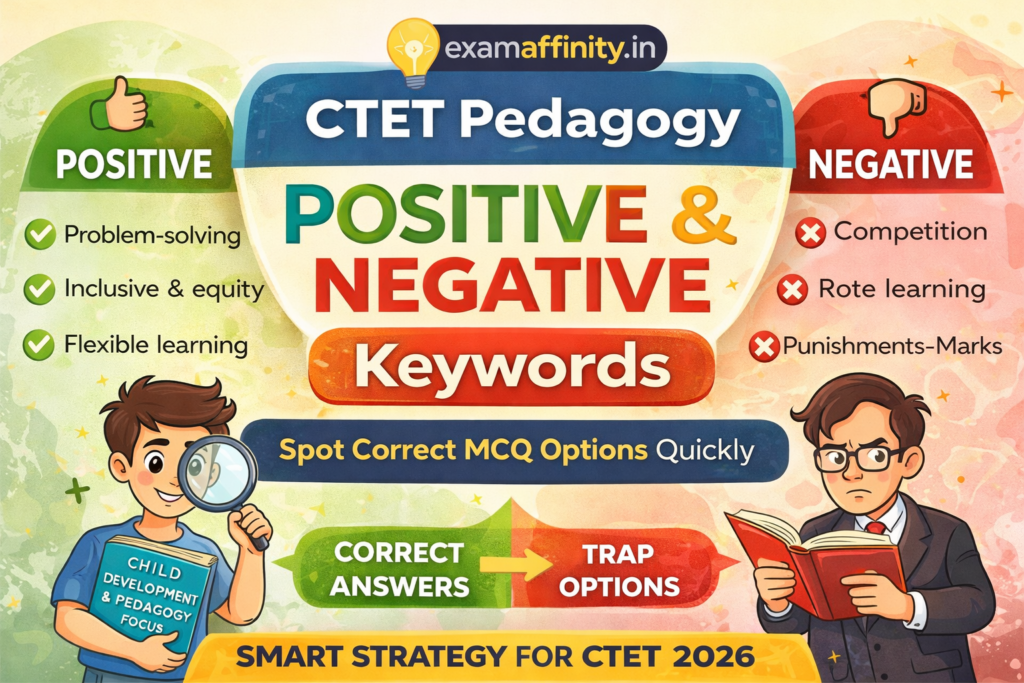
One of the smartest ways to solve CTET Child Development and Pedagogy (CDP) MCQs is by identifying positive and negative keywords hidden inside the question and options.
Many aspirants lose marks not because they lack knowledge, but because they fail to recognise these tag words.
CTET repeatedly uses fixed patterns of educational keywords. Once you learn them, MCQs become easy, fast, and accurate.
This article explains:
- What positive keywords indicate
- What negative keywords signal
- How CTET uses them to trap students
- How you can crack MCQs using keyword logic
What Are “Positive Keywords” in CTET Pedagogy?
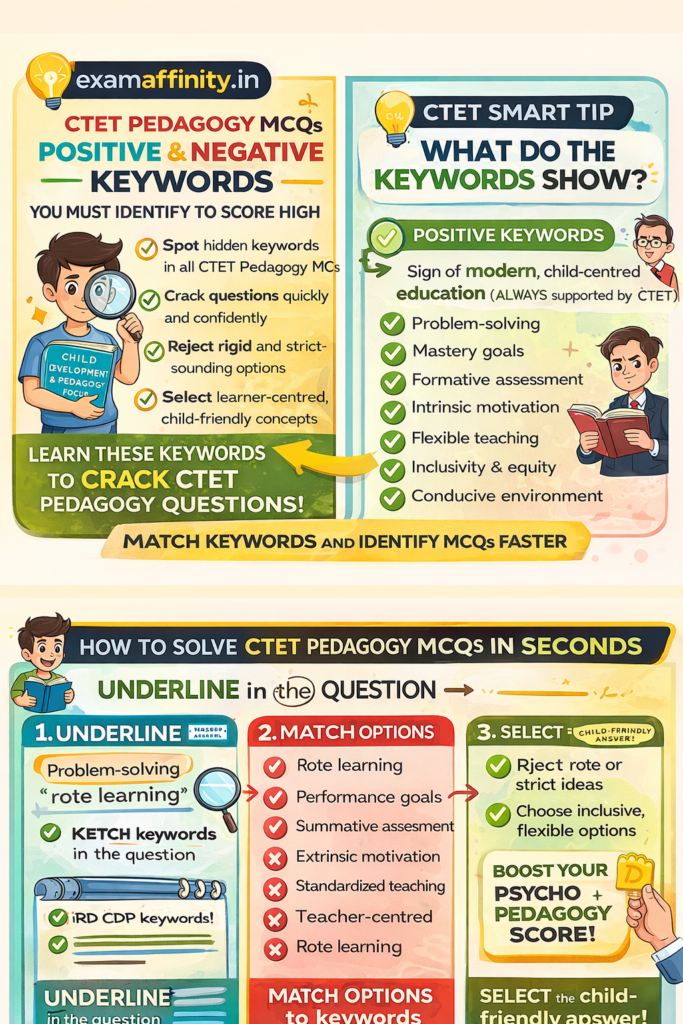
Positive keywords are words or phrases that indicate modern, child-centred, progressive, and psychological approaches to teaching and learning.
Whenever you see such words in options, they usually point towards the correct answer.
These keywords are aligned with:
- Constructivist theory
- NCF and RTE philosophy
- Learner-centred education
How Positive Keywords Appear in MCQs
In CTET questions, positive keywords are linked with:
- Active learning
- Meaningful understanding
- Inclusive classrooms
- Growth mindset
If an option promotes thinking, interaction, flexibility, or context, it is most likely correct.

Examples of Positive Keyword Indicators (CTET Favourites)
When you notice words related to:
- Problem-solving and cooperation
- Mastery goals instead of marks
- Formative or diagnostic assessment
- Alternative or naïve conceptions
- Learning as a process or spiral
- Intrinsic motivation
- Flexible or differentiated teaching
- Divergent thinking
- Inclusivity and equity
- Learner-centred classrooms
- Co-construction of knowledge
- Conducive and fear-free environment
- Incremental or growth ability
- Building on prior knowledge
- Discussion, debate, and interaction
👉 CTET almost always supports these ideas, so such options are usually correct.
What Are “Negative Keywords” in CTET Pedagogy?
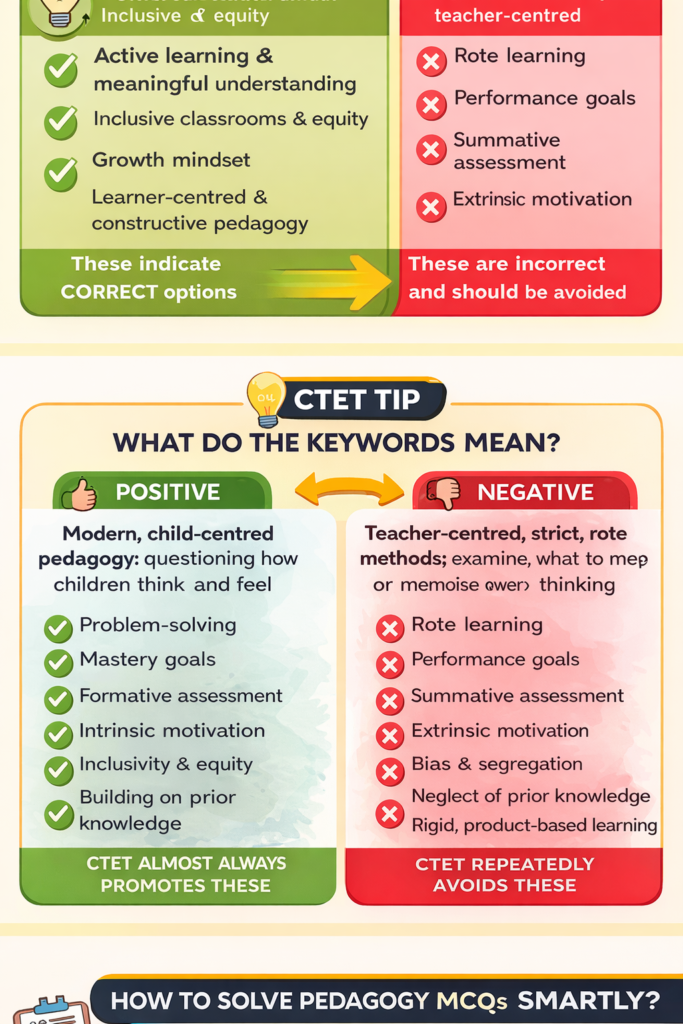
Negative keywords represent outdated, rigid, mechanical, and teacher-dominated approaches.
CTET uses them deliberately to trap rote learners.
These words indicate:
- Traditional schooling
- Behaviourist or rigid thinking
- Examination-oriented teaching
How Negative Keywords Appear in MCQs
Negative keywords are often hidden inside options that:
- Sound strict or authoritative
- Focus only on marks or discipline
- Ignore learner psychology
Such options are mostly incorrect.
Examples of Negative Keyword Indicators (CTET Traps)
Be careful if an option contains ideas related to:
- Functional fixedness
- Excessive competition
- Performance goals only
- Summative assessment as the sole method
- Wrong conceptions without correction
- Learning as product or linear
- Extrinsic motivation (reward/punishment)
- Standardized or rigid teaching
- Convergent thinking only
- Segregation or exclusion
- Rote learning
- Gender stereotypes
- Teacher-centred classrooms
- Blank slate or stimulus–response model
- Fearful learning environment
- Fixed or entity intelligence
- De-contextualized learning
- Bias and neglect of prior knowledge
- Passive or inactive learners
👉 CTET rejects these ideas, so such options are generally wrong.
How CTET Uses These Keywords to Frame MCQs
CTET does not ask direct definitions every time.
Instead, it tests your understanding indirectly.
Typical CTET Pattern:
- One option contains multiple positive keywords
- Another option contains one or two negative keywords
- The correct answer is the one aligned with child-centred pedagogy
If you train your mind to scan for keywords, you can eliminate wrong options within seconds.
Smart Strategy to Solve CTET Pedagogy MCQs
Use this 3-step method:
- Underline keywords in the question
- Match options with positive or negative indicators
- Reject options that show rigidity, fear, rote learning, or teacher dominance
This strategy works even when:
- You are confused between two options
- The question looks lengthy
- You are short of time
Why This Keyword Approach Is Important for CTET 2026
CTET is not testing memory.
It is testing whether you think like a teacher who understands children.
That is why:
- Learner-centred beats teacher-centred
- Process beats product
- Growth mindset beats fixed ability
- Inclusion beats segregation
If your answer reflects these values, it will be correct.
Final Advice for CTET Aspirants
Do not mug up definitions.
Train yourself to recognise positive and negative pedagogical signals.
This single skill can:
- Increase accuracy
- Reduce guesswork
- Save time
- Boost CDP score significantly
- प्राचीन भारत में शिक्षा (विस्तृत नोट्स – B.Ed CCSU)
- Education in Ancient India: Objectives, Features, and Significance

- CTET 2026 Answer Key Released – Download Paper 1 & Paper 2 Answer Key
- BPSC TRE-4: 46,595 शिक्षकों की भर्ती, 22 से 27 सितंबर तक होगी परीक्षा
- BPSC School Teacher TRE 4.0 Recruitment 2026: Apply Online for 44,000+ Teacher Posts