
Evaluation of Comprehension in Teaching–Learning Process
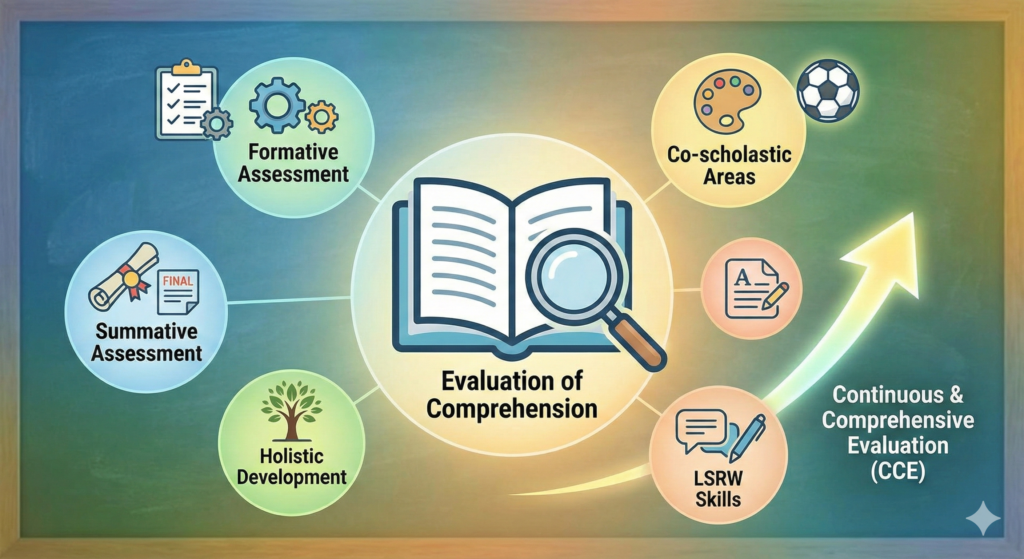
Evaluation of comprehension is an important part of the teaching–learning process. It helps teachers understand whether students have learned what was taught. It also shows whether teaching methods are effective. Through evaluation, learning becomes meaningful and improvement-oriented.
Importance of Evaluation
Evaluation helps teachers judge the success of their teaching methods. First, it shows whether the selected teaching strategy worked well in the classroom. Second, it helps teachers understand how successfully students learned new skills.
These skills include Listening, Speaking, Reading, and Writing (LSRW). When teachers evaluate learning outcomes, they can identify gaps in understanding.
Evaluation also helps students. It allows them to know their strengths and weaknesses. As a result, students can focus more on areas that need improvement. Therefore, evaluation supports better learning and academic growth.
Steps of Evaluation
Evaluation is a systematic process. It follows a sequence of steps to ensure effective assessment.
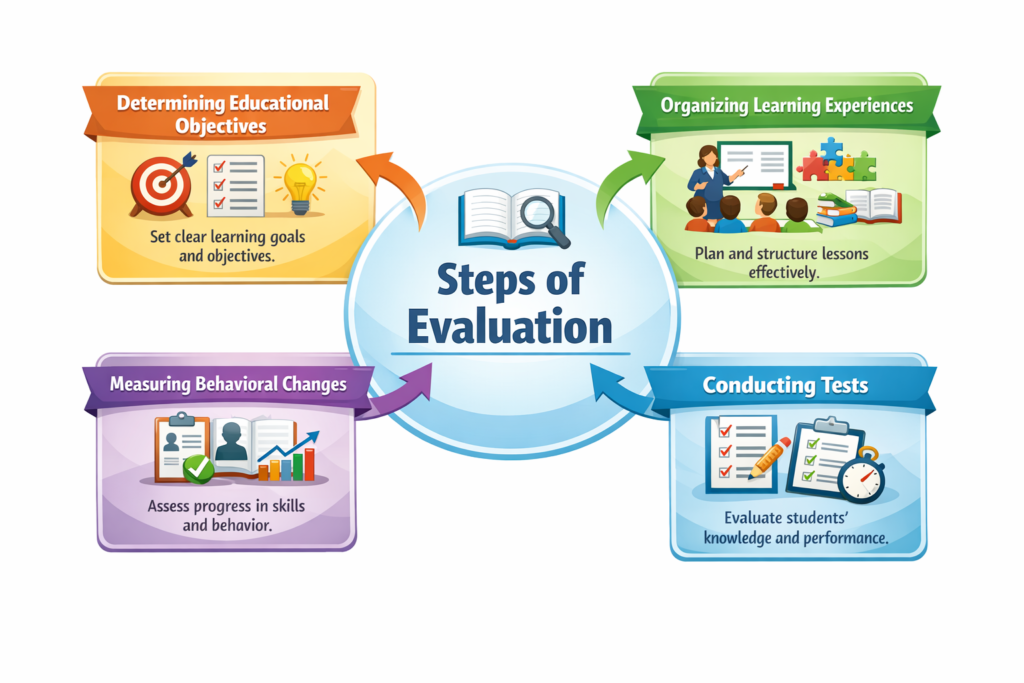
Determining Educational Objectives
First, teachers must define clear educational objectives. These objectives explain what students should learn by the end of instruction. Clear objectives guide lesson planning and assessment. Without objectives, evaluation cannot be effective.
Organizing Learning Experiences
Next, teachers organize learning experiences. Lessons and activities should be well planned. They must match the learning objectives. Well-organized teaching helps students understand concepts easily and develop skills properly.
Measuring Behavioral Changes
After teaching, teachers observe changes in students’ behavior. These changes appear in knowledge, skills, and attitudes. Measuring behavioral changes helps teachers know whether learning has actually taken place.
Conducting Tests
Finally, teachers conduct tests and assessments. These tests measure students’ understanding and achievement. Teachers may use written tests, oral questions, quizzes, or practical tasks. Test results provide feedback about student progress and teaching effectiveness.
Continuous and Comprehensive Evaluation (CCE)
Continuous and Comprehensive Evaluation (CCE) focuses on regular assessment throughout the year. It does not depend only on final examinations. Instead, it supports continuous learning and improvement.
CCE includes both scholastic and co-scholastic areas. Scholastic areas cover academic subjects. Co-scholastic areas include arts, sports, music, dance, and cultural activities. This system values all-round development.
Key Aspects of CCE
Continuous
Assessment takes place regularly during the academic year.
Comprehensive
CCE covers mental, emotional, and physical development.
Evaluation
Different tools and techniques are used to assess student progress.
Objectives of CCE
The main objective of CCE is to develop cognitive, psychomotor, and affective skills. It focuses on understanding and thinking rather than memorization. CCE also integrates evaluation with teaching and learning. Therefore, assessment becomes a tool for quality improvement.
Scholastic and Co-scholastic Areas
Scholastic Areas
These include curriculum-based academic subjects.
Co-scholastic Areas
These include life skills, values, attitudes, and co-curricular activities.
Importance of CCE Scheme
CCE reduces exam stress and anxiety among students. It also lowers dropout rates. Moreover, it promotes conceptual clarity through experiential learning. Students get more time to explore their interests and talents.
CCE creates a friendly learning environment. It motivates students and supports personality development. In addition, it helps in making future decisions about subjects, courses, and careers.
Formative Assessment
Formative assessment is used during the learning process. It helps teachers monitor student progress continuously. This assessment takes place in a supportive and non-threatening environment.
Regular feedback is an important feature of formative assessment. It helps students reflect on their performance and improve step by step.
Features of Formative Assessment
Formative assessment is diagnostic and remedial. It involves active student participation. Teachers can adjust their teaching based on assessment results. It also builds on students’ prior knowledge and encourages peer learning.
Tools and Techniques of Formative Assessment
Tools
Questions, observation schedules, interview schedules, checklists, and portfolios.
Techniques
Assignments, quizzes, competitions, projects, group discussions, experiments, and research activities.
Description of Some Formative Assessment Tools
Observation
Observation helps identify personality traits through debates, group work, and classroom activities.
Rating Scale
A rating scale measures learner behavior from excellent to poor.
Anecdotal Record
This record notes important student behaviors and skills.
Portfolio
A portfolio shows a student’s growth and learning progress over time.
Summative Assessment
Summative assessment takes place at the end of a course. It measures how much a student has learned. This type of assessment evaluates overall achievement.
Features of Summative Assessment
Summative assessments are often high-stakes. They mainly use pen-and-paper tests. These tests may include objective, short-answer, and long-answer questions. They assess listening, speaking, reading, and writing skills.
Evaluation of comprehension refers to the process of assessing how well students understand what has been taught. It helps teachers check learning outcomes and identify gaps in understanding.
Evaluation is important because it helps teachers judge the effectiveness of teaching methods and helps students understand their strengths and weaknesses. It also supports improvement in learning and teaching strategies.
The main steps of evaluation include determining educational objectives, organizing learning experiences, measuring behavioral changes, and conducting tests to assess learning outcomes.
Continuous and Comprehensive Evaluation (CCE) is an assessment system that evaluates students throughout the academic year. It focuses on both scholastic and co-scholastic development for overall growth.
Scholastic evaluation focuses on academic subjects, while co-scholastic evaluation includes life skills, values, attitudes, sports, arts, and other co-curricular activities.
Pingback: Pedagogy of English Language – (CTET English Pedagogy)