
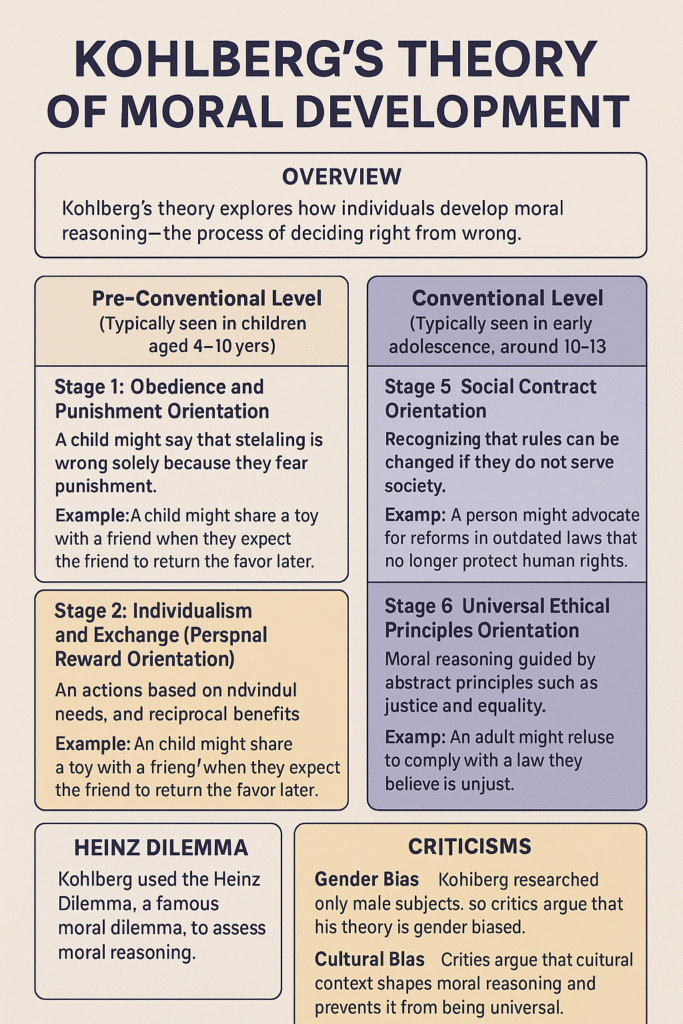
Overview:
Kohlberg’s theory explores how individuals develop moral reasoning—the process of deciding right from wrong. Jean Piaget’s work on cognitive development inspired his ideas. However, because Kohlberg studied only male subjects, critics like his former student Carol Gilligan argue that he created a gender-biased theory that fails to address a feminist perspective on morality.
Key Concepts and Stages
Kohlberg proposed that moral development progresses through three main levels, each containing two stages. These levels reflect increasing sophistication in moral reasoning.
1. Pre-Conventional Level (Typically seen in children aged 4-10 years)
- Stage 1: Obedience and Punishment Orientation
- Description: At this stage, moral reasoning is based on avoiding punishment. Children see right and wrong as what authority figures forbid or reward.
- Example: A child might say that stealing is wrong solely because they fear punished.
- Description: At this stage, moral reasoning is based on avoiding punishment. Children see right and wrong as what authority figures forbid or reward.
- Stage 2: Individualism and Exchange (Personal Reward Orientation)
- Description: Here, the focus is on individual needs and reciprocal benefits. People guide their actions based on personal rewards and a “tit-for-tat” mentality.
- Example: A child might share a toy with a friend when they expect the friend to return the favour later.
- Description: Here, the focus is on individual needs and reciprocal benefits. People guide their actions based on personal rewards and a “tit-for-tat” mentality.
2. Conventional Level (Typically seen in early adolescence, around 10-13 years)
- Stage 3: Interpersonal Relationship (Good Boy/Nice Girl Orientation)
- Description: Moral reasoning is driven by the desire to gain approval from others. This stage emphasizes being seen as a “good” person by adhering to social norms and expectations.
- Example: An adolescent might refrain from lying because they want to be seen as trustworthy and kind by peers and family.
- Description: Moral reasoning is driven by the desire to gain approval from others. This stage emphasizes being seen as a “good” person by adhering to social norms and expectations.
- Stage 4: Maintaining Social Order (Law and Order Orientation)
- Description: At this stage, the individual recognizes the importance of rules and laws to maintain social order. People define morality by following societal rules and respecting authority.
- Example: A teenager might obey school rules and laws even if they disagree, believing that the rules are necessary for the well-being of society.
- Description: At this stage, the individual recognizes the importance of rules and laws to maintain social order. People define morality by following societal rules and respecting authority.
3. Post-Conventional Level (Typically emerging in older adolescents and adults, around 13 and above)
- Stage 5: Social Contract Orientation
- Description: Individuals begin to see laws as flexible instruments that should promote the common good. They recognize that society can change rules when those rules no longer serve the common good.
- Example: A person might advocate for reforms in outdated laws that no longer protect human rights, viewing these laws as social contracts rather than absolute commands.
- Description: Individuals begin to see laws as flexible instruments that should promote the common good. They recognize that society can change rules when those rules no longer serve the common good.
- Stage 6: Universal Ethical Principles Orientation
- Description: People base their moral reasoning on abstract principles such as justice, equality, and respect for human dignity. These principles are self-chosen and serve as a basis for evaluating laws and social norms.
- Example: An adult might refuse to comply with a law that they believe is unjust, even at personal risk, because it conflicts with their deeply held ethical beliefs.
- Description: People base their moral reasoning on abstract principles such as justice, equality, and respect for human dignity. These principles are self-chosen and serve as a basis for evaluating laws and social norms.
The Heinz Dilemma
- Description:
Kohlberg used the Heinz Dilemma, a famous moral dilemma, to assess moral reasoning. In this scenario, Heinz must decide whether to steal medicine to save his dying wife despite the law against theft. This dilemma challenges individuals to weigh personal ethics against legal rules. - Purpose:
Researchers use it to determine an individual’s stage of moral development by examining how they justify their decisions about right and wrong.
Criticisms of Kohlberg’s Theory
- Gender Bias:
Because Kohlberg researched only male subjects, critics therefore label his theory as gender-biased.. Moreover, Carol Gilligan, one of his students, argued that his approach overlooks aspects of moral reasoning more common among females, such as care ethics and relational approaches. - Cultural Limitations:
The theory is based on hypothetical situations that might not be applicable or interpreted the same way in every culture. Critics argue that cultural context shapes moral reasoning and prevents it from being universal. - Reliance on Hypothetical Situations:
The use of abstract dilemmas like the Heinz Dilemma can sometimes fail to capture the complexities of moral decision-making in real-life situations.
Glossary of Key Terms
| Term | Definition |
| Moral Reasoning | The process of determining right from wrong in complex or ethical situations. |
| Pre-Conventional Level | The first level of moral development where judgments are based on avoiding punishment and seeking personal rewards. |
| Conventional Level | The second level, where moral judgments are influenced by social approval and adherence to rules. |
| Post-Conventional Level | The highest level, where moral reasoning is based on abstract principles and the recognition of universal ethical values. |
| Obedience and Punishment Orientation | Stage 1 of the Pre-Conventional Level focused on avoiding punishment. |
| Individualism and Exchange Orientation | Stage 2 of the Pre-Conventional Level where actions are guided by personal benefit and reciprocity. |
| Good Boy/Nice Girl Orientation | Stage 3 of the Conventional Level where behavior is motivated by a desire for approval. |
| Law and Order Orientation | Stage 4 of the Conventional Level emphasizing adherence to rules and the importance of societal order. |
| Social Contract Orientation | Stage 5 of the Post-Conventional Level where laws are seen as flexible agreements meant to serve the common good. |
| Universal Ethical Principles Orientation | Stage 6 of the Post-Conventional Level where moral reasoning is based on self-chosen ethical principles. |
| Heinz Dilemma | A moral dilemma used by Kohlberg to assess the level of moral reasoning, involving a choice between stealing medicine to save a life or obeying the law. |
| Gender Bias | A criticism that a theory or study disproportionately reflects one gender’s experiences or perspectives. |
| Feministic Perspective | An approach that considers the experiences, values, and ethics traditionally associated with women, often emphasizing care and relational aspects. |