
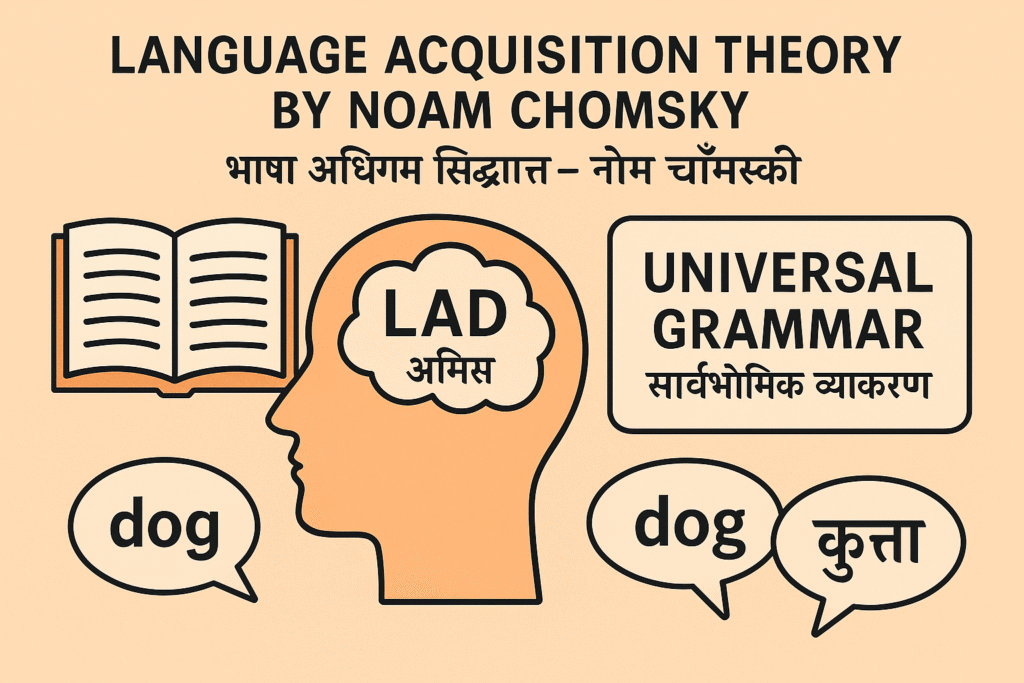
Language Acquisition Theory by Noam Chomsky is widely recognised as the most influential linguist of the late twentieth century. His work transformed the study of language and offered a new explanation for how children acquire complex linguistic abilities so quickly. According to Chomsky, humans are not blank slates. Instead, we are born with an innate capacity for language, which forms the core of his theory.
Language as an Innate Faculty
Chomsky proposes that all humans are born with a mental blueprint for language. He calls this built-in system Universal Grammar. Because of this universal structure, children do not start from zero. Rather, they come equipped with rules and principles that underlie all human languages. As a result, every child can learn any language they are exposed to.
To illustrate this, Chomsky argues that if a Martian linguist visited Earth, they might conclude that human beings speak variations of a single language. Despite thousands of languages existing across the world, all follow similar patterns, which point to a shared underlying grammar.
Children Are Not Passive Learners
Children do far more than copy what they hear. Instead, they analyse language, notice patterns, and generate new sentences. This ability allows them to produce phrases they have never heard before. Consequently, Chomsky rejects the behaviourist view that children learn language through imitation and reinforcement.
For example, toddlers naturally shift from saying “I play” to “I’m playing” without formal instruction. They deduce the rule of adding “-ing” to show continuous action. Such rapid progress is difficult to explain without assuming an inborn linguistic system.
Universal Grammar and Word Order
Universal Grammar does not contain every rule of every language. Instead, it offers a set of possible structures. Word order is one of these. Languages across the world typically follow patterns such as:
– SVO (Subject + Verb + Object), used by English, French, and Vietnamese
– SOV, found in Japanese, Korean, and Tibetan
– VSO, used by Welsh
– VOS, used by Malagasy
Although languages like Latin appear to allow free word order, SOV remains very common. In contrast, patterns such as OSV are extremely rare. A familiar example appears in the speech of Yoda from Star Wars: “Strong with the Force you are.”
Setting the Parameters
Language rules are incredibly complex. Yet children learn them effortlessly. To explain this, Chomsky introduced the idea of parameter setting. When children hear their parents speak, they unconsciously determine which type of language they are learning. Then they adjust their built-in grammar to match the language they hear.
It is as if children are born with several hypotheses about how language might work. Exposure to real speech helps them select the correct option.
The Language Acquisition Device (LAD)
According to Chomsky, children are equipped with a special mental mechanism called the Language Acquisition Device. The LAD contains the tools needed to interpret linguistic input. It helps children recognise categories like nouns and verbs and understand how these categories can be arranged in a sentence. Importantly, adults do not directly teach these structures. Children discover them through the LAD’s internal processing.
Summary
Chomsky’s theory reshaped our understanding of language development. His major ideas include:
– Some aspects of language ability are innate.
– A Universal Grammar forms the foundation for all human languages.
– Children possess a Language Acquisition Device that enables rapid and natural language learning.
CTET Application-Based MCQs: Chomsky’s Language Acquisition Theory
1. A child starts forming grammatically correct sentences without formal teaching. This supports—
A. Behaviorist theory
B. Trial-and-error learning
C. Social learning theory
D. Chomsky’s innate Language Acquisition Device (Correct)
2. A student uses correct verb forms even without hearing them before. Which concept explains this?
A. Reinforcement
B. Overgeneralization
C. Operant conditioning
D. Innate grammar rules (Correct)
3. A 3-year-old says “goed” instead of “went.” This error shows—
A. Correct imitation
B. Lack of practice
C. Memorized grammar
D. Internal grammar rules applied naturally (Correct)
4. A teacher notices that children learn language at similar ages across cultures. This supports—
A. Language as habit
B. Learning through rewards
C. Cultural imitation
D. Universal Grammar (Correct)
5. A child creates new sentences they have never heard before. This ability results from—
A. Stimulus–response
B. Habit formation
C. Imitation
D. Innate generative grammar (Correct)
6. When a child learns language without being formally taught, it indicates—
A. Reinforcement-based learning
B. LAD working automatically (Correct)
C. Imitation of elders
D. Motor skills
7. A teacher encourages natural conversation instead of drills. This aligns with—
A. Strict grammar teaching
B. Rote memorization
C. Translation method
D. Chomsky’s view of natural language acquisition (Correct)
8. A child learns the rules of grammar faster than vocabulary. This shows—
A. Vocabulary-based learning
B. Punishment–reward principles
C. External motivation
D. Innate grammatical competence (Correct)
9. A student understands sentence structure even with limited exposure. This supports—
A. Behaviorist model
B. Trial-and-error
C. Conditioning
D. Universal Grammar (Correct)
10. A teacher provides rich language interaction, believing children already have an internal language capacity. This reflects—
A. Thorndike’s theory
B. Skinner’s reinforcement
C. Piaget’s schema
D. Chomsky’s LAD approach (Correct)
11. A child says “mouses” instead of “mice.” This shows—
A. Poor listening
B. Wrong practice
C. Overlearning
D. Rule-based language application (Correct)
12. A teacher asks open-ended questions to activate children’s natural grammar formation. This follows—
A. Grammar-translation
B. Direct method
C. Audio-lingual method
D. Innate language-learning principles (Correct)
13. A child understands complex sentences but struggles to express them. According to Chomsky, this indicates—
A. Limited intelligence
B. Poor imitation skill
C. Lack of reinforcement
D. Difference between competence and performance (Correct)
14. A child in any country begins to babble at almost the same age. This universal pattern supports—
A. Habit formation
B. Skill training
C. Reward-based learning
D. Biological basis of language (Correct)
15. A teacher allows free expression because children naturally generate sentences through internal rules. This aligns with—
A. Behaviorism
B. Conditioning theory
C. Functional grammar
D. Chomsky’s generative grammar (Correct)
प्राचीन भारत में शिक्षा (विस्तृत नोट्स – B.Ed CCSU)
भारत में शिक्षा का विकास भारत में शिक्षा का विकास अत्यंत प्राचीन काल से होता…

Education in Ancient India: Objectives, Features, and Significance
Education in Ancient India (Easy & Exam-Ready Notes for B.Ed Students) Introduction Education in ancient…
CTET 2026 Answer Key Released – Download Paper 1 & Paper 2 Answer Key
The Central Board of Secondary Education (CBSE) has released the CTET 2026 provisional answer key…

BPSC TRE-4: 46,595 शिक्षकों की भर्ती, 22 से 27 सितंबर तक होगी परीक्षा
बिहार में शिक्षक भर्ती की तैयारी कर रहे अभ्यर्थियों के लिए एक बड़ी और निर्णायक…

BPSC School Teacher TRE 4.0 Recruitment 2026: Apply Online for 44,000+ Teacher Posts
The Bihar Public Service Commission (BPSC) has officially released the short notice for School Teacher…

Pingback: Learning and Acquisition - Exam Affinity