
Language Skills(LSRW) and Their Importance in Language Teaching
Introduction
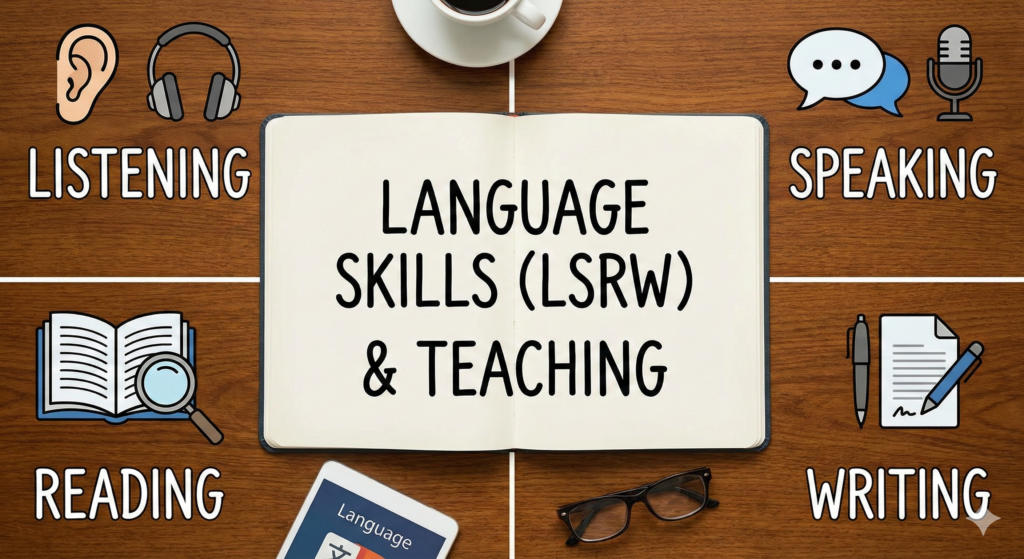
Language teaching is not limited to learning words or grammar rules. Instead, it is a structured process that focuses on developing essential communication abilities. The foundation of language learning lies in four basic language skills(LSRW)—Listening, Speaking, Reading, and Writing, commonly known as LSRW skills. These skills work together to help learners understand and use a language effectively in real-life situations.
What Are Basic Language Skills(LSRW)?
The teaching of a language involves the systematic development of four fundamental skills:
- Listening
- Speaking
- Reading
- Writing
These skills should be developed in a sequential order and through an integrated approach. When taught together, they reinforce one another and lead to better language acquisition.
Classification of Language Skills
Language skills can be broadly classified based on the mode of communication and the direction of communication.
Based on Mode of Communication
- Oral Skills: Listening and Speaking
- Written Skills: Reading and Writing
Based on Direction of Communication

- Receptive Skills: Listening and Reading
- Expressive (Productive) Skills: Speaking and Writing
Receptive skills help learners understand language input, while expressive skills enable them to produce language output.
Importance of Developing Language Skills(LSRW) in Sequence
Language learning becomes more effective when listening, speaking, reading writing and listening, are taught in a natural order. Generally, learners first develop listening, followed by speaking, then reading, and finally writing. This sequence mirrors how language is acquired naturally and supports deeper comprehension.
Primary and Reinforcement Skills
In language teaching:
- Listening and Speaking are considered primary skills because they form the base of communication.
- Reading and Writing are known as reinforcement skills, as they strengthen language accuracy and structure.
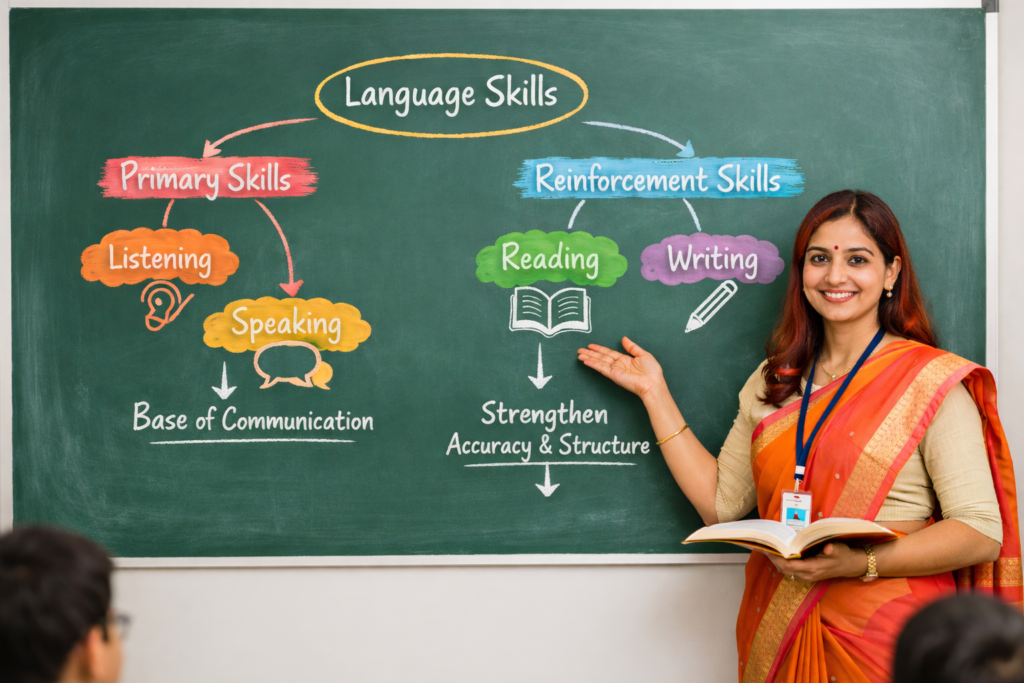
Both sets of skills must be given equal importance to ensure balanced language development.
Role of Integrated Skill Development
Language skills should never be taught in isolation. An integrated approach allows learners to connect listening with speaking and reading with writing. This method improves both linguistic competence and psychological confidence among learners.
Thinking Skills and Language Learning
Along with language skills, thinking skills play a crucial role in learning. Thinking involves imagination, language use, concept formation, and reasoning. When learners think critically, they understand language more deeply and use it more effectively.
Basic Interpersonal Communication Skills (BICS)
Basic Interpersonal Communication Skills refer to the language abilities required for daily social interactions. These skills help learners communicate in face-to-face situations, such as conversations, discussions, and informal exchanges. Developing BICS is essential for building confidence in real-world communication.
Why Language Skills Matter in Education
Strong language skills:
- Improve communication ability
- Enhance academic performance
- Support social interaction
- Build confidence and critical thinking
Therefore, effective language teaching must focus on balanced, integrated, and continuous skill development.
Conclusion
The development of Listening, Speaking, Reading, and Writing skills forms the backbone of language education. When taught in sequence and integrated thoughtfully, these skills not only improve linguistic ability but also enhance thinking, confidence, and interpersonal communication. As a result, learners become competent users of language in both academic and social contexts.
Recommended Reading
To understand language skills and pedagogy in more depth, readers can explore the following trusted resources:
- National Council of Educational Research and Training (NCERT) English pedagogy guidelines
https://ncert.nic.in - British Council resources on language skills and communication
https://learnenglish.britishcouncil.org - UNESCO reports on language education and communication skills
https://www.unesco.org
CTET English Pedagogy Notes
https://examaffinity.in/articles/
- प्राचीन भारत में शिक्षा (विस्तृत नोट्स – B.Ed CCSU)
- Education in Ancient India: Objectives, Features, and Significance

- CTET 2026 Answer Key Released – Download Paper 1 & Paper 2 Answer Key
- BPSC TRE-4: 46,595 शिक्षकों की भर्ती, 22 से 27 सितंबर तक होगी परीक्षा
- BPSC School Teacher TRE 4.0 Recruitment 2026: Apply Online for 44,000+ Teacher Posts

Pingback: Pedagogy of English Language – (CTET English Pedagogy)