Methods of Teaching English
A method of teaching is concerned with how to teach rather than what to teach. An effective teaching method helps the teacher achieve the learning objectives planned for students. Therefore, a teaching method acts as a tool that supports teachers in delivering lessons successfully.
A good method of teaching English must include the following elements:
- Selection and gradation of linguistic material
- Techniques of presentation and practice by learners
- Clear definition of aims and objectives
- Suitable classroom strategies to achieve learning outcomes
Before choosing a method, the teacher should clearly define the aims of teaching and then select methods that help achieve these aims.
Types of Teaching Methods in English
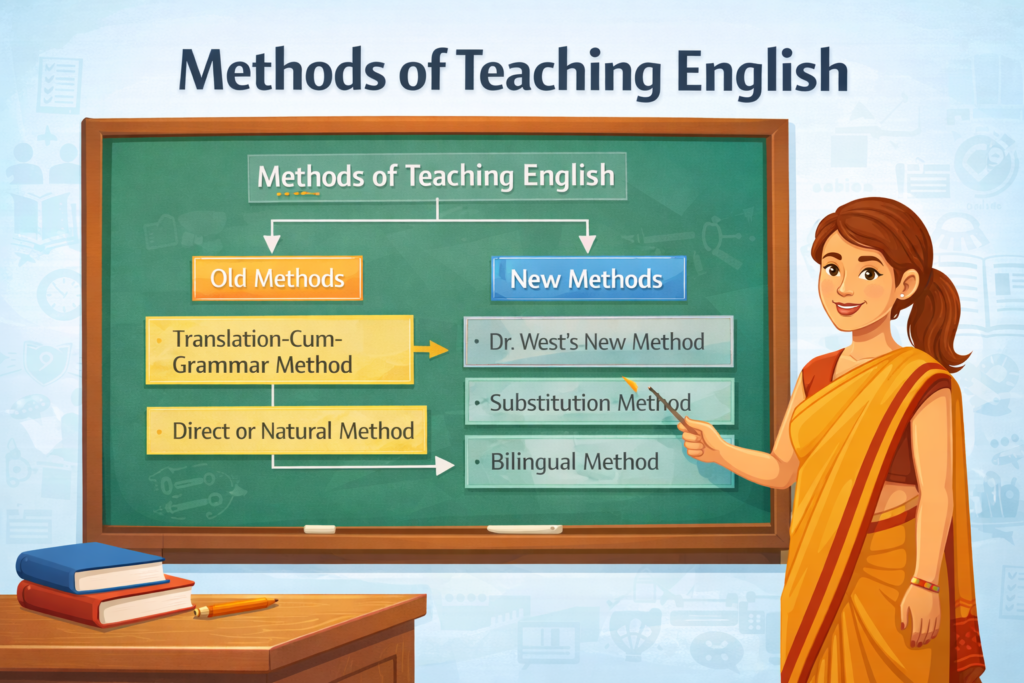
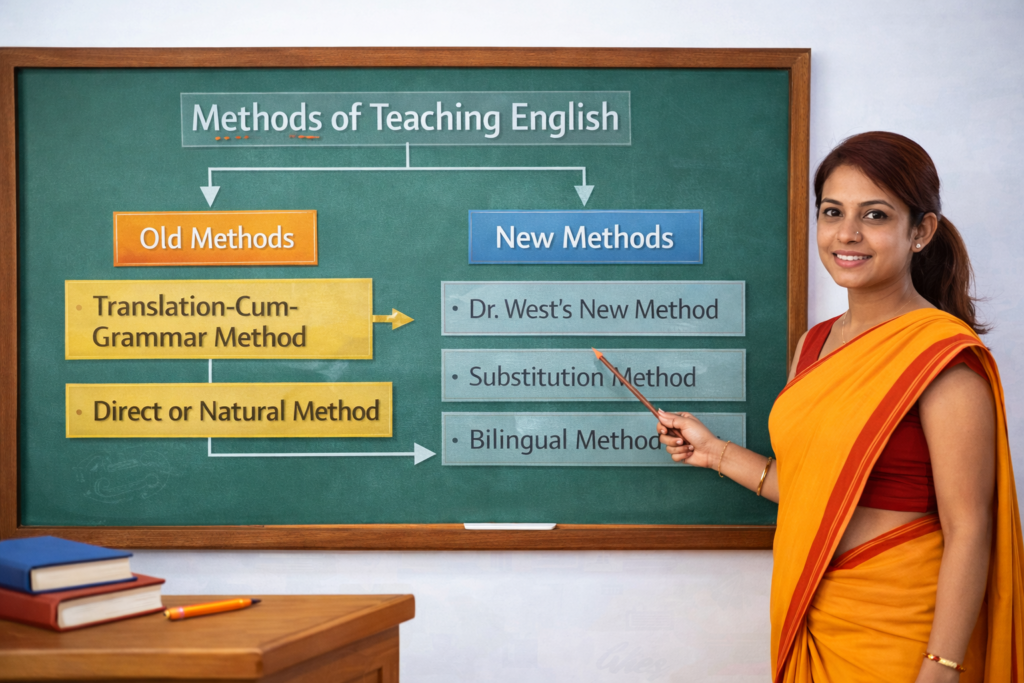
The methods used for teaching English are broadly divided into two categories:
- Old Methods of Teaching English
- New Methods of Teaching English
Old Methods of Teaching English
Translation-Cum-Grammar Method
The Translation-Cum-Grammar Method, also known as the Classical Method, is one of the oldest methods of teaching English. It was introduced in India during British rule. This method is based more on philosophical principles than psychological principles.
Its main beliefs are:
- Grammar is the soul of a language
- A foreign language can be learned easily through translation
In this method, the textbook plays a central role. It provides reading material, graded vocabulary, and fixed grammar rules. Each lesson introduces new words, which are explained by translating them into the mother tongue.
Advantages of the Translation-Cum-Grammar Method
This method is easy and convenient for teachers. It does not require teaching aids, making it suitable for overcrowded classrooms. Grammar rules can be clearly explained using the native language. Students from Hindi-medium backgrounds find this method comfortable. It also helps learners develop translation skills and quickly build vocabulary. The method follows the principle of moving from known to unknown.
Disadvantages of the Translation-Cum-Grammar Method
This method ignores oral work and communication. The focus remains on the mother tongue instead of the target language. Students do not develop speaking ability or correct pronunciation. Thinking in English is discouraged, and learning becomes rule-based rather than skill-based. As a result, students often memorize instead of understanding.
Direct or Natural Method
The Direct Method, also called the Natural Method, developed as a reaction against the Translation-Cum-Grammar Method. It aims to establish a direct connection between thought, expression, experience, and language.
This method teaches English directly without using the mother tongue. Students learn to think and speak in English naturally, similar to how they learn their first language.
Features of the Direct Method
According to H. E. Palmer, the main features of the direct method are:
- No use of translation
- Meanings taught through objects, situations, and actions
- Oral teaching before reading and writing
- Grammar taught inductively
Aims of the Direct Method
The direct method aims to develop thinking in English. It helps learners express ideas without using their mother tongue. It also improves pronunciation and builds natural language understanding.
Advantages of the Direct Method
This method is activity-based and interesting. It helps students develop fluency in speaking and clarity in writing. Teaching is supported by pictures, models, demonstrations, and real-life situations. It provides learners with real command over the English language and strengthens comprehension.
New Methods of Teaching English
Dr. West’s New Method
Dr. M. P. West introduced this method, mainly for Indian learners. He believed that most Indian students require passive knowledge of English, especially reading skills.
Importance of Reading in Dr. West’s Method
Dr. West emphasized reading because Indian students have limited exposure to spoken English. Reading allows self-education, improves understanding of grammar structure, and supports speaking and writing. According to him, reading is easier to acquire than speaking and has high educational value.
Substitution Method
The Substitution Method, developed by H. E. Palmer, supplements the direct method. It helps students learn sentence patterns by replacing words within a fixed structure.
Types of Substitution
Simple Substitution
Words are fixed and cannot be interchanged freely.
Compound Substitution
Certain words can be interchanged within a sentence.
Grammatical Substitution
Grammar is taught by substituting correct forms, such as am, is, are with appropriate pronouns.
Bilingual Method
The Bilingual Method, developed by C. J. Dodson, acts as a bridge between the grammar-translation and direct methods. In this method, the mother tongue is used only to explain meanings, while practice occurs in English.
Merits of the Bilingual Method
This method emphasizes speech practice and saves time and effort. It does not require trained teachers or audio-visual aids. Students often learn more effectively through this balanced approach.
Methods of Teaching Grammar
Grammar is the scientific study of language structure.
- Traditional Method – Grammar taught through memorization
- Grammar Translation Method – Grammar explained using the mother tongue
- Inductive Method – Rules derived from examples
- Deductive Method – Rules explained first, followed by examples
- Situational Method – Grammar taught through real situations
- Structural Approach – Focus on language patterns and structures
Conclusion
Different methods of teaching English serve different learning needs. No single method is perfect. An effective teacher selects methods based on learners’ needs, classroom conditions, and learning objectives. A balanced and flexible approach produces the best results in English language teaching.
Application-Based CTET MCQs: Methods of Teaching English
Set 1: Questions 1-5
1. Mr. Verma, an English teacher in a Hindi medium school, relies heavily on the textbook. He introduces every new lesson by first translating difficult words into Hindi, then explaining the grammatical rules found in the text using Hindi. He rarely asks students to speak in English. According to the provided text, what is a likely long-term outcome for his students?
View Answer Code
Correct Answer: b)
Explanation: Mr. Verma is using the Translation-Cum-Grammar Method. The text lists as disadvantages that “No oral work or communication occurs in the classroom” and “No speaking in the target language is encouraged, with the primary focus on reading.” While it helps develop translation skills and vocabulary comprehension, it neglects speaking ability.
2. A teacher enters the classroom and wants to teach the verb “to jump.” Instead of saying “jump means कूदना (koodna)” in the students’ mother tongue, she physically jumps several times and says, “I am jumping.” She then encourages students to do the same action while repeating the English phrase. Which method is she employing?
View Answer Code
Correct Answer: c)
Explanation: The teacher is using the Direct (or Natural) Method. The text states that essential features of this method include excluding translation entirely and teaching the meanings of words through “objects, natural context, and appropriate action.”
3. A curriculum designer argues that for the majority of students in rural India, the primary goal of English education should be to enable them to read information, scientific texts, and literature independently later in life, rather than focusing on enforcing fluent speech which they may rarely use. This perspective aligns best with the philosophy of:
View Answer Code
Correct Answer: b)
Explanation: Dr. West’s New Method emphasized developing reading ability because Indian children often have limited opportunities to speak English. He argued that reading has a high “surrender value,” meaning students can continue self-education through reading after leaving school.
4. To help students internalize the structure of present continuous tense without explicitly teaching the rule first, a teacher writes a framework on the board using “I am,” “He/She is,” and “We/They are” followed by the phrase “playing cricket.” She then asks students to create different sentences using this framework by changing the variable parts. What technique is she using?
View Answer Code
Correct Answer: c)
Explanation: This is an example of a Grammatical Substitution Table, as described in the text under the Substitution Method (adopted by H.E. Palmer). It is used to teach grammatical points through pattern multiplication.
5. Mrs. Gupta is teaching a complex English poem. She reads a stanza in English, and then uses the students’ mother tongue briefly to explain the abstract ideas and difficult phrases to ensure clarity. Immediately after, she switches back to English for questioning and discussing the poem’s themes. Which method is she practising?
View Answer Code
Correct Answer: b)
Explanation: This approach defines the Bilingual Method, developed by Prof. C.J. Dodson. It serves as a “midway point” where the mother tongue is used specifically to explain meanings of words, phrases, or idioms to ensure understanding, while still retaining the advantages of direct practice in English.
Set 2: Questions 6-10
6. A teacher begins a grammar lesson by writing the rule on the blackboard: “A Proper Noun is the name of a particular person, place, or thing.” After students copy the definition, she provides examples like “Delhi,” “Ravi,” and “Taj Mahal.” According to the text on Methods of Teaching Grammar, which method is she using?
View Answer Code
Correct Answer: c)
Explanation: The text defines the Deductive Method for teaching grammar as: “The teacher explains grammar rules first, then provides examples.” This is exactly what the teacher did in the scenario.
7. An English teacher insists that grammar should not be taught as a separate set of rules to be memorized. Instead, she believes grammar should be acquired naturally through extensive listening and speaking practice in the target language, without ever using the mother tongue for explanations. Which method’s principles regarding grammar is she following?
View Answer Code
Correct Answer: c)
Explanation: The text states that under the Direct Method, “Grammar, when taught, is presented inductively.” The method emphasizes establishing a direct bond between thought and expression in the target language, excluding translation, and learning naturally.
8. A school principal wants to adopt a new English teaching method that saves teachers’ time and labor in explaining difficult concepts, does not require highly specialized training or expensive audio-visual aids, yet still emphasizes speech practice more than the traditional method. Based on the provided text, which method should the principal choose?
View Answer Code
Correct Answer: d)
Explanation: The text lists the merits of the Bilingual Method: it “emphasizes speech practice,” “Saves teachers’ time, labor, and energy,” “Does not require trained teachers,” and “Audio-visual aids are not essential.” This matches the principal’s requirements.
9. During a class observation, an inspector notices that the students can recite grammar rules perfectly and translate Hindi sentences into English accurately in writing. However, when the inspector asks them simple questions in English, they fumble and cannot respond orally. The teacher is most likely using which method exclusively?
View Answer Code
Correct Answer: b)
Explanation: This scenario highlights the major disadvantages of the Translation-Cum-Grammar Method listed in the text: students develop translation skills and learn grammar rules, but “No oral work or communication occurs” and it “doesn’t aid students in learning the correct pronunciation” or fluency.
- प्राचीन भारत में शिक्षा (विस्तृत नोट्स – B.Ed CCSU)
- Education in Ancient India: Objectives, Features, and Significance

- CTET 2026 Answer Key Released – Download Paper 1 & Paper 2 Answer Key
- BPSC TRE-4: 46,595 शिक्षकों की भर्ती, 22 से 27 सितंबर तक होगी परीक्षा
- BPSC School Teacher TRE 4.0 Recruitment 2026: Apply Online for 44,000+ Teacher Posts