
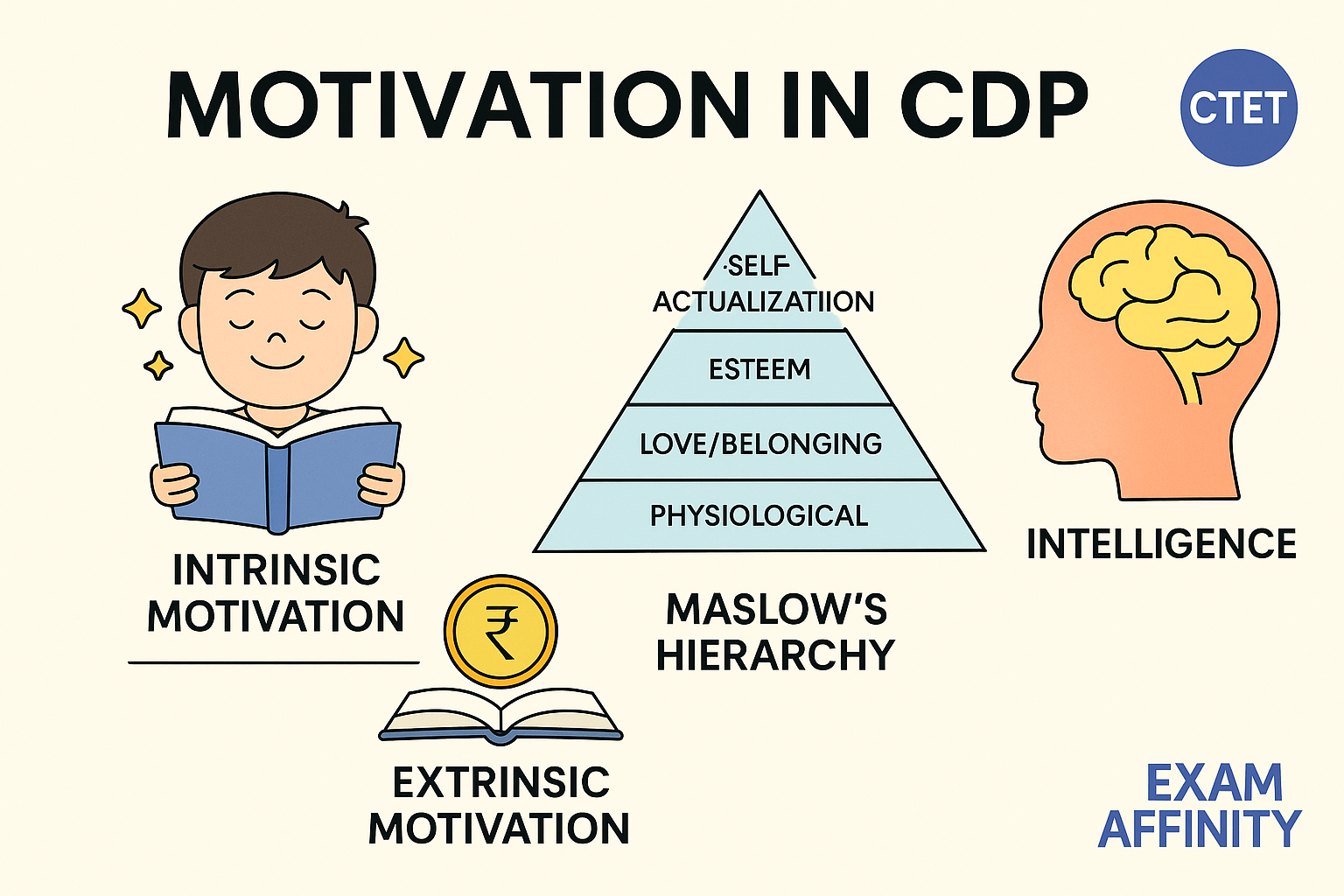
Motivation in CDP is an important topic for CTET and other teaching exams. It explains why learners behave in certain ways and how teachers can guide them. In this article, you will learn the types of motivation, Maslow’s hierarchy of needs, Skinner’s view, the cycle of motivation, intelligence, IQ formula, and the history of IQ tests. Each concept is explained in simple language with examples so that you can revise quickly.
Definition:
Motivation is a psychological process that influences the direction, persistence, and vigor of goal-directed behavior.
Types of Motivation (अभिप्रेरणा के प्रकार)
- Intrinsic Motivation (आंतरिक अभिप्रेरणा) – Motivation driven by internal factors, such as personal satisfaction, curiosity, and a sense of achievement.
- Example: A student studies because they enjoy learning.
- Extrinsic Motivation (बाह्य अभिप्रेरणा) – Motivation driven by external factors, such as rewards, recognition, or fear of punishment.
- Example: A student studies to earn good grades.
Locus of Control (नियंत्रण का स्थान)
- Internal Locus of Control (आंतरिक नियंत्रण) – The belief that success or failure is determined by one’s efforts and abilities.
- External Locus of Control (बाह्य नियंत्रण) – The belief that success or failure is influenced by external forces like luck or fate.
B.F. Skinner’s View on Motivation
- According to B.F. Skinner, motivation is like a National Highway—the better the motivation, the higher the success rate.
- Reward and reinforcement play a significant role in motivation.
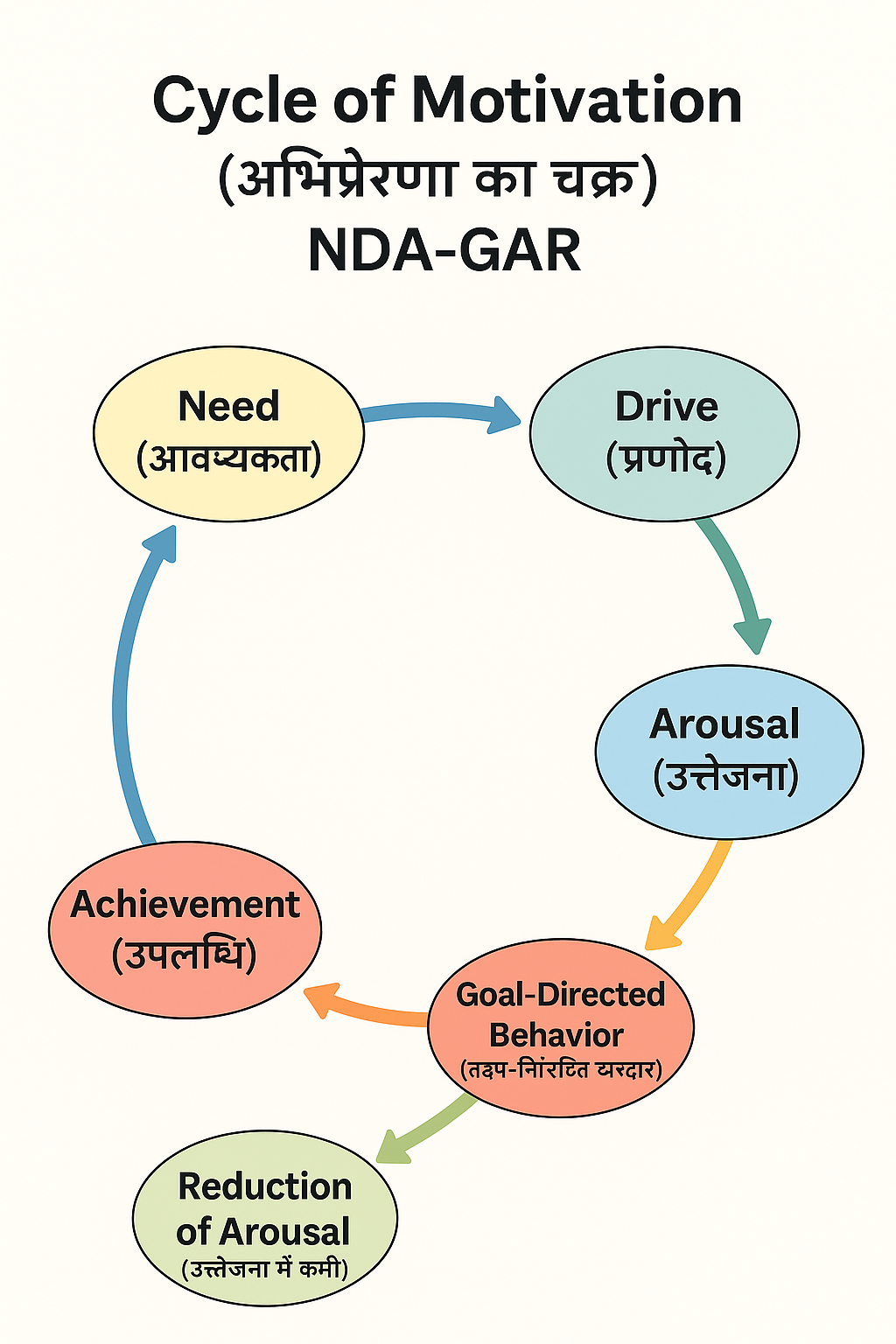
Cycle of Motivation (अभिप्रेरणा का चक्र) – NDA-GAR
- Need (आवश्यकता) – A requirement or deficiency that activates behavior.
- Drive (प्रणोद) – A psychological state of tension that motivates action.
- Arousal (उत्तेजना) – The level of alertness or activation in response to need.
- Goal-Directed Behavior (लक्ष्य-निर्देशित व्यवहार) – Actions taken to fulfill the need.
- Achievement (उपलब्धि) – The outcome or success achieved.
- Reduction of Arousal (उत्तेजना में कमी) – The satisfaction or relief felt after fulfilling the need.
Maslow’s Hierarchy of Needs (मैस्लो की आवश्यकता अनुक्रम सिद्धांत)
American psychologist Abraham Maslow proposed a 5-level hierarchy of human needs:
- Physiological Needs (शारीरिक आवश्यकताएँ)
- Basic survival needs: Food, water, air, shelter, sleep, clothing, reproduction
- Example: Mid-Day Meal Scheme (1995) ensures food for school children.
- Safety Needs (सुरक्षात्मक आवश्यकताएँ)
- Personal security, employment, health, financial stability
- Example: Job security and health insurance contribute to motivation.
- Love and Belonging (प्रेम व अपनत्व की आवश्यकताएँ)
- Friendship, family, relationships, social connection
- Example: A student feels motivated in a supportive classroom environment.
- Esteem Needs (सम्मान की आवश्यकताएँ)
- Self-esteem, confidence, recognition, respect
- Example: A teacher praises students for their hard work.
- Self-Actualization (आत्म-सिद्धि)
- The desire to achieve one’s full potential
- Example: A scientist invents something for the betterment of humanity.
Intelligence (बुद्धि)
Definition:
Intelligence is the ability to reason, adapt, and learn from experience. It is influenced by heredity and environment.
Origin of the Word “Intelligence”
- Derived from the Latin word “Intelligere”, meaning “to understand”.
IQ (Intelligence Quotient) – बुद्धि लब्धि
Formula:
IQ = (Mental Age / Chronological Age) × 100
Example Calculation:
If a child has a Chronological Age of 10 years but a Mental Age of 12 years, then:
IQ = (12 / 10) × 100 = 120
This means the child’s intelligence level is above average for their actual age.
IQ Classification (बुद्धि का वर्गीकरण) – Stanford-Binet Scale
| IQ Score | Category (वर्गीकरण) |
| Above 140 | Genius (प्रतिभाशाली) |
| 120-139 | Very Superior (अत्यधिक श्रेष्ठ) |
| 110-119 | Superior (श्रेष्ठ) |
| 90-109 | Average (औसत) |
| 80-89 | Dull (कमजोर) |
| 70-79 | Borderline Deficiency (सीमांत दुर्बलता) |
| 50-69 | Moron (मूर्ख) |
| 20-49 | Imbecile (मूर्खतम) |
| Below 20 | Idiot (मूर्ख) |
History of IQ Tests
- 1905: First intelligence test by Alfred Binet & Theodore Simon
- 1908: Concept of Mental Age by Alfred Binet
- 1912: Concept of IQ (Intelligence Quotient) by William Stern
Related Articles (Recommended for You)
- Child Development & Pedagogy Notes
- CTET Previous Year Papers CTET December 2024 Question Paper with Answer Key PDF – Free Download for Paper 1 and Paper 2
- Learning Theories in CDP
- Intelligence and Creativity Notes