
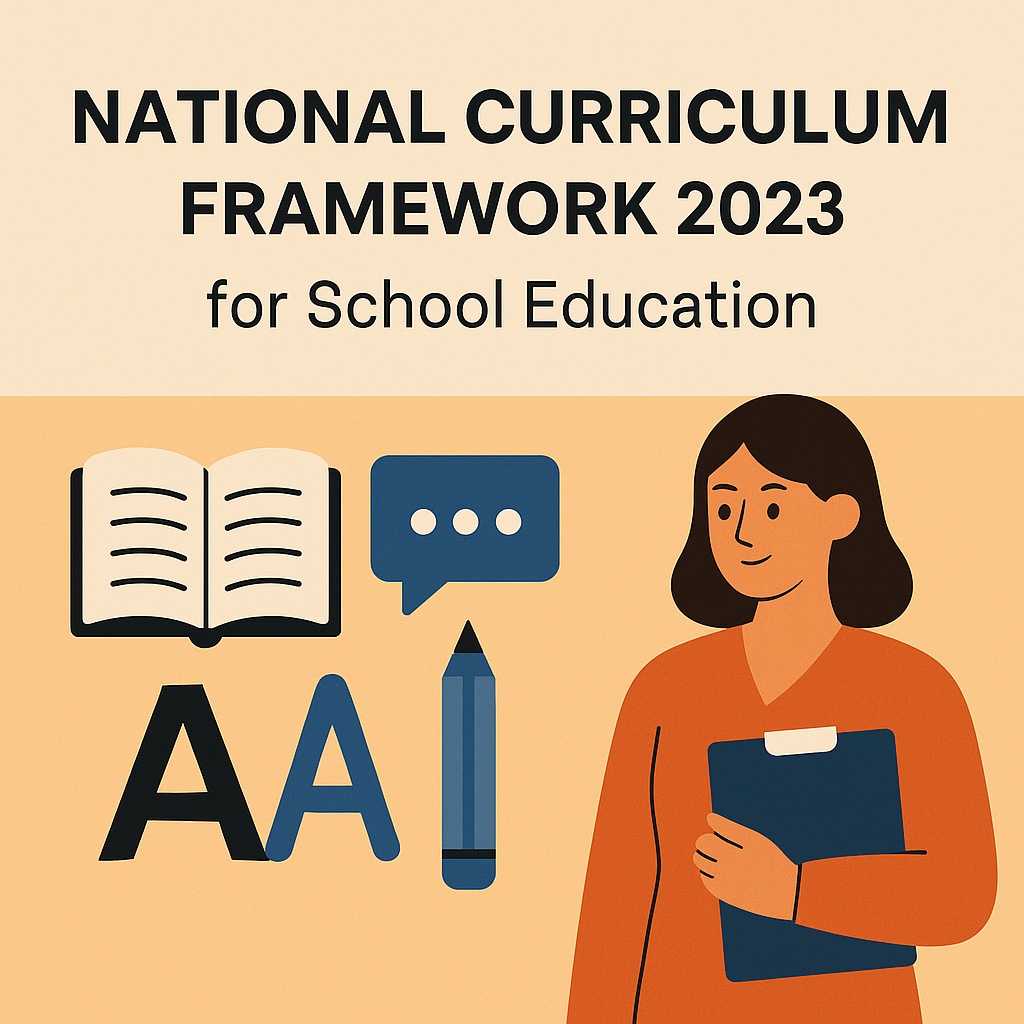
1. Introduction to National Curriculum Framework 2023 – NCF 2023
NCF 2023 defines the educational objectives, curriculum areas, and stages of school education in India. It describes learning standards, teaching methods, learning materials, and assessments for all school stages. It covers foundational learning, languages, mathematics, science, social science, arts, physical education, vocational education, and interdisciplinary areas.
Part C of the document addresses cross-cutting themes such as values, inclusion, ICT, guidance, environment, and India’s social and educational inertia.
NCF 2023 emphasizes building a supportive school culture by ensuring appropriate conditions, balanced student–teacher ratios, and empowered teachers and administrators.
2. Purpose and Scope of NCF 2023
NCF 2023 acts as India’s educational framework and guideline document.
It provides a clear roadmap for curriculum development, teaching practices, and educational reforms.
It guides teachers, policymakers, and stakeholders in shaping school education.
The framework includes modern teaching approaches, subject-specific guidelines, and strategies for holistic and high-quality education.
3. National Curriculum Framework 2023 – Observations and Key Insights
NCF 2023 aligns directly with NEP 2020 and aims to bring positive changes in school education.
It addresses the educational needs of learners aged 3 to 18 across diverse institutions.
The framework implements the 5+3+3+4 structure of school education and lays down principles for curriculum development.
4. School Stages Under NCF 2023 (5+3+3+4 Structure)
Foundational Stage (Ages 3–8)
- 3 years: Anganwadi / pre-school
- 2 years: Grades 1–2
Preparatory Stage (Ages 8–11)
- Grades 3–5
Middle Stage (Ages 11–14)
- Grades 6–8
Secondary Stage (Ages 14–18)
- Grades 9–12 (two parts: 9–10 and 11–12)
5. Three-Language Formula (NEP 2020)
NEP 2020 requires students to learn three languages:
- L1: Mother tongue or home language
- L2: Any other language (including English)
- L3: A different third language
NCF 2023 sets literacy milestones:
- By Grade 3: Students become independent readers and writers in L1
- By Grade 6: Students achieve literacy in L2
- By Grade 9: Students achieve literacy in L3
The framework emphasizes reading, writing, communication skills, and appreciation of India’s literary heritage.
6. Reforms in Board Examinations
NCF 2023 identifies problems in existing board exams, such as excessive rote learning and weak reliability.
To reform the system, NCF 2023:
- Aligns exams with competency-based learning
- Introduces board exams twice a year
- Separates exam design from curriculum development
- Trains exam developers rigorously
- Implements specialized assessment for arts, vocational subjects, and physical education
- Ensures high-quality question papers and review systems
7. Curriculum Changes for Grades 11 and 12
NCF 2023 requires students in Grades 11 and 12 to study two languages, one of which must be an Indian language at a literary level.
It also:
- Offers more subjects through a semester-based system
- Allows flexible selection from eight subject areas
- Requires six exams for Grade 12 certification:
- Two language exams
- Four subject exams (from at least two course groups)
- One optional exam (if needed)
8. Curriculum Changes for Grade 10
To complete Grade 10, students must:
- Finish two mandatory courses from each of the eight subject areas
- Complete local assessments in arts, physical education, and vocational education along with board certification
9. Educational Goals and Principles of NCF 2023
NCF 2023 focuses on the educational goals described in NEP 2020, covering human capabilities, values, and dispositions.
It shifts focus from rote memorization to skill development and value-based learning.
It defines guiding principles for curriculum, pedagogy, learning resources, and assessments.
The framework aims to transform the learning experience by improving teaching methods, school environment, and school culture.
NCF 2023 places teachers at the center of all reforms and recognizes their crucial role in implementation.
10. Usability and Structure of the NCF
NCF 2023:
- Uses a clear and accessible presentation style
- Includes real-life examples for better understanding
- Caters to teachers, school leaders, and education workers
- Reflects the Indian context while remaining aspirational
It encourages educators to read the NCF along with NEP 2020 and the draft NEP 2019 for full clarity.
11. Goal-Directed Curriculum Design
NCF 2023 defines curriculum objectives based on educational goals.
It builds a supportive ecosystem by ensuring:
- Infrastructure
- Resources
- Active roles of teachers, administrators, parents, and communities
The framework promotes a learner-centered, flexible, and inclusive education system to meet diverse student needs.
12. Inquiry-Based Learning
NCF 2023 strengthens inquiry-based learning by:
- Encouraging play and exploration in early years
- Building observation, data analysis, and motor skills
- Introducing subject-specific inquiry methods for deeper understanding
This approach shapes content selection, teaching methods, and assessments.
13. Thematic Approach in Social Science
For Grades 6–8, NCF 2023 adopts a thematic approach that integrates:
- History
- Geography
- Political Science
- Economics
- Psychology, Philosophy, Anthropology, Sociology
Content distribution:
- 20% Local
- 30% Regional
- 30% National
- 20% Global (Japan, South Africa, USA, etc.)
From Grade 9 onward, schools teach social science as separate subjects.
14. Focus Areas in Grades 9 and 10
Grades 9 and 10 focus on broader curricular areas:
- Science
- Social Science
- Humanities
15. Mathematics Education
NCF 2023 reduces math anxiety through:
- Innovative teaching methods
- Interactive assessments
- Integration of mathematics with other subjects
It also highlights India’s historical contributions to mathematics and science.
Practice Questions for CTET and Other Teaching Examinations based on National Curriculum Framework (NCF) 2023 for School Education
1. A school wants to redesign its curriculum to reduce rote learning and promote skill development. Which NCF 2023 focus area should it follow?
A. Administrative reforms
B. Content-heavy textbooks
C. Memory-based assessments
D. Shift toward skills and values (Correct)
2. A teacher wants to use play-based activities for young learners (ages 3–8). According to NCF 2023, these children fall under which stage?
A. Middle Stage
B. Secondary Stage
C. Foundational Stage (Correct)
D. Preparatory Stage
3. A student becomes an independent reader in L1 by Grade 3. This achievement aligns with which guideline?
A. Board examination reforms
B. Three-language formula milestones (Correct)
C. Teacher empowerment strategy
D. Secondary stage restructuring
4. A school schedules board exams twice a year so children get more attempts without stress. This practice reflects—
A. Traditional assessment design
B. NEP 1986 recommendation
C. NCF 2023 examination reforms (Correct)
D. Only CBSE initiatives
5. A teacher integrates local culture, regional festivals, and national themes while planning Social Science lessons for Grade 6. This aligns with—
A. Rote-based curriculum
B. Thematic Social Science approach (Correct)
C. Only language teaching
D. Vocational education guidelines
6. A school uses semester-based exams for Grades 11–12 and allows flexible subject combinations. Which part of NCF 2023 supports this?
A. Foundational literacy plan
B. Secondary stage restructuring (Correct)
C. Middle stage pedagogy
D. ICT integration
7. A teacher begins inquiry-based learning by encouraging children to observe objects and collect simple data. This approach belongs to—
A. Advanced theoretical inquiry
B. Exam preparation
C. Early inquiry and exploration (Correct)
D. Rote memorization techniques
8. A Grade 10 student must complete two courses from each subject area to pass. This rule comes from—
A. NEP 1986
B. Draft curriculum 2005
C. NCF 2023 grade 10 course structure (Correct)
D. Only school-level decision
9. A school develops reading and writing skills in three languages (L1, L2, L3) at different grade levels. This follows—
A. ICT guidelines
B. Assessment reforms
C. Vocational education plan
D. NEP 2020 three-language formula (Correct)
10. A teacher uses India’s history of mathematics while teaching number systems. This practice follows NCF 2023’s focus on—
A. Reducing homework
B. Integrating cultural knowledge (Correct)
C. Eliminating global topics
D. Only exam preparation
11. A school wants to train teachers in designing high-quality question papers. NCF 2023 recommends this to improve—
A. Co-curricular activities
B. Assessment reliability (Correct)
C. Student–teacher ratio
D. Textbook printing
12. A classroom encourages collaboration among teachers, parents, and community members. Which NCF principle does this support?
A. Isolated learning
B. Supportive ecosystem (Correct)
C. Content memorization
D. Exam-only focus
13. A teacher plans activities based on students’ interests and developmental needs, not a fixed syllabus. This relates to—
A. Teacher-centered learning
B. Learner-centered approach (Correct)
C. Content-driven teaching
D. Strict textbook adherence
14. A school wants to provide Arts, Physical Education, and Vocational subjects with practical assessments. NCF 2023 recommends—
A. No assessments for these
B. Only written exams
C. Specialized practical assessment (Correct)
D. Eliminating these subjects
15. A teacher integrates Geography, History, Psychology, and Sociology to teach a topic in Grade 7. This follows—
A. Textbook-only teaching
B. Rigid subject boundaries
C. Thematic and interdisciplinary approach (Correct)
D. Single-subject instruction
Frequently Asked Questions (FAQS)
NCF 2023 is India’s updated educational framework that guides curriculum development, teaching practices, learning materials, and assessments from ages 3 to 18.
The main objective of NCF 2023 is to promote holistic, skill-based, and learner-centered education by reducing rote learning and improving learning outcomes.
NCF 2023 follows the 5+3+3+4 structure: Foundational Stage, Preparatory Stage, Middle Stage, and Secondary Stage.
Students learn three languages—L1 (mother tongue), L2 (another language including English), and L3 (a different third language) with specific literacy milestones for each stage.
NCF 2023 introduces competency-based exams, allows board exams twice a year, and separates curriculum design from exam design to improve validity and reliability.
Students must study two languages, including one Indian language, and follow a semester-based examination system with flexible course choices.
NCF 2023 adopts a thematic and interdisciplinary approach that includes local, regional, national, and global content.
NCF 2023 encourages flexible subject choices, inquiry-based learning, inclusive practices, and teaching methods that match students’ developmental needs.
NCF 2023 promotes interactive teaching, conceptual learning, and the integration of India’s contribution to mathematics to reduce math anxiety.
Teachers play the central role. NCF 2023 focuses on empowering teachers to create supportive, meaningful, and effective learning environments.
प्राचीन भारत में शिक्षा (विस्तृत नोट्स – B.Ed CCSU)
भारत में शिक्षा का विकास भारत में शिक्षा का विकास अत्यंत प्राचीन काल से होता…
Education in Ancient India: Objectives, Features, and Significance
Education in Ancient India (Easy & Exam-Ready Notes for B.Ed Students) Introduction Education in ancient…
CTET 2026 Answer Key Released – Download Paper 1 & Paper 2 Answer Key
The Central Board of Secondary Education (CBSE) has released the CTET 2026 provisional answer key…
BPSC TRE-4: 46,595 शिक्षकों की भर्ती, 22 से 27 सितंबर तक होगी परीक्षा
बिहार में शिक्षक भर्ती की तैयारी कर रहे अभ्यर्थियों के लिए एक बड़ी और निर्णायक…
BPSC School Teacher TRE 4.0 Recruitment 2026: Apply Online for 44,000+ Teacher Posts
The Bihar Public Service Commission (BPSC) has officially released the short notice for School Teacher…
CCS University B.Ed Two-Year Programme: Complete Syllabus Overview for Students
- प्राचीन भारत में शिक्षा (विस्तृत नोट्स – B.Ed CCSU)
- Education in Ancient India: Objectives, Features, and Significance
- CTET 2026 Answer Key Released – Download Paper 1 & Paper 2 Answer Key
- BPSC TRE-4: 46,595 शिक्षकों की भर्ती, 22 से 27 सितंबर तक होगी परीक्षा
- BPSC School Teacher TRE 4.0 Recruitment 2026: Apply Online for 44,000+ Teacher Posts
National Curriculum Framework 2023 :- SUGGESTED LINKS
Join CTET Online Test Series for PAPER I
Join CTET Online Test Series for Paper – II
Pingback: National Curriculum Framework (NCF) 2005 (NCF 2005) : CDP