
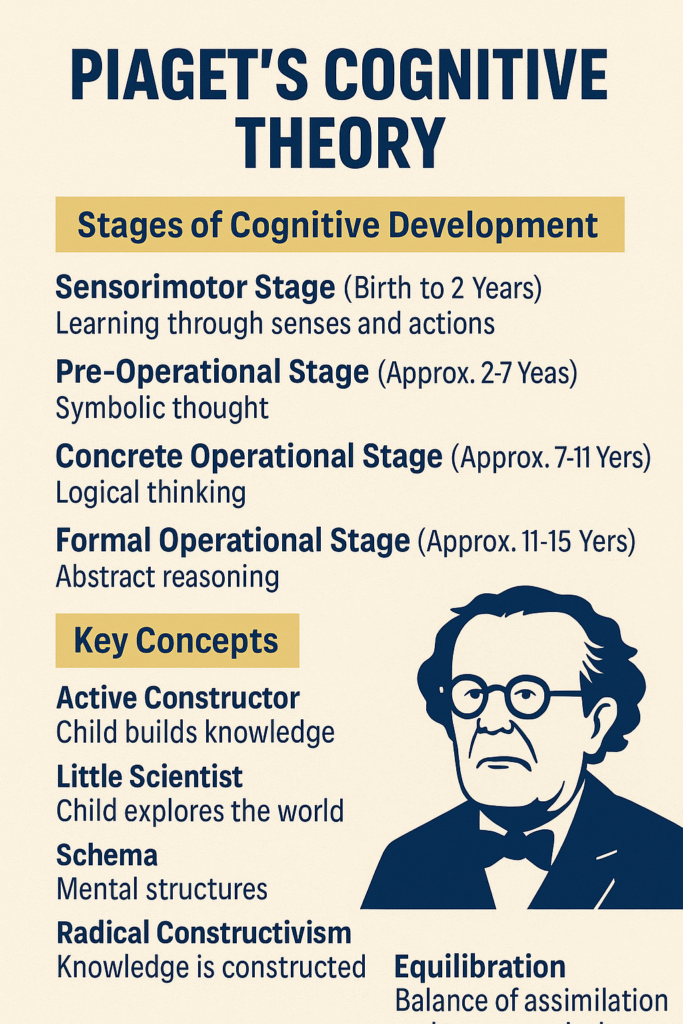
Overview:
Jean Piaget, a Swiss psychologist, proposed that cognitive (intellectual) development occurs through a series of distinct, discontinuous stages. He viewed children as active constructors of knowledge—often called “active constructors” or “little scientists”—who build mental structures (schemas) through interaction with their environment. According to Piaget, a child is born with a basic mental framework that develops and reaches its fullest form by around age 15.
Key Concepts
- Active Constructor / Builder of Knowledge:
Children actively create, modify, and refine their understanding by engaging with their environment. - Little Scientist:
Children explore, experiment, and hypothesize about the world, much like scientists. - Schema (Mental Structures):
Organized patterns of thought or behavior that help individuals interpret and assimilate new information. - Radical Constructivism:
Piaget’s view that knowledge is actively constructed by the individual rather than passively absorbed. - Equilibration:
The process of achieving balance between assimilation (integrating new information into existing schemas) and accommodation (modifying schemas when new information doesn’t fit). - MESE Elements:
Cognitive development is influenced by:- Maturation (M): Biological growth and genetic factors.
- Experience (E): Direct interactions and activities.
- Social Interaction (S): Learning through communication and relationships.
- Equilibration (E): The balancing process of adaptation.
- Maturation (M): Biological growth and genetic factors.
Stages of Cognitive Development
Piaget divided cognitive development into four stages. Each stage represents a qualitative change in how children think and understand the world.
1. Sensorimotor Stage (Birth – 2 Years)
- Key Features:
- Learning Through Senses and Actions: Infants explore the world by using their senses (touch, sight, sound) and motor actions (grasping, crawling, sucking).
- Object Permanence: The realization that objects continue to exist even when they are out of sight.
- Learning Through Senses and Actions: Infants explore the world by using their senses (touch, sight, sound) and motor actions (grasping, crawling, sucking).
- Example:
- A baby playing peek-a-boo gradually learns that the person is still there even when hidden.
- A toddler repeatedly dropping and picking up a toy to understand cause and effect.
- A baby playing peek-a-boo gradually learns that the person is still there even when hidden.
2. Pre-Operational Stage (Approximately 2 – 7 Years)
- Key Features:
- Symbolic Thought: Development of language and the ability to use symbols (e.g., words, images) to represent objects.
- Egocentrism: Difficulty in seeing the world from perspectives other than their own.
- Animism: Attributing life-like qualities to inanimate objects.
- Lack of Conservation: Inability to recognize that quantities remain the same despite changes in form or appearance.
- Centration: Focusing on one prominent feature while neglecting others.
- Symbolic Thought: Development of language and the ability to use symbols (e.g., words, images) to represent objects.
- Example:
- A child believes that a taller glass holds more water than a shorter one, even if the amount is the same.
- Engaging in pretend play where a stick becomes a sword or a wand.
- A child believes that a taller glass holds more water than a shorter one, even if the amount is the same.
3. Concrete Operational Stage (Approximately 7 – 11 Years)
- Key Features:
- Logical Thinking with Concrete Objects: Children begin to use logic to think about objects and events that are tangible.
- Conservation: Understanding that properties like volume, mass, and number remain constant despite changes in appearance.
- Reversibility: Ability to mentally reverse actions or operations.
- Classification and Seriation: Ability to organize objects into groups (classification) and arrange them in order (seriation).
- Decentration: Considering multiple aspects of a situation simultaneously.
- Logical Thinking with Concrete Objects: Children begin to use logic to think about objects and events that are tangible.
- Example:
- A child can understand that rearranging a set of blocks does not change the total number of blocks.
- Solving puzzles that involve grouping similar shapes or colors.
- A child can understand that rearranging a set of blocks does not change the total number of blocks.
4. Formal Operational Stage (Approximately 11 – 15 Years)
- Key Features:
- Abstract Thinking: Ability to think about concepts that are not tied to concrete experiences.
- Hypothetico-Deductive Reasoning: Formulating hypotheses and deducing logical conclusions from them.
- Deductive Reasoning: Drawing logical conclusions from general premises.
- Abstract Thinking: Ability to think about concepts that are not tied to concrete experiences.
- Example:
- An adolescent can solve algebraic equations or consider hypothetical scenarios, such as the potential outcomes of different scientific experiments.
- Engaging in debates that require reasoning about abstract principles like justice or freedom.
- An adolescent can solve algebraic equations or consider hypothetical scenarios, such as the potential outcomes of different scientific experiments.
Summary Table of Piaget’s Stages
| Stage | Age Range | Key Features | Examples |
| Sensorimotor | Birth – 2 Years | Learning through senses and actions; development of object permanence | Peek-a-boo games; exploring toys by touching and grasping |
| Pre-Operational | 2 – 7 Years | Symbolic thought; egocentrism; animism; lack of conservation; centration | Pretend play; misunderstanding conservation (taller vs. shorter glass) |
| Concrete Operational | 7 – 11 Years | Logical thinking about concrete objects; conservation; reversibility; classification; decentration | Grouping objects by color/shape; solving puzzles |
| Formal Operational | 11 – 15 Years | Abstract thinking; hypothetico-deductive reasoning; deductive reasoning | Solving algebra problems; debating abstract concepts |
Glossary
- Cognitive Development (संज्ञानात्मक विकास):
The process by which children learn to think, reason, and understand the world. - Intellectual Development (बौद्धिक विकास):
The growth of mental abilities and knowledge over time. - Active Constructor / Builder of Knowledge:
The notion that children actively construct their own understanding through exploration and experiences. - Little Scientist:
A metaphor describing children as natural experimenters who observe, hypothesize, and test their ideas about the world. - Schema (Mental Structures):
Organized patterns of thought that represent existing knowledge and guide how new information is interpreted. - Radical Constructivism:
A perspective that suggests knowledge is constructed by individuals through their own experiences rather than being passively received. - Equilibration:
The ongoing process of balancing assimilation and accommodation to achieve stable understanding. - Maturation:
The biological growth that prepares a child’s brain for learning. - Assimilation:
The process of incorporating new experiences into existing schemas. - Accommodation:
Adjusting existing schemas to include new information that cannot be assimilated. - Centration:
Focusing on one dominant aspect of a situation, often leading to misinterpretations. - Decentration:
The ability to consider multiple aspects of a situation simultaneously. - Conservation:
Understanding that certain properties of objects (e.g., mass, volume) remain constant despite changes in appearance. - Classification:
The ability to organize objects into groups based on shared attributes. - Seriation:
The skill of arranging objects in a logical order based on size, number, or other characteristics. - Hypothetico-Deductive Reasoning:
A method of reasoning that involves forming hypotheses and testing them systematically. - Deductive Reasoning:
Drawing logical conclusions from general premises.
Pingback: Vygotsky's Socio-Cultural Approach - Exam Affinity