
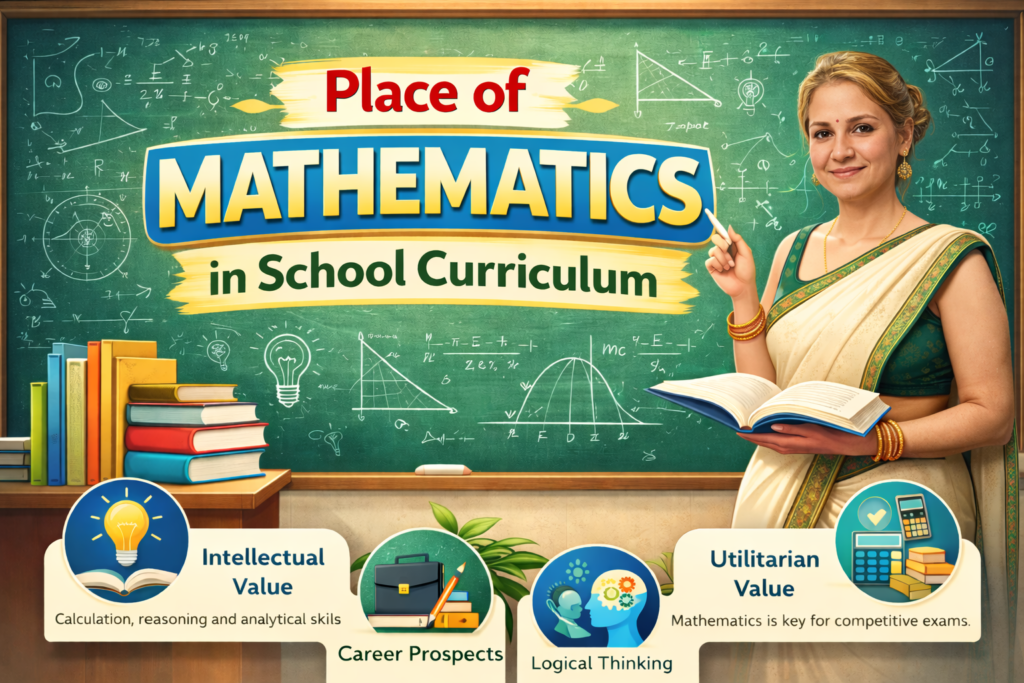
Place of Mathematics in School Curriculum
Mathematics occupies a central and indispensable position in the school curriculum. It is not merely a subject concerned with numbers and calculations, but a powerful discipline that shapes intellectual abilities, practical skills, and scientific thinking. From daily life applications to higher academic pursuits, mathematics plays a foundational role in holistic education.
Mathematics in the School Curriculum
Interdisciplinary Nature of Mathematics
Experts widely regard mathematics as the mother of all sciences. It has a close and inseparable relationship with subjects such as physics, chemistry, economics, geography, and even social sciences. Mathematical concepts are applied across disciplines for measurement, analysis, prediction, and interpretation. This interdisciplinary approach enables learners to connect classroom knowledge with real-world situations.
Recommendations of the Kothari Commission
The Kothari Commission (1964–66) and the National Policy on Education strongly emphasized the importance of mathematics in school education. According to these recommendations:
- Mathematics should be a compulsory subject up to the secondary level (Class X).
- At higher secondary and university levels, mathematics may be offered as an optional subject, depending on students’ interests and career goals.
This highlights the essential role of mathematics in building a strong academic foundation.
High Utilisation Value
Among all school subjects, mathematics has the highest utilisation value. Its applications extend to daily activities such as shopping, banking, time management, budgeting, and problem-solving. Mathematical knowledge is also essential in technology-driven fields, making it highly relevant in modern society.
Values of Mathematical Education
Mathematical education contributes significantly to the overall development of learners by inculcating various values:
Intellectual Value
Mathematics sharpens reasoning, logic, concentration, and analytical thinking. It trains the mind to think systematically and arrive at accurate conclusions.
Utilitarian or Practical Value
Mathematics is directly applied in everyday life, including measurement, calculation, estimation, and financial transactions, making learners self-reliant.
Disciplinary Value
The subject develops discipline, accuracy, patience, and persistence, as mathematical problems require step-by-step solutions.
Moral Value
Honesty, truthfulness, and objectivity are promoted through mathematical reasoning, as results are based on facts rather than opinions.
Social Value
Mathematics helps individuals function effectively in society by enabling them to understand data, statistics, and economic information.
Cultural Value
The development of mathematics across civilizations reflects human intellectual progress and cultural advancement.
Aesthetic Value
There is beauty and harmony in mathematical patterns, symmetry, and logical structure, which nurtures a sense of appreciation and creativity.
Vocational Value
Mathematics provides a strong foundation for careers in engineering, teaching, banking, accounting, data analysis, and competitive examinations.
Psychological Value
Learning mathematics builds confidence, problem-solving ability, and mental alertness, supporting overall psychological growth.
Scientific Attitude
Mathematics encourages logical reasoning, objectivity, precision, and rational thinking, which are essential components of a scientific outlook.
Reasons for Keeping Mathematics in the School Curriculum
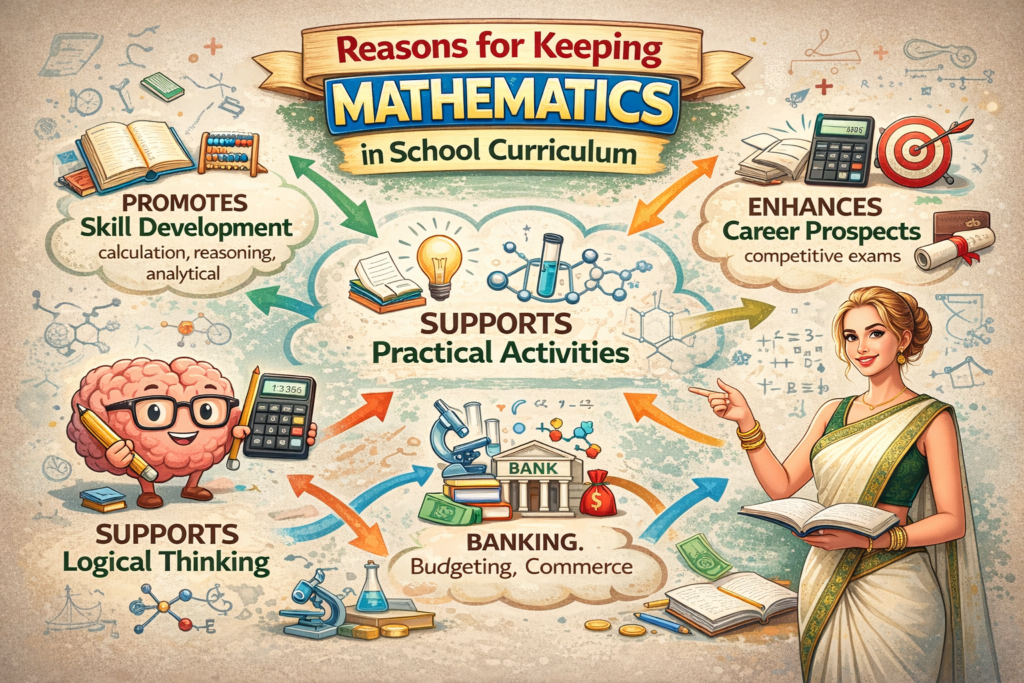
Mathematics continues to remain a core subject in schools due to several important reasons:
- It promotes skill development, especially calculation, reasoning, and analytical skills.
- It enhances career prospects, as mathematics is a key requirement in most competitive examinations.
- It strengthens computational ability, essential for academic and professional success.
- It supports practical activities such as banking, budgeting, and commerce.
- It develops logical and critical thinking among learners.
- It forms the basis of all sciences, enabling deeper understanding of scientific concepts.
Conclusion
The place of mathematics in the school curriculum is both fundamental and unavoidable. It is a subject that not only supports academic growth but also prepares learners for practical life, professional careers, and responsible citizenship. By developing intellectual abilities, moral values, and scientific attitudes, mathematics contributes significantly to the complete development of an individual. Hence, its inclusion as a core subject in school education is fully justified.