Teacher giving remedial teaching to a student in English pedagogy for CTET with diagnostic test, learning difficulties and practice strategies.

Remedial Teaching

Home » Articles » Remedial Teaching

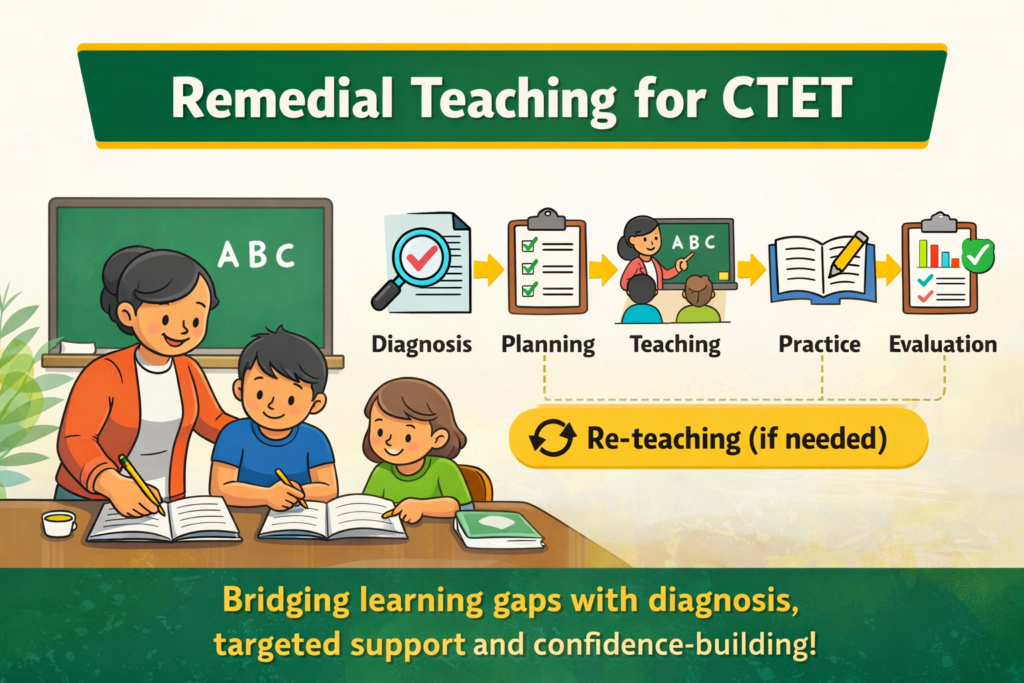
Remedial teaching focuses on correcting learning gaps through diagnosis, targeted support and individual attention. In CTET English pedagogy, it helps teachers analyse errors, plan interventions and improve classroom performance for slow learners and struggling readers.

REMEDIAL TEACHING IN ENGLISH LANGUAGE (अंग्रेज़ी भाषा में सुधारात्मक शिक्षण)

(i) Remedial teaching (सुधारात्मक शिक्षण) is the teaching or instructional work carried out to provide remedial measures to help the pupils to get rid of their common or specific weaknesses (अपनी सामान्य या विशिष्ट कमियों से छुटकारा पाने के लिए सुधारात्मक उपाय प्रदान करने के लिए किया जाता है).

(ii) Thus, depending upon the general or specific nature of the weaknesses or learning difficulties (कमजोरियों या सीखने की कठिनाइयों की सामान्य या विशिष्ट प्रकृति) of the pupils, one has to take appropriate steps for the organisation of remedial teaching for the needy pupils (जरूरतमंद छात्रों के लिए सुधारात्मक शिक्षण के संगठन के लिए उपयुक्त कदम उठाने होंगे).

(iii) Pupils usually may have one or more than one of the following learning difficulties (छात्रों को आमतौर पर निम्नलिखित में से एक या एक से अधिक सीखने में कठिनाई हो सकती है):

  • Poor memory (कमज़ोर याददाश्त).
  • Short attention span (कम ध्यान अवधि) and are easily distracted (आसानी से विचलित) by other things.
  • Relatively poor comprehensive power (नैतिक समझने की क्षमता में कमी). Lack of learning motivation (सीखने की प्रेरणा की कमी).
  • Lack of self-confidence (आत्म-विश्वास की कमी) and relatively low self-expectation (आत्म-अपेक्षा में कमी).
  • Weak in problem-solving power (समस्या सुलझाने की क्षमता में कमजोरी).
  • Fail to grasp information effectively and mix things up easily (जानकारी को प्रभावी रूप से नहीं समझ पाते और चीजों को आसानी से मिलाते हैं).
  • Have difficulty in understanding new / abstract concepts (नए/अध्रक्तिकृत अवधारणाओं को समझने में कठिनाई होती है).
  • Need more time to complete assignments or tasks (सौंपे गए कार्य या कार्य पूरे करने के लिए अधिक समय की आवश्यकता होती है).

(iv) Remedial teachers (सुधारात्मक शिक्षक) should design diversified teaching activities (विविध शिक्षण गतिविधियाँ) and adopt various teaching methods (विभिन्न शिक्षण विधियों को अपनाना) to help pupils develop their potential (छात्रों की संभावनाओं को विकसित करने में मदद करने के लिए) and remove the obstacles in learning (सीखने में बाधाओं को दूर करने के लिए).

Objectives of Remedial Teaching (सुधारात्मक शिक्षण के उद्देश्य):

Each pupil is different in terms of academic standards (शैक्षणिक मानकों), classroom learning (कक्षा में सीखने), learning ability (सीखने की क्षमता) and academic performance (शैक्षणिक प्रदर्शन).

  • The main objective of the Remedial Teaching Program is to provide learning support (सीखने का समर्थन प्रदान करना) to pupils who are not as good as their peers (जो अपने सहपाठियों की तरह अच्छे नहीं हैं) in performance.
  • With the help of the school curriculum (विद्यालय पाठ्यक्रम) and teaching strategies (शिक्षण रणनीतियाँ), a teacher provides learning activities (सीखने की गतिविधियाँ) and practical experiences (व्यावहारिक अनुभव) to pupils according to their abilities and requirements (उनकी क्षमताओं और आवश्यकताओं के अनुसार).
  • The teacher also designs individualized educational programs (व्यक्तिगत शैक्षिक कार्यक्रम) with intensive remedial support (गहन सुधारात्मक समर्थन) to help pupils consolidate their basic knowledge (मूलभूत ज्ञान को मजबूत करने में मदद करने के लिए) in different subjects, master the learning methods (सीखने के तरीकों में महारत हासिल करने के लिए), strengthen their confidence (आत्मविश्वास को मजबूत करने के लिए) and enhance the effectiveness of learning (सीखने की प्रभावशीलता को बढ़ाने के लिए).
  • The teacher should provide systematic training (प्रणालीबद्ध प्रशिक्षण प्रदान करना) to develop pupils’ generic skills (छात्रों के सामान्य कौशलों को विकसित करना), including interpersonal relationship (अंतरवैयक्तिक संबंध), communication (संचार), problem-solving (समस्या सुलझाने), self-management (स्व-प्रबंधन), self-learning (स्व-सीखना), independent thinking (स्वतंत्र सोच), creativity (रचनात्मकता) and the use of information technology (सूचना प्रौद्योगिकी का उपयोग).

Remedial teaching lays the foundation (मूलभूत आधार डालता है) for pupils’ life-long learning (जीवन भर के लिए सीखने में मदद करता है), helps them develop positive attitudes (सकारात्मक दृष्टिकोण विकसित करने में मदद करता है) and values (मूल्य), as well as prepares them for future studies and careers (भविष्य के अध्ययन और करियर के लिए तैयार करता है).

Principles of Helping Pupils with Learning Difficulties (सीखने में कठिनाई वाले छात्रों की सहायता के सिद्धांत):

i. Teaching Preparation (शिक्षण की तैयारी): Before preparing their lessons, teachers should identify pupils’ diverse learning needs (छात्रों की विविध सीखने की आवश्यकताओं को पहचानना) as soon as possible, so that they may design appropriate teaching plans (उपयुक्त शिक्षण योजनाएँ तैयार कर सकें) to facilitate pupils’ effective learning (छात्रों के प्रभावी सीखने को सुगम बनाने के लिए).

ii. Devise Various Learning Activities (विभिन्न शिक्षण गतिविधियों की योजना बनाना): Teachers must devise different learning activities (विभिन्न शिक्षण गतिविधियाँ तैयार करनी चाहिए) with the same teaching objective (समान शिक्षण लक्ष्य) to develop pupils’ varied abilities and skills in problem-solving (छात्रों की विविध क्षमताओं और समस्या सुलझाने में कौशल विकसित करने के लिए). It is more effective for teachers to adopt a series of relevant and simple teaching activities (संबंधित और सरल शिक्षण गतिविधियों की एक श्रृंखला अपनाना) than assigning one long teaching activity (एक लंबे शिक्षण कार्य का आवंटन).

iii. Design Meaningful Learning Situations (अर्थपूर्ण सीखने की स्थितियाँ बनाना): Teachers should specifically design meaningful learning situations (अर्थपूर्ण सीखने की स्थितियों) and language environments (भाषाई वातावरण), especially for English (विशेष रूप से अंग्रेजी के लिए), games or activities (खेल या गतिविधियाँ) to provide personal learning experiences (व्यक्तिगत सीखने के अनुभव) for pupils and stimulate their interest (उनकी रुचि को उत्तेजित करना) and initiative in learning (सीखने में पहल).

iv. Teaching Approaches (शिक्षण के दृष्टिकोण): Teachers should give concrete and valuable examples (व्यावहारिक और मूल्यवान उदाहरण देना) before proceeding to abstract concepts (अध्रक्तिकृत अवधारणाओं की ओर बढ़ने से पहले) by way of simple and easy steps (सरल और आसान चरणों द्वारा) at a pace in line with the learning abilities of pupils (छात्रों की सीखने की क्षमताओं के अनुरूप गति पर). Teachers should encourage pupils’ active participation (छात्रों की सक्रिय भागीदारी को प्रोत्साहित करना) by more frequent use of teaching aids (शिक्षण सहायक उपकरण), games, and activities (गतिविधियों का अधिक बार उपयोग करके). They can also make use of information technology (सूचना प्रौद्योगिकी का उपयोग करना) and all the teaching resources available (सभी उपलब्ध शिक्षण संसाधनों का उपयोग करना) to help pupils understand the main points (मुख्य बिंदुओं को समझने में मदद करना).

v. Provide Clear Instructions (स्पष्ट निर्देश प्रदान करना): Pupils with learning difficulties (सीखने में कठिनाई वाले छात्र) are less competent in understanding written language (लिखित भाषा को समझने में कम सक्षम होते हैं). Therefore, teachers should give pupils short and clear instructions (छोटे और स्पष्ट निर्देश देना) to avoid confusion (भ्रम से बचने के लिए). They must explain clearly the arrangement of each learning activity (प्रत्येक शिक्षण गतिविधि की व्यवस्था को स्पष्ट रूप से समझाना).

vi. Summarize the Main Points (मुख्य बिंदुओं का सारांश देना): At the course of teaching (शिक्षण के दौरान), teachers should always sum up the main points in teaching (शिक्षण में मुख्य बिंदुओं का सारांश देना) and write the key phrases on the board (बोर्ड पर मुख्य वाक्यांश लिखना) to enhance pupils’ audio and visual memories (छात्रों की श्रवण और दृश्य स्मृतियों को बढ़ाना). Teachers can guide their pupils to link up the knowledge they learn from class (कक्षा से सीखी गई जानकारी को जोड़ने के लिए मार्गदर्शन करना) with their life experiences (उनके जीवन के अनुभवों) so as to enhance the effectiveness of learning (सीखने की प्रभावशीलता को बढ़ाने के लिए).

vii. Enhance Learning Interest and Motivation (सीखने की रुचि और प्रेरणा को बढ़ाना): Pupils with learning difficulties (सीखने में कठिनाई वाले छात्र) may lose their interest in learning (सीखने में रुचि खो सकते हैं). Therefore, teachers should adapt the curriculum (पाठ्यक्रम को अनुकूलित करना) to meet the needs of pupils (छात्रों की आवश्यकताओं को पूरा करने के लिए). With fewer pupils in the Remedial Teaching Program (सुधारात्मक शिक्षण कार्यक्रम में कम छात्र), teachers can design interesting activities (रोचक गतिविधियाँ तैयार करना) coupled with reward schemes (इनाम योजनाओं के साथ) to stimulate pupils’ interest (छात्रों की रुचि को उत्तेजित करने के लिए).

viii. Encourage Pupils’ Active Participation in Class Activities (कक्षा की गतिविधियों में छात्रों की सक्रिय भागीदारी को प्रोत्साहित करना): Pupils with learning difficulties (सीखने में कठिनाई वाले छात्र) usually lack self-confidence (आत्मविश्वास की कमी) and are more passive in class (कक्षा में अधिक निष्क्रिय होते हैं). They seldom ask questions (सवाल कम पूछते हैं) or express their views (या अपने विचार व्यक्त करते हैं). Remedial teachers should patiently encourage active participation in class (कक्षा में सक्रिय भागीदारी को धैर्यपूर्वक प्रोत्साहित करना). Pleasurable learning experiences (सुखद शिक्षण अनुभव) may help enhance pupils’ interest in learning (छात्रों की सीखने में रुचि को बढ़ाने में मदद कर सकते हैं).

ix. Focus on the Learning Process (सीखने की प्रक्रिया पर ध्यान केंद्रित करना): Teaching should not only focus on the transmission of knowledge (ज्ञान के संचरण पर ध्यान केंद्रित नहीं करना चाहिए). It is also important to see that pupils benefit from the entire learning process (छात्रों को पूरी सीखने की प्रक्रिया से लाभ मिलना भी महत्वपूर्ण है). Teachers should provide ample opportunities in class for pupils to practice (छात्रों को अभ्यास करने के लिए कक्षा में पर्याप्त अवसर प्रदान करना) and think about what they have learned (जो उन्होंने सीखा है उसके बारे में सोचना) and allow them to solve problems (समस्याओं को हल करने की अनुमति देना) by different means (विभिन्न तरीकों से). Teachers should also carefully observe the performances of pupils (छात्रों के प्रदर्शन पर ध्यान से नजर रखना).

x. Show Concern for the Performances of Individual Pupils (व्यक्तिगत छात्रों के प्रदर्शन के प्रति चिंता दिखाना): Teachers should carefully observe the learning process of individual pupils (व्यक्तिगत छात्रों की सीखने की प्रक्रिया का ध्यानपूर्वक अवलोकन करना). Whenever necessary (जब भी आवश्यक हो), they should provide individualized remedial teaching (व्यक्तिगत सुधारात्मक शिक्षण प्रदान करना) before and after class (कक्षा से पहले और बाद में), so that they can remove their learning obstacles (ताकि वे अपनी सीखने में बाधाओं को दूर कर सकें) as soon as possible. When marking assignments (असाइनमेंट को चिह्नित करते समय), teachers should take note of the common errors of pupils (छात्रों की सामान्य गलतियों पर ध्यान देना) and deliver the correct concepts and knowledge to them promptly (उन्हें सही अवधारणाएँ और ज्ञान समय पर प्रदान करना).

Curriculum Adaptation (पाठ्यक्रम का अनुकूलन):

  1. Teachers should adapt the curriculum (पाठ्यक्रम को अनुकूलित करना) to accommodate the learning characteristics and abilities of pupils (छात्रों की सीखने की विशेषताओं और क्षमताओं के अनुकूल).
  2. Teachers should set some easy teaching objectives (कुछ आसान शिक्षण लक्ष्यों को निर्धारित करना) to acquire knowledge (ज्ञान प्राप्त करने के लिए).
  3. Teaching should not be directed by textbooks (पाठ्यपुस्तकों द्वारा शिक्षण का निर्देशन नहीं किया जाना चाहिए), which should not be taken as the school curriculum (जो विद्यालय पाठ्यक्रम के रूप में नहीं लिया जाना चाहिए).
  4. Schools should classify the teaching content (शिक्षण सामग्री को वर्गीकृत करना) into core and non-core learning aspects (मुख्य और गैर-मुख्य सीखने के पहलुओं) according to the teaching objectives (शिक्षण लक्ष्यों के अनुसार) and pupils’ abilities (और छात्रों की क्षमताओं).
  5. Core learning aspects require in-depth studies (मुख्य सीखने के पहलू गहन अध्ययन की आवश्यकता होती है) and application (और अनुप्रयोग), whereas materials in the non-core or advanced learning aspects may be streamlined or appropriately selected for teaching (जबकि गैर-मुख्य या उन्नत सीखने के पहलुओं में सामग्री को शिक्षण के लिए सुव्यवस्थित या उचित रूप से चुना जा सकता है).
  6. Teachers should be encouraged to adopt recommendations (शिक्षकों को अनुशंसाएँ अपनाने के लिए प्रोत्साहित किया जाना चाहिए) on cross-curricular teaching (पार-पाठ्यक्रम शिक्षण) by linking up related teaching areas flexibly (संबंधित शिक्षण क्षेत्रों को लचीले ढंग से जोड़ना) so that more time can be spared for effective activities and learning (ताकि प्रभावी गतिविधियों और सीखने के लिए अधिक समय निकाल सकें).
  7. Teachers should be capable of designing materials of different standards (विभिन्न मानकों की सामग्री डिजाइन करने में सक्षम होना चाहिए) which could be taken from the internet, newspapers, magazines, and references (जो इंटरनेट, समाचार पत्रों, पत्रिकाओं और संदर्भों से ली जा सकती हैं) provided by the Education Department (शिक्षा विभाग द्वारा प्रदान की गई).

Strategies for Remedial Teaching (सुधारात्मक शिक्षण की रणनीतियाँ):

Individualized Educational Program (IEP)

  1. Individualized Educational Program (IEP) (व्यक्तिगत शैक्षिक कार्यक्रम): To fulfill the learning needs of individual pupils (व्यक्तिगत छात्रों की सीखने की आवश्यकताओं को पूरा करने के लिए), the Individualized Educational Program (IEP) aims to reinforce the foundation of learning (सीखने की नींव को मजबूत करने का लक्ष्य) and help pupils overcome their learning difficulties (छात्रों को उनकी सीखने की कठिनाइयों को दूर करने में मदद करना) and develop their potentials (उनकी क्षमताओं का विकास करना). Individualized Educational Program should include short-term and long-term teaching objectives (व्यक्तिगत शैक्षिक कार्यक्रम में लघु-कालिक और दीर्घ-कालिक शिक्षण उद्देश्यों को शामिल करना चाहिए), learning steps (सीखने के चरण), activities, and reviews (गतिविधियाँ और समीक्षाएँ) to ensure that the program is implemented effectively (ताकि कार्यक्रम को प्रभावी ढंग से लागू किया जा सके). Teachers must evaluate the effectiveness of the work (शिक्षण के काम की प्रभावशीलता का मूल्यांकन करना चाहिए) and try to gather opinions of pupils for improvisation and betterment (सुधार और बेहतरी के लिए छात्रों की राय इकट्ठा करने का प्रयास करना चाहिए).

Peer Support Program

  1. Peer Support Program (सहकर्मी समर्थन कार्यक्रम): Teachers may train up pupils who perform better (जो छात्र बेहतर प्रदर्शन करते हैं) in a certain subject to become ‘little teachers’ (छोटे शिक्षक बनना) and who will be responsible for helping schoolmates with learning difficulties (जो सीखने में कठिनाइयों वाले सहपाठियों की सहायता के लिए जिम्मेदार होंगे) in group teaching (समूह शिक्षण) and self-study sessions (स्व-अध्ययन सत्र) as well as outside class (कक्षा के बाहर). Peer support program helps pupils reinforce their knowledge (सहकर्मी समर्थन कार्यक्रम छात्रों को उनके ज्ञान को मजबूत करने में मदद करता है), and develop their communication and cooperation skills (संचार और सहयोग कौशल विकसित करने में) as well as good interpersonal relationships (अच्छे अंतरवैयक्तिक संबंध).

Reward Scheme

  1. Reward Scheme (इनाम योजना): To motivate pupils (छात्रों को प्रेरित करने के लिए), teachers must implement a reward scheme (इनाम योजना लागू करनी चाहिए) which focuses on guiding pupils to set their own objectives and plans (जो छात्रों को अपने लक्ष्यों और योजनाओं को स्थापित करने के लिए मार्गदर्शन करता है), and positively reinforcing their good performance (और उनके अच्छे प्रदर्शन को सकारात्मक रूप से सुदृढ़ करता है). To design the rewards (इनामों को डिजाइन करने के लिए), teachers must take note of the following (नीचे दिए गए बिंदुओं का ध्यान रखना चाहिए):
    • Set clear and specific targets (स्पष्ट और विशिष्ट लक्ष्य निर्धारित करना).
    • Set achievable objectives (प्राप्त करने योग्य लक्ष्य निर्धारित करना).
    • Give diversified rewards to accommodate pupils’ interest (छात्रों की रुचियों के अनुसार विविध इनाम देना); give rewards instantly (तुरंत इनाम देना).
    • Review and revise the reward scheme regularly (नियमित रूप से इनाम योजना की समीक्षा और संशोधन करना).
    • Invite parents/guardians to help children improve their work (बच्चों के कार्य में सुधार करने के लिए माता-पिता/अभिभावकों को आमंत्रित करना).

Handling Pupils’ Behaviour Problems

  1. Handling Pupils’ Behavior Problems (छात्रों के व्यवहार की समस्याओं को संभालना): Teachers should observe the following when dealing with the behavior problems of pupils (छात्रों की व्यवहार संबंधी समस्याओं से निपटते समय निम्नलिखित बातों का अवलोकन करना चाहिए):
    • Always observe the performance of pupils in class (कक्षा में छात्रों के प्रदर्शन का हमेशा अवलोकन करना) and their behavior in groups (और उनके समूह में व्यवहार).
    • Establish close relationships with pupils (छात्रों के साथ निकट संबंध स्थापित करना), develop mutual trust (आपसी विश्वास विकसित करना) and listen carefully to what they say (जो वे कहते हैं उसे ध्यान से सुनना).
    • Help pupils understand the effect of their behavior on others as well as themselves (छात्रों को उनके व्यवहार का दूसरों और अपने पर प्रभाव समझाने में मदद करना).
    • Keep in close contact with parents (माता-पिता के साथ निकट संपर्क बनाए रखना) to find out the cause of pupils’ behavior problems (छात्रों की व्यवहार समस्याओं के कारण का पता लगाने के लिए).
    • Help pupils build up self-confidence (छात्रों को आत्मविश्वास बनाने में मदद करना) and a healthy self-image (और एक स्वस्थ आत्म-छवि).
    • Give positive reinforcement to pupils’ good behavior (छात्रों के अच्छे व्यवहार को सकारात्मक सुदृढ़ीकरण देना), and do not pay undue attention to their misbehavior (उनकी गलत व्यवहार पर अनावश्यक ध्यान

CTET MCQs based on Remedial Teaching

Practice Questions: Remedial Teaching & Diagnostic Testing

Q1. If a student is in the habit of speaking the word “Ma’am” like “Maem”, what will you do?

  • A) Nothing, because she has not been corrected since her childhood
  • B) It may be heredity as per Dalton’s experiment
  • C) She is not a willing learner
  • D) The teacher will arrange remedial classes for her
Click to Check Answer
Correct Answer: D) The teacher will arrange remedial classes for her
Reason: Persistent pronunciation errors require specific remedial intervention to correct the habit.

Q2. The purpose of remedial teaching is to:

  • A) Introduce new language items
  • B) Test recently taught items
  • C) Teach again the language items not properly learnt
  • D) Teach again language items already learnt
Click to Check Answer
Correct Answer: C) Teach again the language items not properly learnt
Reason: Remedial teaching focuses on filling the learning gaps identified during assessment.

Q3. Which of the following is NOT a strategy of remedial teaching?

  • A) Advance learning strategy
  • B) Action research
  • C) Mastery learning strategy
  • D) Branching programme
Click to Check Answer
Correct Answer: A) Advance learning strategy
Reason: “Advance learning” implies moving ahead or enrichment, whereas remedial teaching focuses on fixing past difficulties.

Q4. Diagnostic tests are administered to:

  • A) Find out deficiencies of the students with a view to planning remedies
  • B) Assess the suitability of a candidate for a specific programme
  • C) Test the language proficiency of students for providing them jobs
  • D) Judge the students’ capabilities
Click to Check Answer
Correct Answer: A) Find out deficiencies of the students with a view to planning remedies
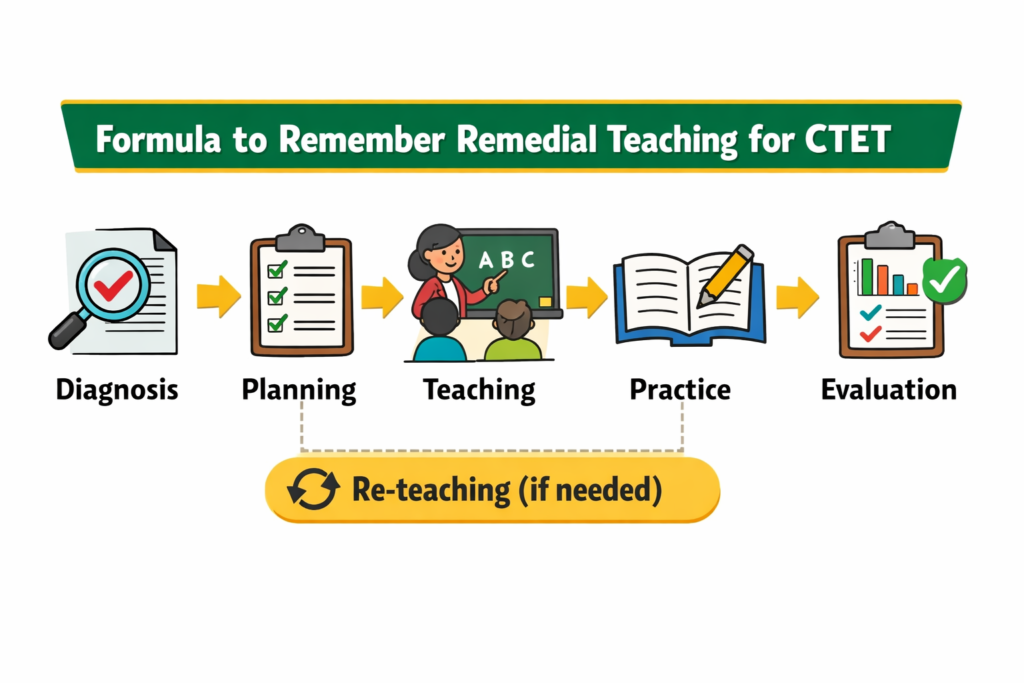
Reason: Diagnosis (identifying the problem) is the first step before providing a remedy (teaching).

Q5. Remedial teaching is a:

  • A) Preparation of teaching
  • B) Systematic process
  • C) Pre-teaching program
  • D) Random process
Click to Check Answer
Correct Answer: B) Systematic process
Reason: It involves planned steps: Diagnosis -> Planning -> Teaching -> Re-evaluation.

Q6. Remedial teaching involves:

  • A) Improvement of learning skills
  • B) Rectifying a particular problem area
  • C) Both A and B
  • D) Neither A nor B
Click to Check Answer
Correct Answer: C) Both A and B
Reason: It aims to fix specific errors (rectifying) which ultimately leads to overall skill improvement.

Q7. Remedial Teaching syllabus should be based on:

  • A) The teacher’s impression of language difficulties
  • B) Students’ interest in learning language
  • C) An analysis of errors made by the learner
  • D) An analysis of future needs of the learners
Click to Check Answer
Correct Answer: C) An analysis of errors made by the learner
Reason: You cannot create a remedy without first analyzing the specific errors (symptoms).

Q8. Which strategy can be used to train students for good speech?

  • A) Demonstration of correct pronunciation
  • B) Group practice to ensure the correct position of the tongue and lips
  • C) Both A and B
  • D) Proper training for eye movement
Click to Check Answer
Correct Answer: C) Both A and B
Reason: Modeling (demonstration) and Drill (practice) are the two pillars of teaching pronunciation.

Q9. A student of class-V while reading a chapter finds some difficult and unfamiliar words and is not able to get the meaning. He should:

  • A) Ignore or skip the word and keep reading
  • B) Guess the meaning in context
  • C) Ask his classmate every time to help
  • D) Ask the teacher
Click to Check Answer
Correct Answer: B) Guess the meaning in context
Reason: This is a key reading strategy known as “inferencing,” which helps maintain reading flow and comprehension.

Q10. A remedial program is designed keeping in mind:

  • A) Each student’s strength
  • B) Each student’s weakness
  • C) Each student’s strength and weakness
  • D) None of the above
Click to Check Answer
Correct Answer: C) Each student’s strength and weakness
Reason: A good teacher uses a student’s strengths to help them overcome their weaknesses.

More Questions

Part 3: Advanced Application-Based Scenarios on Remedial Teaching

Q1. Ms. Riya observes that one of her students, Amit, consistently confuses ‘b’ and ‘d’ while writing, despite repeated corrections in the main class. As a remedial teacher, what should be her best approach?

  • A) Ask Amit to write ‘b’ and ‘d’ 100 times each as punishment.
  • B) Ignore the error as he will grow out of it.
  • C) Use tactile methods (like sandpaper letters or clay) and auditory association to re-teach the distinction.
  • D) Send a complaint note to Amit’s parents.
Click to Check Answer
Correct Answer: C) Use tactile methods and auditory association
Reason: Remedial teaching demands “alternative strategies”. If visual teaching failed, multisensory approaches (touch/sound) often help students with dyslexia or confusion.

Q2. After conducting a diagnostic test, a teacher realizes that 60% of the class has not understood the concept of ‘Subject-Verb Agreement’. The remaining 40% have understood it perfectly. How should she plan her remedial class?

  • A) She should re-teach the entire topic to the whole class using the same lecture method.
  • B) She should move to the next chapter to save time.
  • C) She should use peer-tutoring, where the 40% who understood assist the 60% in small groups, supervised by her.
  • D) She should ask the 60% to stay back after school while the others go home.
Click to Check Answer
Correct Answer: C) She should use peer-tutoring
Reason: In a large gap scenario, peer tutoring is an effective remedial strategy. It reinforces learning for the “tutors” (the 40%) and provides comfortable, student-friendly explanations for the “learners” (the 60%).

Q3. A bright student who usually scores high marks has missed two weeks of school due to illness and is now struggling with the current English grammar topic. Does this student need remedial teaching?

  • A) No, remedial teaching is only for slow learners.
  • B) Yes, remedial teaching is for any student with a learning gap, regardless of their intelligence.
  • C) No, he is smart enough to study on his own.
  • D) Yes, but only if he fails the final exam.
Click to Check Answer
Correct Answer: B) Yes, remedial teaching is for any student with a learning gap
Reason: Remedial teaching aims to rectify specific gaps. Even a gifted child may need remedial support to cover missed content or specific misunderstandings.

Q4. During a remedial session for students with poor vocabulary, the teacher decides to use “Realilies” (Real Objects). Why is this a good decision?

  • A) It is less work for the teacher than writing on the board.
  • B) Students can play with the objects and waste time.
  • C) It bridges the gap between abstract words and concrete meaning, aiding memory retention.
  • D) It is the only method prescribed by the NCF 2005.
Click to Check Answer
Correct Answer: C) It bridges the gap between abstract words and concrete meaning
Reason: Remedial students often struggle with abstract concepts. Concrete objects (Realia) make the learning experience tangible and easier to grasp.

Q5. You have identified a student with severe anxiety who freezes when asked to speak English. Which remedial strategy would be most effective?

  • A) Force the student to speak in front of the assembly to conquer fear.
  • B) Correct every grammar mistake immediately so they learn faster.
  • C) Create a non-threatening environment (Affective Humanistic Approach) and start with one-on-one conversations.
  • D) Advise the student to switch to a vernacular medium school.
Click to Check Answer
Correct Answer: C) Create a non-threatening environment and start with one-on-one conversations
Reason: Remedial teaching involves emotional support. Lowering the “Affective Filter” (anxiety) is the first step before any language learning can occur.

FAQs

What is the purpose of remedial teaching?

It removes learning difficulties by reteaching concepts, correcting errors and strengthening basic skills.

How does a teacher start remedial teaching?

The teacher diagnoses errors, plans activities based on weaknesses and evaluates improvement regularly.

1 thought on “Remedial Teaching”

  1. Pingback: Pedagogy of English Language – (CTET English Pedagogy)

Leave a Comment

Your email address will not be published. Required fields are marked *