Introduction
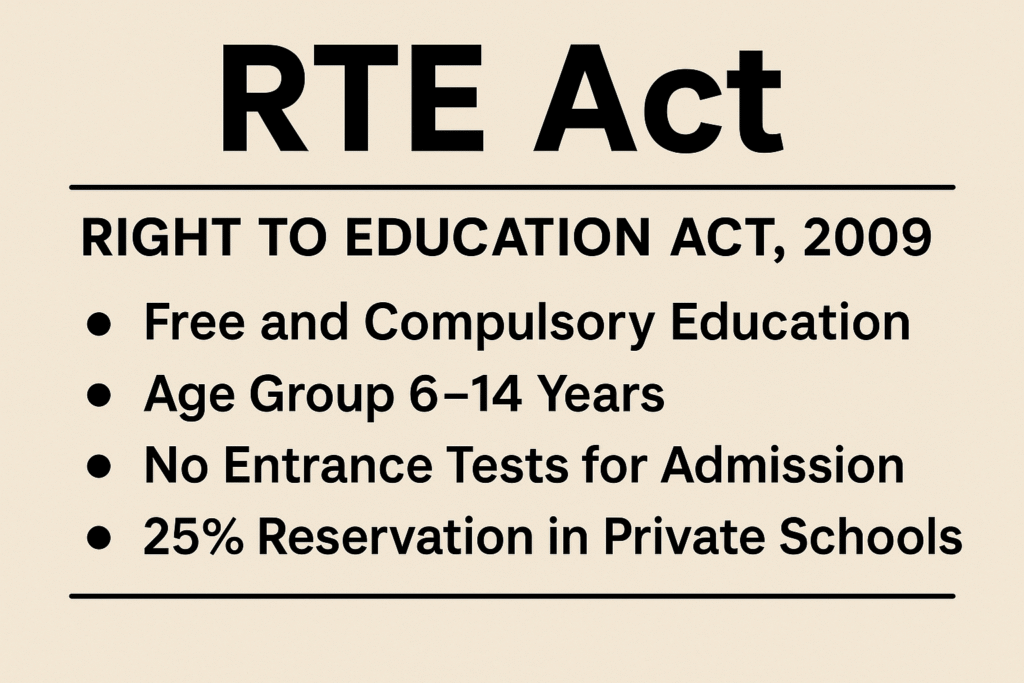
The Right to Education (RTE) Act, 2009—formally known as the Education Right Act—was enacted in 2009 and came into force on 1 April 2010, with certain exceptions such as Jammu & Kashmir.
Its foundation lies in the 86th Constitutional Amendment (2002), which added Article 21-A to the Constitution, guaranteeing free and compulsory education to all eligible children.
Under this Act:
- Children aged 6 to 14 years receive free and compulsory education.
- Children with disabilities are covered from 6 to 18 years, ensuring wider protection and inclusion.
Key Features of the Right to Education(RTE) Act
Free and Compulsory Education
Every child within the specified age group must be provided free and compulsory education in a neighbourhood school.
The Act emphasizes age-wise admission, ensuring children enter the class appropriate for their age, even if they have never attended school before.
Prohibitions under the RTE Act
The law incorporates several protective measures for children:
No Corporal Punishment
Schools cannot subject children to physical or mental punishment.
No Screening or Entrance Tests
Admissions must be based strictly on age, without interviews or entrance evaluations.
No Admission Fee
No school, whether government or aided, may charge an admission fee.
Ban on Private Tuitions by Government Teachers
Government teachers are strictly prohibited from offering private tuition services.
Prohibition of Unrecognized Schools
Running a school without government recognition is illegal under the Act.
Reservation for Economically Weaker Sections
25% Reservation in Private Schools
Private unaided schools must reserve 25% of seats for children belonging to BPL (Below Poverty Line) or Economically Weaker Sections (EWS).
This aims to create a more inclusive and socially diverse classroom environment.
School Infrastructure and Accessibility
Pupil-Teacher Ratio
To ensure quality learning, the Act mandates:
Primary Level
- Ratio: 30:1
(One teacher for every 30 children)
Elementary Level (as per many norms)
- Ratio often considered: 35:1
Proximity Norms
To minimize travel distance:
Primary Schools
Should be located within 1 km of a child’s home.
Upper Primary Schools
Should be available within a 3 km radius.
Academic Calendar and Instructional Norms
Working Days
Schools must follow minimum annual working days:
Classes 1 to 5
At least 200 working days per year.
Classes 6 to 8
At least 220 working days per year.
Instructional Hours
The Act mandates structured instructional time:
Classes 1 to 5
Minimum 800 hours of teaching per year.
Classes 6 to 8
Minimum 1000 hours of teaching per year.
Teacher Categories and Workload
Teacher Designations
Different class ranges are assigned specific teacher categories:
Primary School (Classes 1–5)
Teachers are designated as PRT (Primary Teachers).
Elementary School (Classes 6–8)
Teachers are known as TGT (Trained Graduate Teachers).
Secondary School (Classes 9–10)
Designations follow state regulations.
Senior Secondary (Classes 11–12)
Teachers are referred to as PGT (Post Graduate Teachers).
Teacher Workload
Every teacher must work 45 hours per week, which includes classroom teaching, planning, preparation, and evaluation time.
Additional Staffing Norms
Schools with more than 150 students must have:
- Five teachers, plus
- One Head Teacher
This ensures effective management and academic support.
Glossary Charts
Key Provisions and Norms of the RIGHT TO EDUCATION Act
| Aspect | Provision / Norm |
|---|---|
| Implementation Date | Act passed in 2009; enforced from 1 April 2010 |
| Constitutional Basis | Article 21-A under 86th Amendment (2002) |
| Age Group (General) | 6–14 years |
| Age Group (Disabled) | 6–18 years |
| Class Enrollment | Age-appropriate admission |
| Prohibitions | No corporal punishment; no entrance tests; no fees |
| Private Tuition Ban | Govt teachers cannot give private tuitions |
| Unrecognized Schools | Illegal to run without recognition |
| Reservation in Private Schools | 25% seats for EWS/BPL students |
| Pupil-Teacher Ratio | Primary: 30:1 |
| School Proximity | Primary: 1 km; Upper Primary: 3 km |
| Working Days | 1–5: 200 days; 6–8: 220 days |
| Instruction Hours | 1–5: 800 hrs; 6–8: 1000 hrs |
| Teacher Workload | 45 hours/week |
| Additional Staff | 5 teachers + 1 Head Teacher for >150 students |
Chart: Teacher Categories and Pupil-Teacher Ratio
| School Level | Classes | Designation | PTR |
|---|---|---|---|
| Primary | 1–5 | PRT | 30:1 |
| Elementary | 6–8 | TGT | Often 35:1 in norms |
| Secondary | 9–10 | As per state rules | Varies |
| Senior Secondary | 11–12 | PGT | Varies |
Summary
The Right to Education (RTE) Act, 2009 is a landmark step toward educational equity in India. It guarantees free and compulsory education for children aged 6–14 and extends support to disabled children up to 18 years. The Act prohibits discriminatory practices, ensures fair admission processes, mandates child-friendly schools, and sets strict norms for teacher deployment, school infrastructure, academic hours, and accessibility.
The Act ensures that every child within the defined age groups receives free and compulsory education. Moreover, schools must enroll children in age-appropriate classes to maintain classroom homogeneity.
CTET Practice Questions on the RTE Act, 2009
Q1. A 10-year-old child who has never attended school approaches a government school for admission. According to the RTE Act, what should the school do?
A. Conduct a written entrance test to assess his level
B. Admit him to Class 3 only if he passes an oral test
C. Refuse admission because of age–class mismatch
D. Admit him directly to the age-appropriate class and provide special training
Q2. A primary teacher in a government school starts giving private tuitions after school hours to earn extra income. Which clause of the RTE Act is being violated?
A. Teacher workload regulation
B. Restriction on private tuition by government teachers
C. Pupil-teacher ratio
D. Instructional hours requirement
Q3. A village has a school located 2 km away, and parents complain that children aged 6–10 cannot walk that far. Under the RTE norms of school proximity, what should the local authority ensure?
A. Provide transport at subsidized rates
B. Set up a primary school within 1 km of the habitation
C. Shift the existing school closer
D. Reduce school timing to adjust for travel time
Q4. A private school denies admission to a child from an Economically Weaker Section (EWS) saying that all seats are full. The school’s EWS quota is only 20%. According to the RTE Act, this action violates which provision?
A. No corporal punishment
B. Age-based enrolment
C. Mandatory 25% reservation for EWS/BPL children
D. Teacher-student ratio
Q5. A teacher spends only classroom teaching time at school and does all lesson planning at home. According to the RTE Act, this practice violates which requirement?
A. Instruction hours
B. Working days
C. 45-hour weekly working requirement including preparation time
D. Pupil-teacher ratio
CTET Practice Questions on the RTE Act, 2009
Q6. A school enrolls 180 students in the academic year. According to RTE norms, what minimum staffing arrangement is required?
A. 3 teachers including Head Teacher
B. 5 teachers and no Head Teacher
C. 5 teachers + 1 Head Teacher
D. 6 teachers and 2 Head Teachers
Q7. A child with special needs (CWSN) aged 16 wishes to join school. Under the RTE provisions and 86th Amendment, what is the correct interpretation?
A. Child cannot be enrolled as RTE covers only up to age 14
B. Only private schools must admit him
C. Education is free and compulsory for disabled children up to 18 years
D. He must clear a medical test for eligibility
Q8. A primary school operates for only 160 days in an academic year. Which RTE requirement is not being fulfilled?
A. Instruction hours
B. Age-wise enrolment
C. Minimum 200 working days for Classes 1–5
D. Pupil-teacher ratio
Q9. A teacher threatens children with punishment if they fail to submit homework. Which principle of the RTE Act is directly violated?
A. Workload regulation
B. Instruction hours
C. No corporal punishment or mental harassment
D. Age-appropriate admission
Q10. A Class 5 school has a total enrolment of 120 students. How many teachers should the school have to meet the RTE-mandated pupil–teacher ratio at the primary level?
A. 2 teachers
B. 3 teachers
C. 4 teachers (30:1 ratio → 120/30 = 4)
D. 5 teachers
For chapter-wise tests, full mocks, and performance analysis, explore Exam Affinity’s test series.
Suggested Reading: NEP 2020
प्राचीन भारत में शिक्षा (विस्तृत नोट्स – B.Ed CCSU)
भारत में शिक्षा का विकास भारत में शिक्षा का विकास अत्यंत प्राचीन काल से होता…

Education in Ancient India: Objectives, Features, and Significance
Education in Ancient India (Easy & Exam-Ready Notes for B.Ed Students) Introduction Education in ancient…
CTET 2026 Answer Key Released – Download Paper 1 & Paper 2 Answer Key
The Central Board of Secondary Education (CBSE) has released the CTET 2026 provisional answer key…
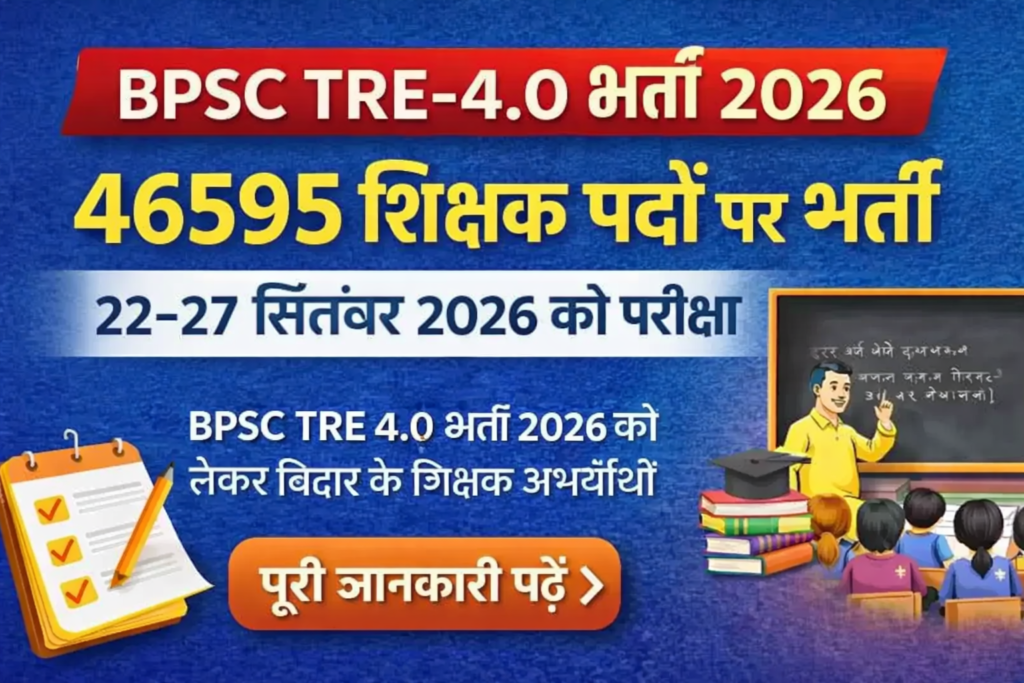
BPSC TRE-4: 46,595 शिक्षकों की भर्ती, 22 से 27 सितंबर तक होगी परीक्षा
बिहार में शिक्षक भर्ती की तैयारी कर रहे अभ्यर्थियों के लिए एक बड़ी और निर्णायक…

BPSC School Teacher TRE 4.0 Recruitment 2026: Apply Online for 44,000+ Teacher Posts
The Bihar Public Service Commission (BPSC) has officially released the short notice for School Teacher…