
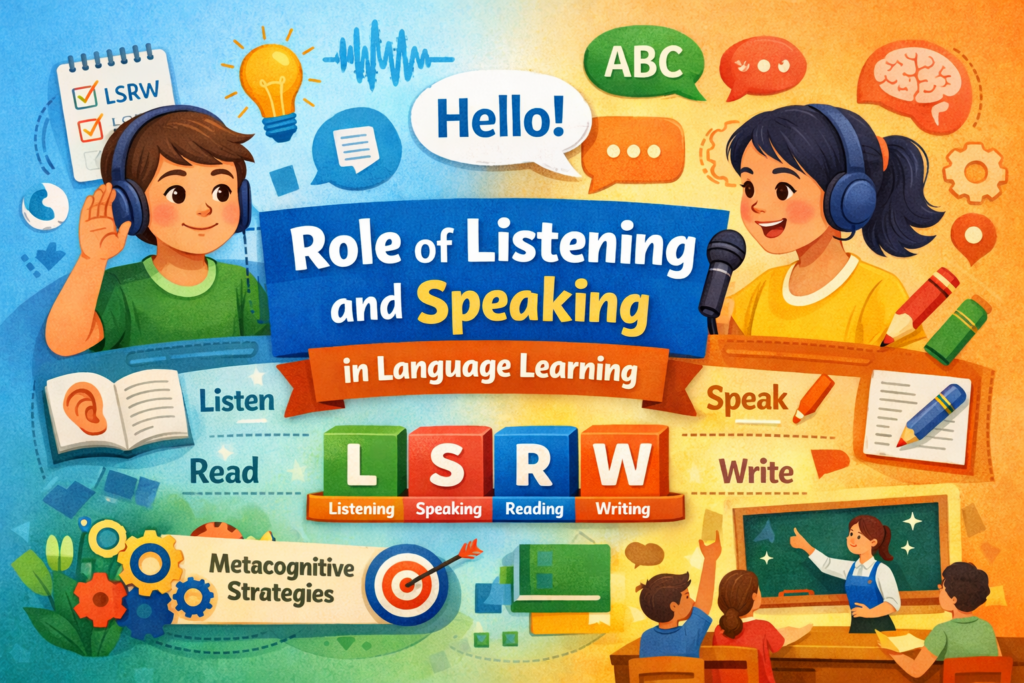
Role of Listening and Speaking
Instructors (शिक्षक) aim to develop students who, even if they don’t have complete control over grammar (व्याकरण) or an extensive vocabulary (शब्दावली), can still manage communication in different situations. In terms of listening, this means teaching students to:
- Use listening strategies to maximise comprehension (समझ).
- Identify what is relevant (प्रासंगिक) and non-relevant (अप्रासंगिक) information.
- Tolerate incomplete understanding (अधूरी समझ) and focus on the overall meaning rather than individual words.
*Metacognitive: किसी की अपनी विचार प्रक्रियाओं के बारे में जागरूकता और समझ।
Metacognitive Strategies (मेटाकॉग्निटिव रणनीतियाँ) for Listening:
Before Listening:
- Plan (योजना बनाना) for the listening task.
- Set a purpose (उद्देश्य) or decide in advance what information to focus on.
- Decide if more linguistic knowledge (भाषाई ज्ञान) or background knowledge (पृष्ठभूमि ज्ञान) is required.
- Determine if you should listen for overall meaning (सामान्य अर्थ) or focus on specific words and phrases (शब्द और वाक्यांश).
During and After Listening:
- Monitor comprehension (समझ की निगरानी करें):
- Verify predictions (पूर्वानुमानों की पुष्टि करें) and check for incorrect guesses (गलत अनुमानों की जांच करें).
- Decide what is important (महत्वपूर्ण) and what can be ignored (नजरअंदाज किया जा सकता है).
- Listen again (दोबारा सुनें) to improve understanding.
- Ask for help (मदद मांगें) if necessary.
After Listening:
- Evaluate comprehension and strategy use (समझ और रणनीति के उपयोग का मूल्यांकन करें):
- Reflect on comprehension of the task (कार्य की समझ पर विचार करें).
- Evaluate progress (प्रगति का मूल्यांकन करें) in listening, particularly in different types of listening tasks.
- Assess if the strategies used were appropriate (उपयुक्त) for the task.
- Modify strategies (रणनीतियों को संशोधित करें) if needed for better performance.
Reading Aloud (उच्च स्वर में पढ़ना)
A student’s performance when reading aloud is not always an accurate reflection (प्रतिबिंब) of their reading ability (पढ़ने की क्षमता). A student may fully understand a text when reading silently (चुपचाप), but struggle when asked to read aloud. Additionally, reading aloud is not a real-world skill (वास्तविक दुनिया का कौशल) students will often need outside of the classroom, making it an unreliable method of assessment (मूल्यांकन की अविश्वसनीय विधि).
Comprehension Questions (समझ के प्रश्न):
Comprehension questions should be aligned with the purpose (उद्देश्य) of reading. For instance:
- If the purpose is to find specific information (विशिष्ट जानकारी), questions should focus on that.
- If the purpose is to understand opinions (राय) and arguments (तर्क), questions should address those aspects.
Authentic Assessment (प्रामाणिक मूल्यांकन):
To authentically assess a student’s reading ability, post-reading activities should reflect real-life applications (वास्तविक जीवन के अनुप्रयोग). Tasks should allow students to demonstrate (प्रदर्शित करना) their understanding by using the information gained from reading to complete meaningful tasks (सार्थक कार्य).
Role of Listening, Speaking, Reading, and Writing
English is our major window (मुख्य खिड़की) to the modern world (आधुनिक दुनिया), and its importance in schools and colleges remains significant. Even though English lost its dominant position after independence, it remains crucial, especially in fields of science and technology (विज्ञान और प्रौद्योगिकी).
The Four Fundamental Objectives (चार मौलिक उद्देश्य):
- Listening (सुनना) – Teaching students to understand spoken English (बोली गई अंग्रेज़ी) by helping them recognize sounds (ध्वनियाँ) and the meaning conveyed by stress (बलाघात) and intonation (स्वरक्रम).
- Speaking (बोलना) – Developing the ability to communicate ideas verbally (मौखिक रूप से), using correct pronunciation (सही उच्चारण) and sentence structure (वाक्य संरचना).
- Reading (पढ़ना) – Enabling students to comprehend (समझना) written English, by focusing on reading comprehension skills (पढ़ने की समझ) and vocabulary building (शब्दावली निर्माण).
- Writing (लिखना) – Teaching students to express thoughts (विचार) in written form, using proper grammar (सही व्याकरण) and structure (संरचना).
Importance of Listening and Speaking Skills in Language Learning
To enable students to communicate effectively (प्रभावी ढंग से संवाद करना), it’s crucial to teach both listening (सुनना) and speaking (बोलना) skills. Students should be able to:
- Recognize different sounds (विभिन्न ध्वनियाँ) and differentiate between them.
- Understand the meaning behind intonation (स्वरक्रम) and stress patterns (बलाघात के पैटर्न).
- Speak fluently (धारा प्रवाह) and accurately (सटीकता से) using appropriate grammar (उपयुक्त व्याकरण) and vocabulary (शब्दावली).
Effective communication requires both listening (सुनने) and speaking (बोलने) to complement each other.
Language Skills: LSRW
Language educators have long emphasized four fundamental language skills:
- Listening
- Speaking
- Reading
- Writing
These skills are interrelated based on two parameters:
- Mode of Communication: Oral or Written
- Direction of Communication: Receiving or Producing the message
1. Listening (सुनना)
Listening comprehension (श्रवण समझ) is a receptive skill in the oral mode. It involves understanding what we hear.
Listening Situations (सुनने की स्थितियाँ):
- Interactive (इंटरैक्टिव): This includes face-to-face conversations and telephone calls in which listeners can ask for clarification, repetition, or slower speech.
- Non-interactive (गैर-इंटरैक्टिव): Involves listening to radio, TV, films, or lectures where there’s no opportunity to ask for clarification.
Micro-skills (सूक्ष्म कौशल) for Listening:
- Retain chunks of language (भाषा के टुकड़ों को स्मृति में रखना): Retaining small portions of language in memory.
- Discriminate among distinctive sounds (अलग-अलग ध्वनियों को अलग पहचानना): Recognizing sounds unique to the language.
- Recognize stress and rhythm patterns (तनाव और लय के पैटर्न को पहचानना): Identifying the rhythm and stress in speech.
- Recognize reduced forms of words (शब्दों के घटित रूपों को पहचानना): Understanding shortened or contracted forms of words.
- Recognize word boundaries (शब्दों की सीमाओं को पहचानना): Differentiating between where words begin and end.
- Guess meaning from context (प्रसंग से अर्थ अनुमानित करना): Using context to understand the meaning of unknown words.
- Detect sentence constituents (वाक्य के घटकों को पहचानना): Identifying parts of a sentence like subject, verb, object, etc.
2. Speaking (बोलना)
Speaking is a productive skill (उत्पादक कौशल) in the oral mode. It’s more complex than simply pronouncing words and involves expressing thoughts clearly.
Speaking Situations:
- Interactive (इंटरैक्टिव): Face-to-face conversations where there is a back-and-forth exchange.
- Partially Interactive (आंशिक इंटरैक्टिव): Giving a speech where audience reactions help gauge understanding.
- Non-interactive (गैर-इंटरैक्टिव): Situations like recording a speech for a radio broadcast.
Micro-skills for Speaking:
- Pronounce distinctive sounds clearly (विशिष्ट ध्वनियों का स्पष्ट उच्चारण करना): Ensuring correct pronunciation.
- Use stress and rhythmic patterns (तनाव और लय पैटर्न का प्रयोग): Utilizing stress and rhythm effectively.
- Put words together in correct order (शब्दों को सही क्रम में रखना): Formulating grammatically correct sentences.
- Use vocabulary appropriately (शब्दावली का सही प्रयोग): Using the right words for the situation.
- Make discourse coherent (वार्तालाप को सुसंगत बनाना): Ensuring the conversation flows logically.
3. Reading (पढ़ना)
Reading is a receptive skill in the written mode. It can develop independently but often complements listening and speaking skills.
Micro-skills for Reading:
- Decipher the script (लिपि को समझना): Recognizing the connection between sounds and written symbols.
- Recognize vocabulary (शब्दावली को पहचानना): Understanding the meaning of individual words.
- Guess meaning from context (प्रसंग से शब्दार्थ अनुमानित करना): Understanding unknown words by their context.
- Recognize grammatical word classes (व्याकरणिक शब्द वर्गों को पहचानना): Identifying parts of speech like nouns, verbs, adjectives, etc.
- Detect sentence constituents (वाक्य घटकों को पहचानना): Recognizing elements such as subject, verb, and object.
- Distinguish main ideas from details (मुख्य विचारों और विवरणों में अंतर करना): Identifying the central point versus supporting details.
- Adjust reading strategies (पढ़ने की रणनीतियों को समायोजित करना): Skimming for main ideas or in-depth study depending on the purpose.
4. Writing (लिखना)
Writing is a productive skill in the written mode. It’s considered one of the most challenging language skills, involving not just the graphical representation of speech but also the organized presentation of ideas.
Micro-skills for Writing:
- Use orthography correctly (शब्दलेखन का सही उपयोग): Proper use of spelling and punctuation.
- Use correct word forms (शब्दों के सही रूपों का प्रयोग): Using the right tense, case, or gender.
- Put words together in the correct order (शब्दों को सही क्रम में रखना): Forming grammatically correct sentences.
- Use appropriate style (उपयुक्त शैली का प्रयोग): Adjusting writing style according to genre and audience.
- Ensure coherence (लेख को सुसंगत बनाना): Making sure the text is logically structured.
- Judge audience’s knowledge (श्रोता के ज्ञान का अनुमान लगाना): Providing enough background for the reader to understand the text.
These language skills—Listening, Speaking, Reading, and Writing (LSRW)—are essential for effective communication in any language.
Language Skills: LSRW (Productive and Receptive Skills)
Language learning involves mastering four fundamental skills categorized into Productive and Receptive skills:
- Listening (सुनना) – Receptive Skill
- Speaking (बोलना) – Productive Skill
- Reading (पढ़ना) – Receptive Skill
- Writing (लिखना) – Productive Skill
- प्राचीन भारत में शिक्षा (विस्तृत नोट्स – B.Ed CCSU)
- Education in Ancient India: Objectives, Features, and Significance

- CTET 2026 Answer Key Released – Download Paper 1 & Paper 2 Answer Key
- BPSC TRE-4: 46,595 शिक्षकों की भर्ती, 22 से 27 सितंबर तक होगी परीक्षा
- BPSC School Teacher TRE 4.0 Recruitment 2026: Apply Online for 44,000+ Teacher Posts


Pingback: Pedagogy of English Language – (CTET English Pedagogy)