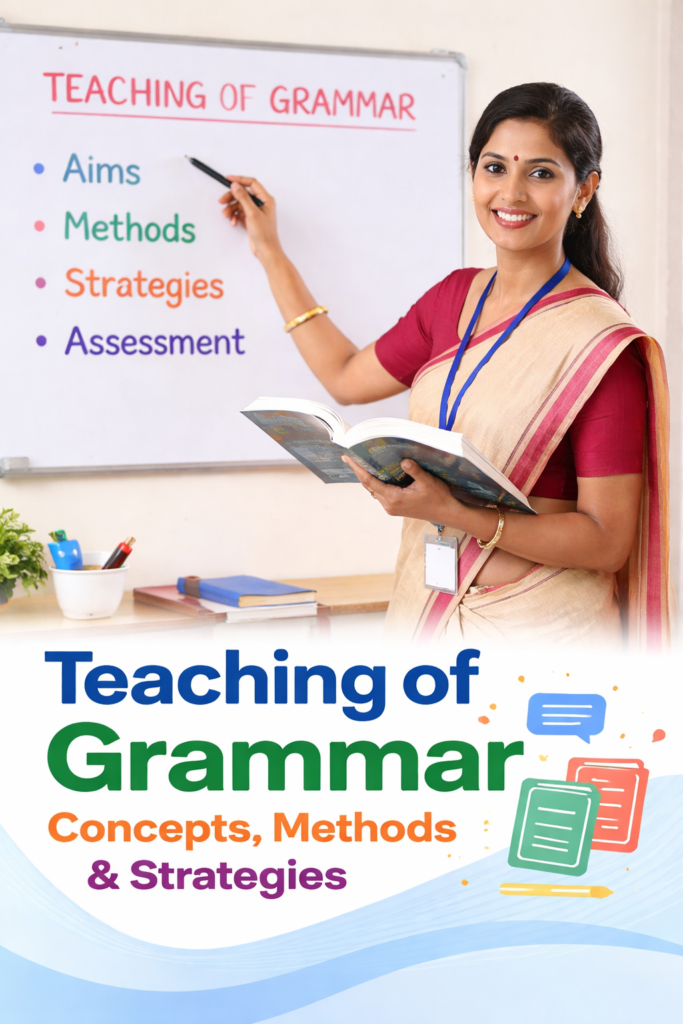
Grammar plays a central role in language learning because it provides the structural foundation through which meaning is conveyed. In English language pedagogy, the teaching of grammar has evolved from rote learning of rules to a communicative, learner-centred process. This article offers a comprehensive understanding of the teaching of grammar, its aims, strategies, methods, drills, and assessment practices, as prescribed in CTET/TET English Language and Pedagogy syllabi.
Introduction to Teaching of Grammar
Grammar is the systematic study of how words are organised into meaningful sentences. It is governed by rules that enable learners to communicate accurately and effectively. According to linguists, grammar provides learners with formal patterns of language that help them speak and write correctly.
Importantly, grammar is not merely about rules. Instead, it develops the learner’s ability to use language appropriately in real situations. Children naturally acquire grammar by listening, speaking, reading, and writing. Therefore, grammar learning should be integrated with communication rather than taught in isolation.
Aims of Teaching Grammar
The teaching of grammar aims to develop a learner’s insight into the structure of the English language. It helps learners understand how language works through regular use and practice. Moreover, grammar instruction enables learners to assimilate correct language patterns without relying on rote memorisation.
Another key aim is to help students speak and write accurately. In addition, grammar teaching nurtures a scientific and analytical attitude towards language learning, which supports long-term language development.
Strategies of Learning Grammar
Learners often know grammar rules but struggle to apply them in communication. This gap exists due to the difference between declarative knowledge and procedural knowledge.
Declarative knowledge refers to knowledge about grammar rules. In contrast, procedural knowledge refers to the ability to use those rules in actual communication. Effective grammar teaching must bridge this gap.
Relating Knowledge to Learning Goals
Grammar knowledge should be connected to learners’ communicative goals. When learners understand why they are learning a grammar structure, their motivation and application improve.
Applying Higher Order Thinking Skills
When learners compare grammatical structures across languages, they develop analytical and critical thinking skills. As a result, grammar learning becomes deeper and more meaningful.
Providing Rich Language Input
Learners develop grammar competence through exposure to meaningful oral and written input. Therefore, teachers should focus on the relationship between form, meaning, and use while presenting grammar items.
Using Predictive Skills
Learners naturally predict language patterns such as tense, sentence structure, and discourse style. For example, past tense is commonly used in historical texts. Such awareness enhances grammar learning.
Limiting Mechanical Drills
Although mechanical drills help memorisation, they do not promote communicative competence. Hence, their use should be limited and balanced with communicative activities.
Techniques for Teaching Grammar
The primary goal of grammar instruction is to enable learners to use language for communication. Grammar can be taught explicitly or implicitly, depending on learners’ needs.
Teachers should present grammar points both orally and in written form to accommodate different learning styles. Furthermore, examples used in teaching must be accurate, appropriate, and context-based.
Gap-filling exercises and focused examples help learners practice grammar structures effectively. At the same time, grammar teaching should always be linked to real language use.
Relevance of Grammar Instruction
In the communicative competence model, grammar is not an end in itself. Instead, it is a tool for learning language meaningfully. Therefore, grammar instruction should integrate structure, meaning, and use to support authentic communication.
Error Correction in Grammar Teaching
Error correction should not hinder communication or reduce learner confidence. Teachers should focus more on content than on grammatical accuracy during communication.
When used constructively, error correction can guide learners by offering alternatives rather than discouraging them. Thus, error correction should support language acquisition, not obstruct it.
Methods of Teaching Grammar in English
There are four main methods of teaching grammar:
The Traditional Method
This method focuses on teaching grammar through rules, definitions, examples, and exercises. Learning progresses from rule to example. However, it relies heavily on rote memorisation and is often considered monotonous by learners.
The Informal Method
The informal method teaches grammar through usage rather than rules. When grammar is taught through real-life situations, it is known as pedagogical grammar. This method emphasises natural language use.
The Reference or Correlation (Incidental) Method
In this method, grammar is taught incidentally while teaching other language skills such as reading or writing. Although it focuses on application, it is not considered a complete method because grammar items are not taught systematically.
The Inductive and Deductive Method
This method encourages active learner participation and discourages rote learning.
In the inductive approach, learners observe examples, analyse them, and derive rules. This method is suitable for primary learners.
In the deductive approach, rules are presented first, followed by examples and practice. This approach is useful for advanced learners.
Developing Grammar Activities
Grammar activities should integrate form, meaning, and use. The Larsen-Freeman model highlights the interdependence of morphosyntax, semantics, and pragmatics.
Structured Input
Teachers should explain grammar points clearly and provide meaningful oral or written input. Reviewing grammar through examples helps reinforce learning.
Structured Output
Learners should practice grammar through communicative tasks. When teaching focuses explicitly on structure, it is known as Explicit Grammar Instruction (EGI).
Communicative Output
Communicative tasks allow learners to use grammar naturally. In such activities, content is not predetermined, which promotes authentic language use.
Grammar Exercises and Drills
There are three main types of grammar drills:
Mechanical Drills
These drills have only one correct answer and do not require understanding of meaning. Although they help memorisation, they are the least effective for real communication.
Meaningful Drills
Meaningful drills require learners to understand meaning to complete tasks. They help learners form connections between form and meaning.
Communicative Drills
Communicative drills focus on the relationship between form, meaning, and use. Learners use language to convey ideas and information, making these drills the most effective.
Assessing Grammar Proficiency
Authentic assessment of grammar should reflect real-life language use. Grammar assessment should involve meaningful tasks rather than memory-based tests.
Activities such as responding to audio inputs or completing communicative tasks help evaluate learners’ grammar proficiency effectively. Teachers can use checklists to assess grammar use in context.
Key Grammar Concepts: Syntax and Dangling Modifiers
Syntax refers to the principles governing sentence structure in a language. It explains how words are arranged to form meaningful sentences.
A dangling modifier is a grammatical error where a modifier is incorrectly associated with a word. Such errors create ambiguity and confusion, highlighting the importance of clear sentence structure.
Conclusion
The teaching of grammar is most effective when it is communicative, contextual, and learner-centred. Rather than focusing solely on rules, grammar instruction should integrate form, meaning, and use. By applying appropriate strategies, methods, drills, and assessments, teachers can help learners achieve grammatical accuracy and communicative competence simultaneously.
- प्राचीन भारत में शिक्षा (विस्तृत नोट्स – B.Ed CCSU)
- Education in Ancient India: Objectives, Features, and Significance

- CTET 2026 Answer Key Released – Download Paper 1 & Paper 2 Answer Key
- BPSC TRE-4: 46,595 शिक्षकों की भर्ती, 22 से 27 सितंबर तक होगी परीक्षा
- BPSC School Teacher TRE 4.0 Recruitment 2026: Apply Online for 44,000+ Teacher Posts