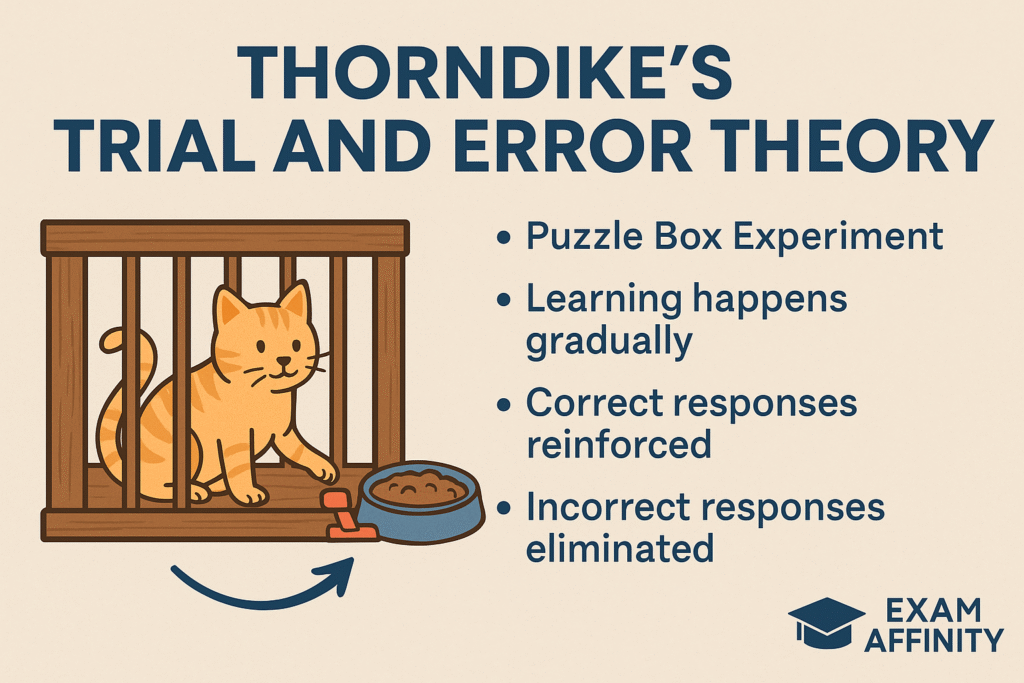
Edward Lee Thorndike was an American psychologist who introduced Thorndike’s Trial and Error Theory in 1911. He is often called the founder of the Trial and Error method of learning. His landmark experiment in 1911 demonstrated how animals and humans learn through repeated attempts, gradual improvement, and the elimination of mistakes. According to him, learning happens gradually when a learner keeps trying, makes mistakes, and finally discovers the correct solution.
Thorndike explained that learning forms a bond between a stimulus (S) and a response (R), and this connection improves through trial, error, and success.
What is Thorndike’s Trial and Error Theory?
The Trial and Error Principle states that a learner tries different methods, fails repeatedly, and ultimately performs the correct action.
In simple words:
“Learning is the process of forming an S-R bond through trial, error, and reward.”Thorndike explained that learning occurs when a learner tries different methods, experiences errors, and eventually discovers the correct response. Through this process, a Stimulus–Response (S-R) bond is formed.
According to him, “Learning is a process of forming a connection between stimulus and response through trial, error, and success.”
Join Test Series — https://examaffinity.org/
Thorndike’s Puzzle Box Experiment
Procedure
In Thorndike’s Trial and Error Theory, Thorndike placed a hungry cat inside a wooden puzzle box. A piece of food was kept outside the box. Since the cat wanted to escape, it tried several random actions such as scratching, biting, and jumping. After many unsuccessful attempts, the cat accidentally pressed a lever that opened the door. As soon as the cat reached the food, it experienced satisfaction.
Observation
At first, the cat took a long time to escape. However, with each trial, errors gradually reduced. The cat soon learned to press the lever quickly. This showed that learning becomes faster when unnecessary movements are eliminated.
Conclusion
– Learning develops gradually through repeated attempts.
– Correct responses become stronger because they bring satisfaction.
– Incorrect responses fade because they bring no reward.
– Practice and experience help the learner adopt the correct behaviour more quickly.
More about Thorndike:
External Source: https://en.wikipedia.org/wiki/Edward_Thorndike
Thorndike’s Three Primary Laws of Learning
1. Law of Effect (Most Important)
“Responses followed by satisfaction are strengthened, while responses followed by discomfort are weakened.”
Key Points:
– Reward strengthens learning.
– Punishment weakens the response.
Easy Trick: RN
– R = Reward → Strong connection
– N = No reward / punishment → Weak connection
2. Law of Readiness
“Learning occurs effectively when the learner is mentally and physically prepared.”
Explanation:
When a learner shows readiness, learning becomes smooth and efficient. In contrast, if the learner is not ready, instruction may lead to frustration instead of progress.
3. Law of Exercise
“Practice strengthens the S-R bond, while lack of practice weakens it.”
Explanation:
Repeated practice makes learning permanent. Without revision, the learned response gradually disappears.
Summary Table of Thorndike’s Trial and Error Theory
| Law | Explanation | Impact on Learning |
|---|---|---|
| Law of Effect | Reward strengthens response; punishment weakens it | Motivation improves learning |
| Law of Readiness | Learning occurs when learner is prepared | Learning becomes easier and faster |
| Law of Exercise | Repetition strengthens learning | Retention improves and becomes permanent |
Educational Implications of Trial and Error Theory
Effective teaching can apply Thorndike’s principles in several ways:
– Use rewards to motivate learners.
– Ensure students are mentally prepared before introducing new concepts.
– Provide opportunities for practice and revision.
– Allow students to learn from their mistakes to build confidence.
– Promote activity-based learning so that learners can explore and discover solutions.
SUGGESTED READING:
https://examaffinity.in/child-centred-and-progressive-education/
Thorndike’s Trial and Error Theory: Important Terms
| Term | Meaning |
|---|---|
| Trial and Error | Learning through repeated attempts and the removal of incorrect responses |
| S-R Bond | Connection between stimulus (S) and response (R) |
| Law of Effect | Reward strengthens correct responses; punishment weakens wrong ones |
| Law of Readiness | Learning becomes easy when the learner is prepared |
| Law of Exercise | Practice and repetition strengthen learning |
| Reinforcement | Reward given after a correct response |
| Puzzle Box | Box used by Thorndike to study animal learning |
| Connectionism | Thorndike’s theory explaining how S-R bonds form |
| Reward (R) | Satisfaction received after the correct response |
| No Reward (N) | Absence of reward or discomfort after an incorrect response. |
Common Questions About Thorndike’s Learning Theory
Thorndike’s Trial and Error Theory explains that learning happens gradually through repeated attempts. A learner tries different methods, makes mistakes, and finally performs the correct response. This correct response becomes stronger due to satisfaction or reward.
Thorndike placed a hungry cat inside a wooden puzzle box with food outside. The cat tried many random actions and accidentally pressed a lever that opened the door. Over time, the cat learned to press the lever quickly. This proved that learning happens through trial, error, and success.
The Law of Effect states that responses followed by satisfaction or reward are strengthened, while responses followed by dissatisfaction or punishment are weakened. Reward helps in forming strong learning bonds.
The Law of Readiness means learning becomes easy and effective when a learner is mentally and physically prepared. If a student is not ready, learning can cause annoyance or frustration.
The Law of Exercise states that practice strengthens the connection between a stimulus and a response. Without practice, learning weakens. Repetition helps make learning permanent.
Teachers should use rewards to motivate students, prepare them mentally before teaching, provide repetition and practice, and allow them to learn from mistakes. Activity-based learning should be encouraged.
Connectionism refers to Thorndike’s idea that learning is the formation of connections (bonds) between stimulus and response. These connections strengthen with reward and practice.
प्राचीन भारत में शिक्षा (विस्तृत नोट्स – B.Ed CCSU)
भारत में शिक्षा का विकास भारत में शिक्षा का विकास अत्यंत प्राचीन काल से होता…

Education in Ancient India: Objectives, Features, and Significance
Education in Ancient India (Easy & Exam-Ready Notes for B.Ed Students) Introduction Education in ancient…

CTET 2026 Answer Key Released – Download Paper 1 & Paper 2 Answer Key
The Central Board of Secondary Education (CBSE) has released the CTET 2026 provisional answer key…

BPSC TRE-4: 46,595 शिक्षकों की भर्ती, 22 से 27 सितंबर तक होगी परीक्षा
बिहार में शिक्षक भर्ती की तैयारी कर रहे अभ्यर्थियों के लिए एक बड़ी और निर्णायक…

BPSC School Teacher TRE 4.0 Recruitment 2026: Apply Online for 44,000+ Teacher Posts
The Bihar Public Service Commission (BPSC) has officially released the short notice for School Teacher…