
Introduction
Mathematics occupies a central place in school education and human intellectual development. According to NCFSE 2023, mathematics is not merely a subject of numbers and calculations; it is a powerful way of understanding the world through patterns, measurements, quantities, and logical reasoning. It plays a vital role in shaping a learner’s thinking, reasoning ability, and problem-solving skills.
Nature of Mathematics
Mathematics is a universal discipline that is deeply rooted in human nature. It finds an important place in school education and is taught as a compulsory subject at the elementary stage, continuing up to the secondary level.
Although many learners perceive mathematics as a difficult subject that creates fear, stress, and anxiety, research and educational experience suggest that this fear is largely a result of ineffective teaching methods, not the subject itself. A stress-free and activity-based classroom environment can make mathematics enjoyable and meaningful.
Mathematics helps learners:
- Quantify ideas with precision
- Use spatial and numerical concepts in daily life
- Develop accuracy and clarity in thinking
It is widely used as an essential tool in various fields such as natural sciences, engineering, medicine, social sciences, economics, and technology.
Beyond practical utility, mathematics nurtures logical reasoning, abstract thinking, imagination, and creativity. Due to these qualities, mathematics holds a permanent and indispensable position in the school curriculum.
📘 Access Testbook CTET Mock TestsMathematics in the View of NCFSE 2023
According to NCFSE 2023, mathematics is a structured way of making sense of the world through:
- Patterns
- Measurements
- Quantities
- Logical relationships
It encourages learners to observe, generalize, and apply ideas in real-life situations.
What is Mathematics?
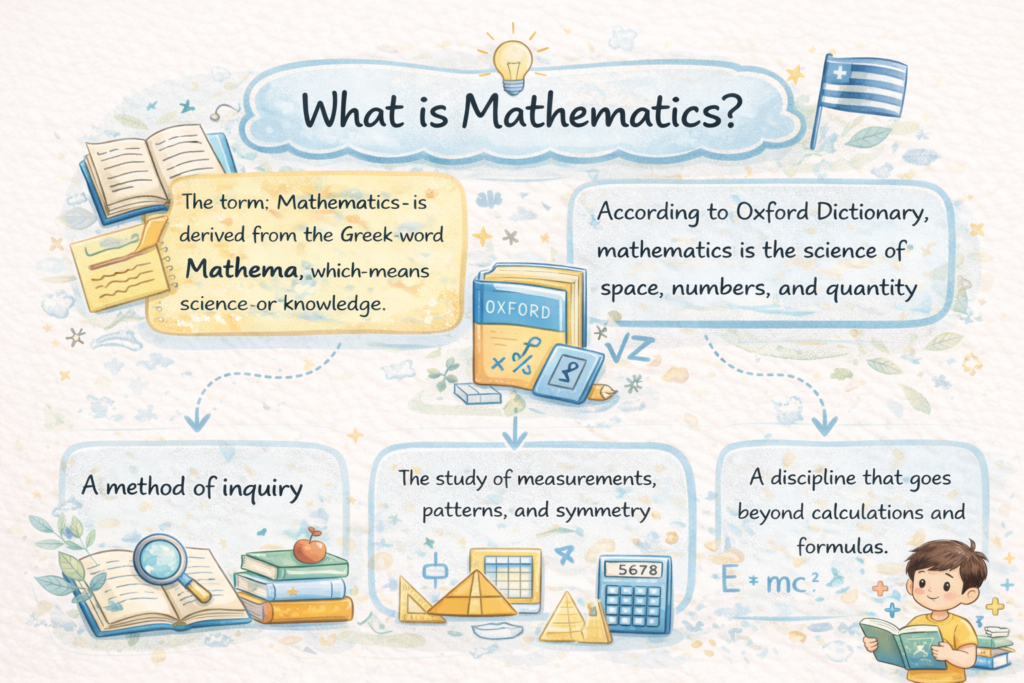
The term “Mathematics” is derived from the Greek word “Mathema”, which means science or knowledge.
According to the Oxford Dictionary, mathematics is the science of space, numbers, and quantity.
Mathematics can also be understood as:
- A method of inquiry
- The study of measurements, patterns, and symmetry
- A discipline that goes beyond calculations and formulas
While many people think mathematics is only about calculations, in reality, it is a science of reasoning that strengthens the human brain.
Important Definitions of Mathematics
Various scholars have defined mathematics from different perspectives:
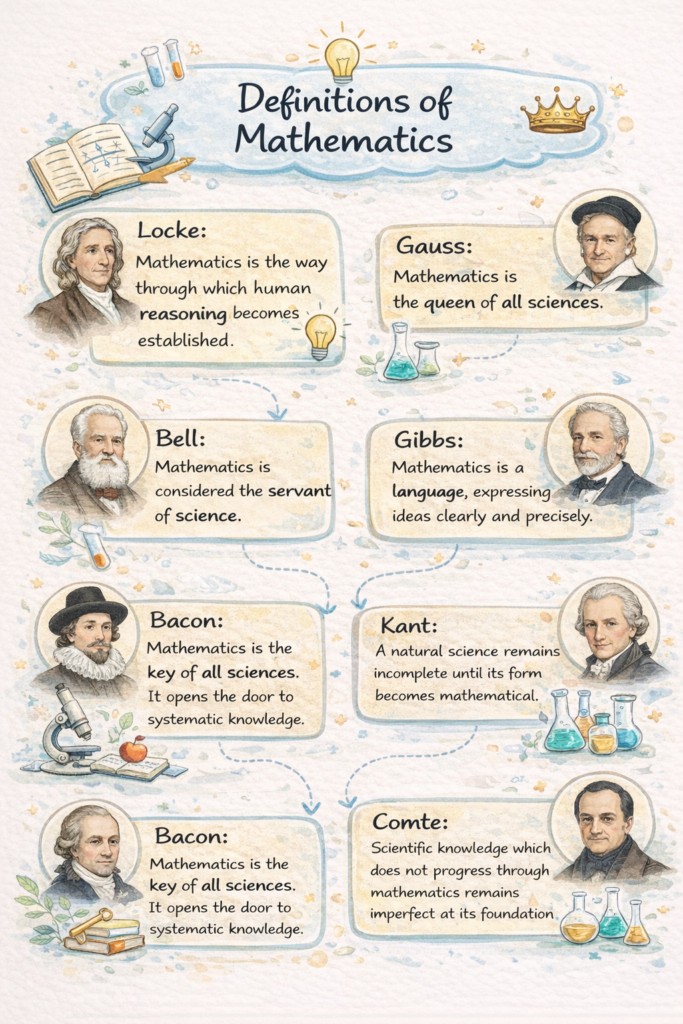
Locke stated that mathematics is the way through which human reasoning becomes established.
Gauss described mathematics as the queen of all sciences, highlighting its foundational role.
Bell considered mathematics as the servant of science, supporting scientific discoveries.
Gibbs defined mathematics as a language, expressing ideas clearly and precisely.
Bacon said mathematics is the key to all sciences, opening the door to systematic knowledge.
Kant believed that a natural science remains incomplete until it becomes mathematical in form.
Comte emphasized that scientific knowledge that does not progress through mathematics remains imperfect at its foundation.
Key Characteristics of Mathematics
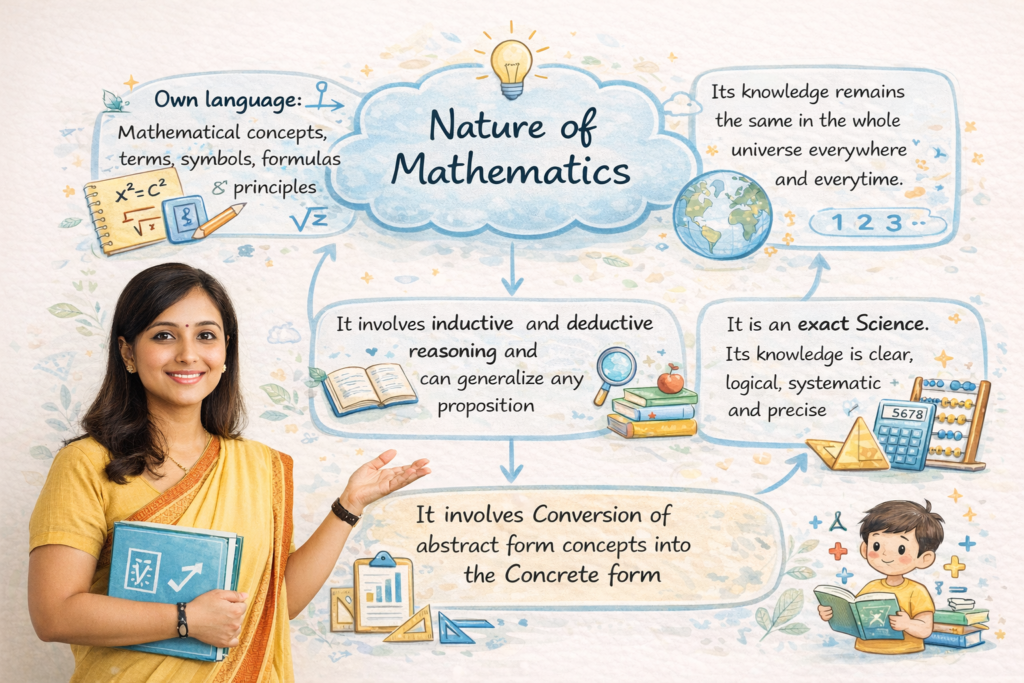
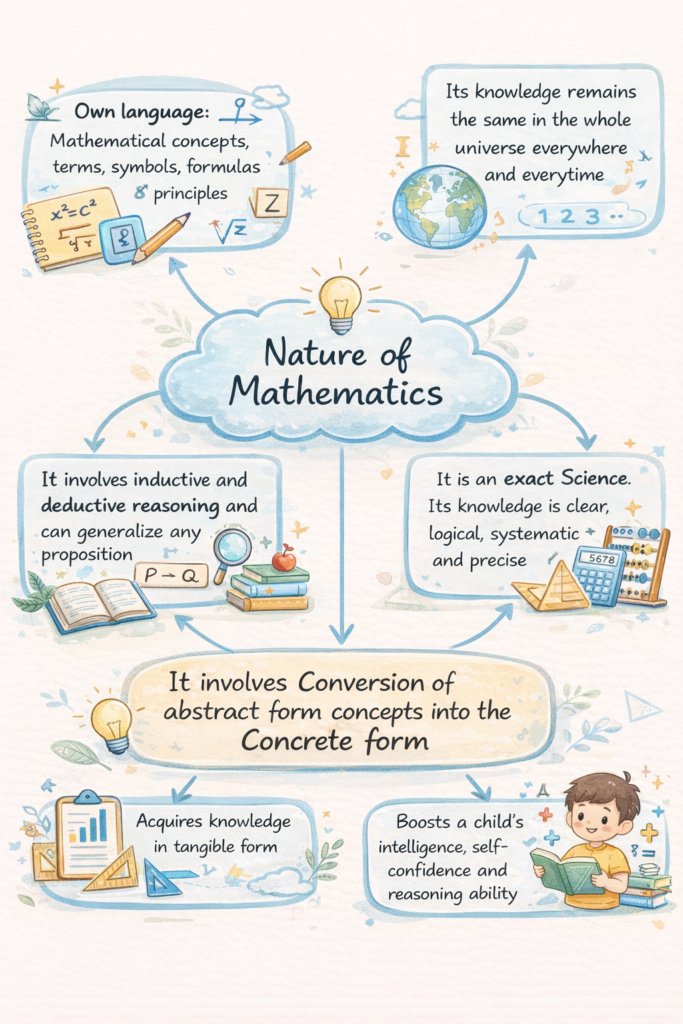
Mathematics has its own unique language, which includes symbols, formulas, principles, and concepts that are universally accepted.
Its knowledge remains the same everywhere in the world, irrespective of culture or region.
Mathematics is an exact science, and its knowledge is always clear, logical, systematic, and precise.
It involves both inductive and deductive reasoning, enabling learners to generalize propositions and draw valid conclusions.
Mathematical learning progresses from the concrete to the abstract and again from abstract to concrete, helping learners gain knowledge in a tangible and meaningful form.
Educational Value of Mathematics
Learning mathematics helps in:
- Developing intelligence and reasoning ability
- Building self-confidence
- Strengthening problem-solving skills
- Enhancing logical and analytical thinking
Thus, mathematics is not only a subject of study but also a powerful tool for mental discipline and intellectual growth.
CTET Mathematics Pedagogy – Application Based MCQs
Explanation: Mathematics is a method of inquiry where reasoning and thinking processes are emphasized, not just answers.
Explanation: Mathematical knowledge remains the same everywhere and can be applied universally.
Explanation: Mathematics involves converting abstract concepts into concrete forms for better understanding.
- समास क्या है? हिंदी व्याकरण समास के भेद, परिभाषा और उदाहरण – PDF Notes

- BPSC TRE 3.0 Question Paper PDF डाउनलोड करें – TRE 4.0 की तैयारी के लिए महत्वपूर्ण प्रश्न
- CTET Paper 1 Previous Year Question Papers with Answer Key PDF – 2018 to 2026
- CCSU B.Ed 1st Year Question Papers 2026 – Download June 2026 Exam Papers PDF
- CTET 2026: 22वें संस्करण के लिए आवेदन का फिर से मौका, 25 अगस्त से 1 सितंबर तक खुला पोर्टल


This article may contain affiliate links. If you purchase through these links, we may earn a small commission at no extra cost to you.