
Introduction | The Rise of Nationalism in Europe
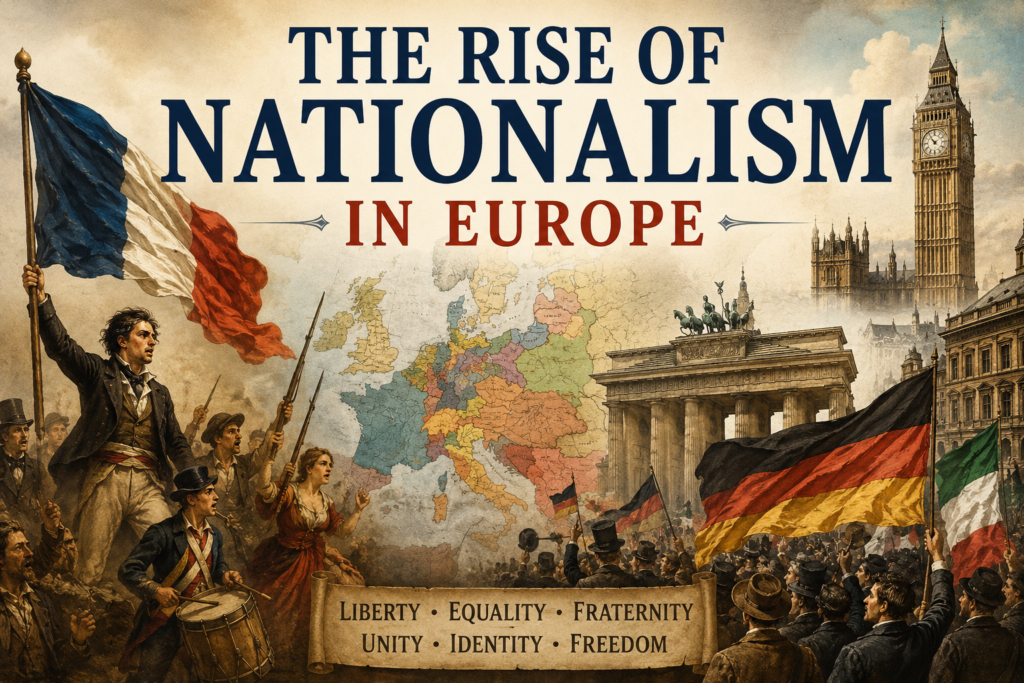
The chapter The Rise of Nationalism in Europe is one of the most important chapters in Class 10 History because it explains how nationalism emerged in Europe and gradually spread across the world. This chapter is not only about historical events but also about the ideologies that inspired revolutions, political movements, and social changes.
The Rise of Nationalism in Europe (Part 1)
1. Key Political Terminologies
- Nationalism: A socio-economic and political philosophy emphasizing collective faithfulness, devotion, and allegiance to a nation-state.
- Utopia (Utopian Vision): A vision of a highly idealized society that is so perfect it is practically impossible to exist, though societies continuously strive to achieve it.
- Absolutist Institutions: Centralized, monarchical governments that exercise completely unrestricted, autocratic, and uncontrolled power over citizens.
- Plebiscite (Referendum): A democratic mechanism involving a direct vote by all inhabitants of an area to accept or reject a specific government proposal.
- Nation-State: A geographically distinct territory functioning as a sovereign unit, where citizens are bound together by shared identity and a feeling of nationalism.
Frédéric Sorrieu’s Print Analysis (1848)
- Title of the Print: “The Dream of Worldwide Democratic and Social Republics: The Pact Between Nations”.
- The Artist: Frédéric Sorrieu, a French artist who created a series of four prints in 1848 visualizing a democratic world order.
Key Visual Elements & Symbolism
- The Statue of Liberty: A personified female figure. She holds the Torch of Enlightenment in her right hand (symbolizing wisdom) and the Charter of the Rights of Man in her left (symbolizing citizen rights).
- The Marching Train: People of all ages and social classes from Europe and America marching together in traditional costumes, carrying their national flags to show their desire for national unification.
- The Leaders (Pioneers): The USA and Switzerland lead the procession because they had already successfully established themselves as sovereign nation-states by 1848.
- The Followers: France (identifiable by the revolutionary tricolor flag) is just reaching the statue, followed closely by Germany (carrying the black, red, and gold flag).
- The Foreground: Broken crowns, sceptres, and royal armor lie shattered on the ground, symbolizing the destruction of absolutist monarchies.
- The Heavens: Christ, angels, and saints watch over the scene from the sky, which Sorrieu used to symbolize fraternity (brotherhood) among the diverse nations of the world.
Ernst Renan’s Philosophy: “What is a Nation?” (1882)
- Context: A famous lecture delivered by French philosopher Ernst Renan at the University of Sorbonne.
Renan’s Core Arguments:
- Rejection of Superficial Markers: Renan explicitly argued against the idea that a nation is defined merely by a common language, race, religion, or geographical border.
- The True Blueprint: He defined a nation as the ultimate culmination of a long past of endeavors, sacrifice, and devotion. A shared heroic past and a unified common will in the present are the true foundations.
- The “Daily Plebiscite”: Renan famously stated that a nation’s existence is a daily plebiscite—it relies completely on the continuous, daily consent of its inhabitants to live together.
- The Purpose of Nations: The existence of distinct nation-states is a vital guarantee of individual liberty, which would be lost if the world had only one master and one uniform law.
Probable Assignment Questions (Based on Video End)
- Define the terms Utopian Vision, Absolutist, and Plebiscite.
- Describe the political conditions symbolized by the shattered remains in the foreground of Sorrieu’s 1848 print.
- Why did Frédéric Sorrieu include figures of Christ, saints, and angels in his artwork? What did they represent?
- How did Ernst Renan’s definition of a nation differ from standard views based on language, race, or territory?
The French Revolution and the Idea of the Nation
Core Definitions & Ideological Vocabulary
The European revolutions and structural updates were fundamentally driven by ideologies, rather than random, isolated incidents.
- Nationalism: A socio-economic and political philosophy emphasizing collective identity, deep devotion, faithfulness, and primary allegiance to a unified nation-state over regional rulers.
- Utopia / Utopian Vision: A vision of a highly idealized, perfect society that is structurally flawless. It is practically impossible to achieve in reality, yet it serves as a constant evolutionary benchmark that societies strive toward (e.g., the concept of Ramrajya).
- Absolutist Institutions: A centralized system of monarchical rule that exercises absolute, unchecked, and uncontrolled power. It is typically autocratic, despotic, and deeply oppressive to common citizens.
- Plebiscite (Referendum): A direct, democratic voting mechanism where all inhabitants of a defined geographical territory are requested to accept or reject a specific government proposal.
- Nation-State: A geographically distinct territory functioning as a completely sovereign political unit, where the citizens share a common language, culture, historical trajectory, and a collective feeling of nationalism.
- Despotism: The exercise of absolute power, typically by a cruel and tyrannical monarch, lacking legal or structural restraints.
Visual & Ideological Analysis of Historical Artwork
A. Frédéric Sorrieu’s Utopian Vision (1848)
- The Artwork: A series of four prints prepared by French artist Frédéric Sorrieu visualizing his dream of a world composed of “Democratic and Social Republics.”
- The Statue of Liberty: Personified as a majestic female figure holding the Torch of Enlightenment in her right hand (signifying wisdom) and the Charter of the Rights of Man in her left hand (signifying institutional citizen rights).
- The Train of Nations: A massive, continuous procession of citizens from Europe and America marching together, dressed in distinct traditional folk costumes and proudly holding their respective national flags.
- The Progression Order:
- The United States and Switzerland lead the line past the statue, having already successfully evolved into recognized, sovereign nation-states by 1848.
- France (identifiable by its revolutionary tricolor flag) is just reaching the base of the statue.
- Germany follows closely behind, displaying a unified black, red, and gold flag (reflecting their active 1848 democratic unification campaigns).
- The Foreground: The terrain is covered with the shattered, broken remains of crowns, sceptres, and royal armor, symbolizing the complete destruction and end of absolutist monarchies.
- The Heavens: Christ, angels, and holy saints look down from the clouds. Sorrieu intentionally included this divine imagery to symbolize fraternity (universal brotherhood) among the diverse nations of the earth.
B. The German Almanac Cover (1798) — Andreas Rebmann
- Visual Strategy: Juxtaposes a print of the storming of the Parisian Bastille side-by-side with a structurally matching, oppressive feudal fortress in Kassel, Germany.
- Slogan: “The people must seize their own freedom.”
- Significance: It serves as historical evidence showing how German middle-class thinkers and Jacobin clubs drew direct tactical inspiration from the French Revolution to challenge local despotism.
C. “The Planting of the Tree of Liberty” — Karl Kaspar Fritz
- Setting: The occupied German town of Zweibrücken.
- The Scene: French soldiers in blue, white, and red uniforms are depicted acting as cruel conquerors rather than liberators. They are shown confiscating a peasant’s cart, harassing local young women, and forcing citizens onto their knees.
- The Sarcastic Plaque: A signpost reads, “Take freedom and equality from us, the model of humanity.” This is highly ironic and serves to mock the hypocrisy of the French imperial troops.
D. Napoleon as the Courier of Rhineland
- Context: Depicts Napoleon dressed as a postal carrier retreating home after his severe military defeat at the Battle of Leipzig (1813).
- The Symbolism: A stream of paper letters is shown falling out of his torn bag. Each dropping paper is explicitly inscribed with the names of the specific European territories he lost control over due to the defeat.
Section 3: Ernst Renan’s Philosophy: “What is a Nation?” (1882)
In a famous lecture delivered at the University of Sorbonne, French philosopher Ernst Renan offered a direct critique of contemporary definitions of nationhood.
- Rejection of Superficial Standards: Renan fiercely argued that a nation is not formed merely by sharing a common language, belonging to the same race, practicing one religion, or being bound by a natural geographic border.
- The True Blueprint: He defined a nation as the ultimate culmination of a long past of endeavors, intense sacrifice, and total devotion. A shared, heroic historic past combined with a unified “common will” in the present are the true foundational blocks.
- The “Daily Plebiscite”: Renan coined the phrase that a nation’s ongoing existence is a daily plebiscite. It relies entirely on the continuous daily consent of its citizens to remain united.
- The Purpose of Nation-States: The existence of sovereign nations is a critical guarantee of human liberty. If the entire world possessed only one uniform law and one singular master, individual freedom would be permanently lost.
The French Revolution & National Identity (1789)
Specific Measures Implemented to Build a “Collective Identity”
Following the 1789 uprising, the revolutionaries introduced specific steps to forge an intense sense of national belonging among the populace:
- La Patrie & Le Citoyen: Popularized the concepts of the “Fatherland” (La Patrie) and the “Citizen” (Le Citoyen) to promote a unified community enjoying completely equal rights under a single constitution.
- The Flag: Replaced the former Royal Standard flag with the revolutionary French Tricolor.
- National Assembly: Reorganized the old, elite Estates General legislative branch into a newly elected, citizen-driven body renamed the National Assembly.
- Patriotic Culture: Composed uniform national hymns, forced public officials to take oaths of loyalty, and widely commemorated revolutionary martyrs in the name of the nation.
- Administrative Consolidation: Formed a highly centralized administrative system that crafted uniform laws for every citizen across all corners of the state.
- Economic Streamlining: Abolished all internal custom duties, border checkpoint taxes, and feudal dues. Additionally, they adopted a mandatory uniform system of weights and measures.
- Linguistic Unification: Discouraged regional dialects and formally established French as the standardized common written and spoken language of the country.
The Napoleonic Era & The Civil Code of 1804
The Administrative Framework
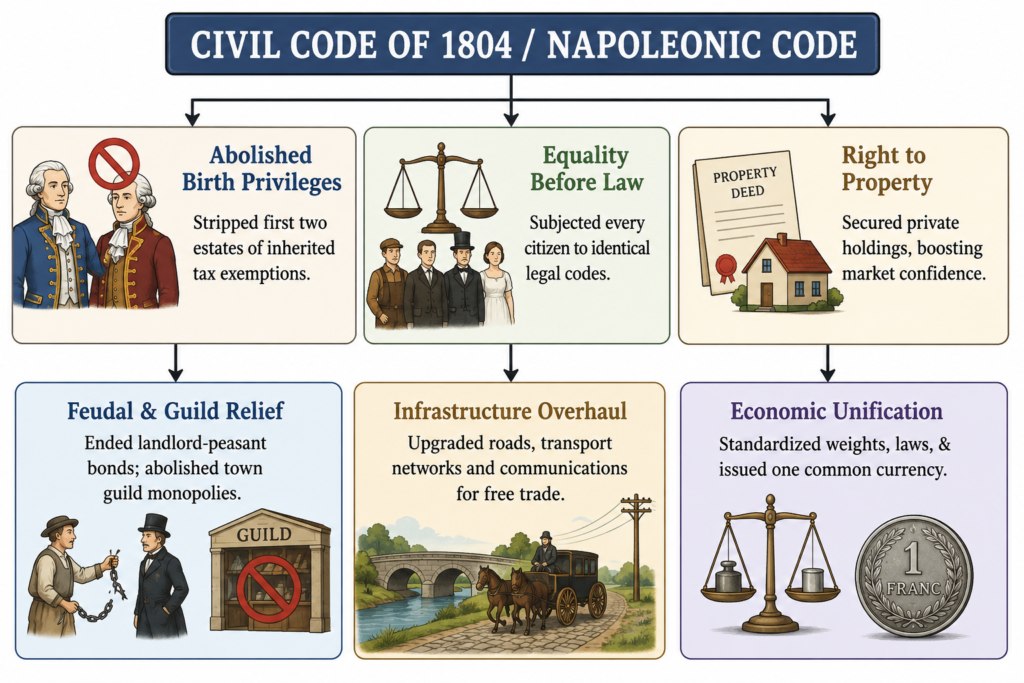
In 1799, Napoleon Bonaparte seized state control via a military coup d’état. By 1804, he crowned himself Emperor, ending political democracy. However, in the administrative sphere, he implemented radical revolutionary changes to create a highly rational and efficient state apparatus. This is famously termed “liberty under monarchy.”
Mixed Reactions to French Rule in Europe
As the French imperial armies marched across Europe into Holland, Switzerland, Belgium, and Italy, the local populations went through a massive psychological shift.
1. The Welcome: “Harbingers of Liberty”
In major hubs like Brussels, Milan, Mainz, and Warsaw, local citizens initially welcomed the arriving French regiments as harbingers (messengers) of absolute liberty. They expected the French forces to easily dismantle their local despotic monarchies and gift them the progressive judicial, economic, and administrative systems enjoyed in France.
2. The Turn to Hostility
The early excitement quickly turned into fierce public hostility when it became evident that Napoleon’s efficient administrative arrangements did not bring political freedom. Napoleon’s grand imperial goal to conquer all of Europe resulted in three highly oppressive policies that completely outweighed his civil updates:
- Increased Taxation: Subjected conquered territories to massive tax increases to fund France’s continuous, expensive foreign wars.
- Strict Censorship: Banned freedom of speech and stripped away press liberties. It was illegal to publish any criticism of Napoleon’s regime.
- Forced Conscription: Local young men were forcefully drafted into the French imperial armies to serve as front-line soldiers in Napoleon’s pan-European conquest campaigns.
📝 Interactive Practice Quiz: Rise of Nationalism in Europe
Q1. Which of the following best defines an ‘absolutist’ system of rule as described in the lectures?
- A) A democratic republic where the rule of law is absolute and supreme over all citizens.
- B) A monarchical government that exercises centralized, unrestricted, and autocratic power.
- C) A constitutional monarchy where the king acts purely as a symbolic head of state.
- D) A system where power is completely decentralized and managed by autonomous local guilds.
Reveal Answer & Rationale
Absolutist regimes are historically characterized by total centralized authority with zero institutional, legal, or constitutional checks on the ruler’s power.
Q2. What does a ‘utopian vision’ refer to in the context of Frédéric Sorrieu’s 1848 artistic prints?
- A) A realistic political roadmap blueprint designed for immediate implementation by diplomats.
- B) A vision of an idealized society that is so perfect that it is unlikely to actually exist in reality.
- C) A critical satire mocking the chaotic collapse of early democratic movements across Europe.
- D) A historical documentation of geographic borders finalized after the Battle of Leipzig.
Reveal Answer & Rationale
A utopia is defined as a conceptually flawless state that societies use as an idealistic blueprint benchmark to strive toward, even if it remains practically unattainable in everyday reality.
Q3. In Frédéric Sorrieu’s famous 1848 print, what is symbolized by the presence of Christ, angels, and saints gazing down from the heavens?
- A) Fraternity and universal brotherhood among the distinct nations of the world.
- B) The re-establishment of absolute religious execution courts across the continent.
- C) The military alliance of Britain, Russia, Prussia, and Austria against dictatorships.
- D) A warning that democratic revolutions would lead to widespread moral decay.
Reveal Answer & Rationale
The instructor highlights that the divine figures look down upon the human march with deep approval to serve as an artistic symbol of fraternity (universal brotherhood) among the world’s changing nations.
Q4. According to the French philosopher Ernst Renan, what forms the true foundation of a nation?
- A) A common language, a shared biological race, and clear natural geographical boundaries.
- B) A combination of a long past of shared endeavors, sacrifice, devotion, and a common will in the present.
- C) The successful military conquest and annexation of neighboring territories against their will.
- D) The structural centralization of power under a single, unchallenged monarchical ruler.
Reveal Answer & Rationale
Renan fiercely criticized the idea that superficial markers like language or race make a nation. Instead, he defined a nation as an emotional and moral culmination built on shared historic solidarity and continuous present agreement.
Q5. What did Ernst Renan mean when he famously stated that a nation’s existence is a ‘daily plebiscite’?
- A) Citizens must cast formal balance sheets and votes every morning to update national tax rates.
- B) A nation relies entirely on the continuous, daily consent of its inhabitants to remain united.
- C) The military must conduct daily checks on the population to maintain geographic stability.
- D) The ruler holds the absolute right to consult or dismiss government assemblies on a daily basis.
Reveal Answer & Rationale
A ‘plebiscite’ is a direct vote of acceptance or rejection. Using it metaphorically as a ‘daily’ event means that a nation status isn’t fixed forever by geography; it requires the continuous, active will of its citizens to stay together.
Q6. Which specific measure was introduced immediately after the 1789 French Revolution to cultivate a collective identity among the French people?
- A) The introduction of regional dialects to replace standard Parisian French writing.
- B) The creation of the concepts of ‘La Patrie’ (the Fatherland) and ‘Le Citoyen’ (the Citizen).
- C) The expansion of complex internal custom checkpoint taxes across different provinces.
- D) The formal transfer of legislative power to the traditional Bourbon Dynasty.
Reveal Answer & Rationale
These two explicit terms emphasized a completely unified fraternal community where all individuals enjoyed equal rights under a shared, uniform constitutional document.
Q7. While Napoleon destroyed democracy by re-establishing a dictatorship, how did he revolutionize the administrative field in France?
- A) He restored all feudal duties and birth privileges to the First and Second Estates.
- B) He incorporated revolutionary principles to make the whole state system more rational and efficient.
- C) He decentralized authority by creating dozens of unique, regional currencies.
- D) He banned private land ownership and eliminated the right to property.
Reveal Answer & Rationale
Through the Civil Code of 1804, Napoleon simplified internal regional borders and modernized infrastructure systems. This unique ideological structural blend is often referred to as “liberty under monarchy.”
Q8. Which of the following was NOT a core provision of the Civil Code of 1804 (Napoleonic Code)?
- A) The complete removal of town guild monopolies and trade restrictions.
- B) The establishment of legal equality before the law for all citizens.
- C) The reservation of high-ranking state positions and tax exemptions exclusively for the nobility by birth.
- D) The standardizing of weights and measures alongside an upgraded transport network.
Reveal Answer & Rationale
Napoleon explicitly stripped away all inherited, birth-based advantages held by the first two estates (Clergy and Nobility), making state selection based on capability rather than family status.
Q9. Why did the local populations of conquered European territories (like Holland and Germany) quickly become hostile to French rule?
- A) Napoleon refused to replace regional currencies or standardize local weights.
- B) The new administrative steps failed to bring political freedom, resulting instead in increased taxation, censorship, and forced conscription.
- C) The French armies immediately restored the absolute power of the local noble landowners.
- D) The populations preferred to keep their internal custom checkpoints and trade barriers.
Reveal Answer & Rationale
Any progressive benefits brought by Napoleon’s civil updates were entirely ruined in the eyes of locals by heavy taxes, a total clampdown on free speech, and the forced drafting of local young men to expand the French Empire.
Q10. What is the satirical message behind Karl Kaspar Fritz’s artwork, ‘The Planting of the Tree of Liberty in Zweibrücken, Germany’?
- A) It celebrates the pure, uncorrupted model of humanity brought by French troops to German cities.
- B) It highlights the deep hypocrisy of French forces who claimed to be liberators but acted as harsh military oppressors.
- C) It documents the voluntary surrender of German peasants to the Napoleonic code.
- D) It illustrates the peaceful cooperation between German Jacobin clubs and the French high command.
Reveal Answer & Rationale
By matching acts of military force (seizing carts, harassing women) with a wooden sign reading “Take freedom and equality from us,” the artist creates a sharp, ironic commentary mocking the reality of French occupation.
The making of Nationalism in Europe
Europe in the 18th Century
In the eighteenth century, nation-states did not exist in Europe. Countries such as Germany, Italy, and Switzerland were divided into kingdoms, duchies, and cantons whose rulers controlled autonomous territories. These regions were fragmented and lacked political unity.
Eastern and Central Europe were ruled by autocratic monarchies. Within these territories lived diverse groups of people who did not share a collective identity or common culture. They spoke different languages and belonged to different ethnic groups.
The Habsburg Empire
The Habsburg Empire was a patchwork of many different regions and peoples. Different territories and cultures existed together, but they were not strongly connected politically or culturally.
Regions Included in the Habsburg Empire
The empire included:
- Alpine regions
- Tyrol
- Austria
- Sudetenland
- Bohemia
In Bohemia, the aristocracy mainly spoke German.
The empire also included:
- Lombardy
- Venetia
These were Italian-speaking provinces.
In Hungary:
- Half of the population spoke Magyar
- The remaining population spoke different dialects
In Galicia, the aristocracy spoke Polish.
Besides these groups, many other communities lived within the empire:
- Bohemians
- Slovaks
- Slovenes
- Croats
- Romanians
These differences did not promote political unity. The only factor connecting these diverse groups was their common allegiance to the Habsburg Emperor.
Emergence of Nationalism and Nation-State
Nationalism and the idea of the nation-state gradually emerged among culturally and regionally diverse groups of Europe. The first clear expression of nationalism had already appeared in France, and later these ideas spread across Europe.
A major factor behind the rise of nationalism was industrialisation and the transformation of society.
Industrialisation created:
- Businessmen
- Industrialists
- Working professionals
- Labourers
- New middle-class groups
This new middle class played an important role in spreading nationalist ideas.
Industrialisation first began in England during the second half of the eighteenth century. In France and the German states, it developed during the nineteenth century.
The educated middle class encouraged:
- National unity
- Abolition of aristocratic privileges
- Unification of culturally similar groups
The ideas of nationalism became popular among educated liberal middle-class people who opposed aristocratic dominance.
Aristocracy and Aristocrats
Aristocrats were the high-class people of society. They were socially and politically dominant across Europe.
Features of Aristocracy
- Owned large estates in the countryside
- Possessed town houses
- Lived luxurious lifestyles
- Shared similar customs across Europe
- Spoke French, which was considered a sophisticated language
Marriage alliances usually took place among aristocratic families themselves.
Although powerful, aristocrats formed only a small section of society.
Liberal Nationalism
Liberal nationalism or liberalism became another important ideology in Europe.
The word “liberalism” is derived from the Latin word liber, meaning free. Liberalism was based on:
- Liberty
- Equality before law
- Consent of the governed
- Individual rights
Liberal nationalism promoted:
- Freedom
- Tolerance
- Equality
- Individual rights
It supported an inclusive form of nationalism.
Liberalism in Political Sphere
In the political sphere, liberalism demanded:
- Right to vote
- Equality before law
Liberalism in Economic Sphere
In the economic sphere, liberalism demanded:
- Freedom of markets
- Removal of state-imposed restrictions on trade and business
Economists believed that economic measures could unite territories and strengthen nationalism.
Economic Nationalism and Zollverein
Friedrich List, a professor of economics at the University of Tübingen, wrote in 1834 that the aim of the Zollverein was to bind Germans economically into one nation.
According to him:
- Economic unity would strengthen the nation materially
- It would encourage internal productivity
- It would create national sentiment through common economic interests
Economic Conditions in German States
Napoleon had created a confederation of 39 German states out of numerous small principalities. Each state possessed:
- Its own currency
- Separate systems of weights and measures
- Different customs barriers
A merchant travelling from Hamburg to Nuremberg in 1833 had to cross 11 customs barriers and pay customs duties at each point.
Different regions also used different systems of measurement. For example, the unit “ell” for cloth measurement differed from region to region.
- Introduction | The Rise of Nationalism in Europe
- The French Revolution and the Idea of the Nation
- Core Definitions & Ideological Vocabulary
- Visual & Ideological Analysis of Historical Artwork
- B. The German Almanac Cover (1798) — Andreas Rebmann
- C. "The Planting of the Tree of Liberty" — Karl Kaspar Fritz
- D. Napoleon as the Courier of Rhineland
- Section 3: Ernst Renan's Philosophy: "What is a Nation?" (1882)
- The French Revolution & National Identity (1789)
- Specific Measures Implemented to Build a "Collective Identity"
- The Napoleonic Era & The Civil Code of 1804
- Mixed Reactions to French Rule in Europe
- 📝 Interactive Practice Quiz: Rise of Nationalism in Europe
- The making of Nationalism in Europe
- Europe in the 18th Century
- The Habsburg Empire
- Regions Included in the Habsburg Empire
- Emergence of Nationalism and Nation-State
- Aristocracy and Aristocrats
- Features of Aristocracy
- Liberal Nationalism
- Liberalism in Political Sphere
- Liberalism in Economic Sphere
- Economic Nationalism and Zollverein
- Economic Conditions in German States
- Formation of Zollverein
- Features of Zollverein
- 📝 Practice Quiz: The Making of Nationalism in Europe
- Conservatism and the Treaty of Vienna
- The Revolutionaries
- The Age of Revolutions : 1830 – 1848
These conditions created obstacles to economic growth and trade.
Formation of Zollverein
In 1834, a customs union called Zollverein was formed under the leadership of Prussia and joined by most German states.
Features of Zollverein
- Abolished tariff barriers
- Reduced the number of currencies
- Promoted free movement of goods
- Encouraged economic integration
The development of railway networks further connected territories and strengthened national unity.
A wave of economic nationalism strengthened wider nationalist sentiments and laid the foundation for German unification.
📝 Practice Quiz: The Making of Nationalism in Europe
Q1. Which political entity ruled over the fragmented, multi-ethnic patchwork of regions including Tyrol, Bohemia, Lombardy, and Venetia in the 18th century?
- A) The Prussian Customs Union
- B) The Habsburg Empire
- C) The Bourbon Dynasty
- D) The German Confederation of 39 States
Reveal Answer & Rationale
The Habsburg Empire was a patchwork of diverse regions (Alpine zones, Bohemian lands, Italian provinces) that lacked cultural unity and was held together solely by a common allegiance to the Emperor.
Q2. In the Habsburg territory of Hungary, what language was spoken by exactly half of the total domestic population?
- A) Polish
- B) German
- C) Magyar
- D) Galician
Reveal Answer & Rationale
According to the text, half of the population in Hungary spoke Magyar, while the remaining half spoke various regional dialects.
Q3. During the 18th century, which country pioneered the industrialisation process ahead of continental Europe?
- A) England
- B) France
- C) Prussia
- D) Bohemia
Reveal Answer & Rationale
Industrialisation first began in England during the second half of the eighteenth century, whereas it developed in France and German states later during the nineteenth century.
Q4. Which social group was most responsible for actively spreading and encouraging the ideas of national unity and the abolition of aristocratic privileges?
- A) The rural peasantry
- B) The educated liberal middle class
- C) The autocratic monarchs
- D) High-class landowning aristocrats
Reveal Answer & Rationale
Nationalist sentiments grew popular among educated, liberal middle-class professionals, businessmen, and industrialists who strongly opposed traditional aristocratic dominance.
Q5. Which language was adopted as a symbol of sophistication and spoken universally by the high-class European aristocracy?
- A) German
- B) Latin
- C) French
- D) Magyar
Reveal Answer & Rationale
To showcase high social status and standard diplomatic traditions across highly fragmented European borders, elite aristocrats spoke French.
Q6. The concept of “liberalism,” stemming from the Latin word “liber,” fundamentally demanded which of the following in the ECONOMIC sphere?
- A) Centralised state determination of all domestic product values.
- B) Freedom of markets and the removal of state-imposed trade restrictions.
- C) Exemption of noble families from paying internal border customs.
- D) The establishment of separate weights and measures for each state.
Reveal Answer & Rationale
In the economic sphere, liberal nationalism stood for market freedom and breaking down the complex mercantilist state blocks that choked standard commercial growth.
Q7. How many individual customs barriers did a merchant traveling from Hamburg to Nuremberg have to cross in 1833 before the standardisation of trade?
- A) 39 barriers
- B) 11 barriers
- C) 5 barriers
- D) 34 barriers
Reveal Answer & Rationale
A merchant had to cross 11 customs barriers, paying an independent 5% tax duty at each stop, which created severe economic friction and delayed trade operations.
Q8. Which prominent state took the operational leadership role in establishing the customs union known as the Zollverein in 1834?
- A) Austria
- B) Bohemia
- C) Prussia
- D) Galicia
Reveal Answer & Rationale
The Zollverein was formed in 1834 under the leadership of Prussia and was subsequently joined by most of the German states to streamline commerce.
Q9. What was one of the major practical features and structural changes introduced by the formation of the Zollverein?
- A) It expanded the total count of valid regional market currencies.
- B) It completely abolished internal tariff barriers and reduced currency confusion.
- C) It banned the expansion of railways to safeguard traditional wagon transport.
- D) It forced the 39 German principalities to adopt independent weights and measures.
Reveal Answer & Rationale
The Zollverein simplified trading by completely removing tariff barriers, promoting the free movement of goods, and dropping the number of official circulating currencies down significantly.
Q10. According to the economic principles of Professor Friedrich List, what was the primary political-economic purpose of the customs union?
- A) To safely isolate distinct German principalities from external global competition.
- B) To bind Germans economically into a single nation and awaken national sentiment.
- C) To restrict industrial productivity to favor agricultural landlords.
- D) To help the Habsburg Emperor collect high-class border taxes.
Reveal Answer & Rationale
Professor Friedrich List maintained that establishing shared commercial frameworks would protect internal productivity while fusing separate regions into a single economic nation, laying down the groundwork for absolute political unification.