
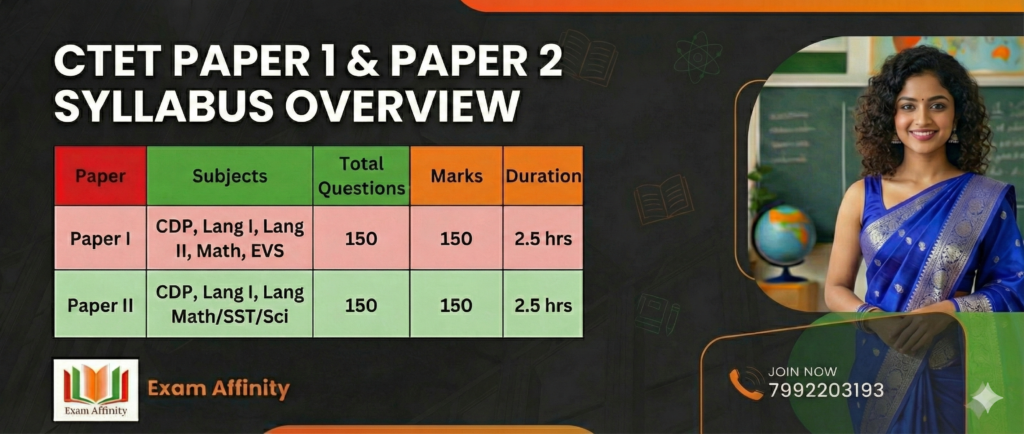
Preparing for CTET FEB 2026? Whether you’re targeting Paper I (for Classes I–V) or Paper II (for Classes VI–VIII), knowing the latest CTET syllabus is essential to plan your study smartly. This guide breaks down the complete CTET FEB 2026 syllabus, helping you understand what to focus on for success.
📄 Click here to download the CTET 2026 Syllabus PDF
What is CTET?
The Central Teacher Eligibility Test (CTET) is conducted by the Central Board of Secondary Education (CBSE). It is a national-level eligibility test for those who wish to become teachers in central government schools like KVS, NVS, and also many state-level schools.
The exam consists of two papers:
- Paper I – For teaching Classes I to V
- Paper II – For teaching Classes VI to VIII
Candidates aiming to teach Classes I–VIII must appear for both papers. The B.Ed candidates can appear in Paper-II only however, those who have done D.El.Ed can appear in both the papers.
CTET 2025 Paper I Syllabus (Primary Level)
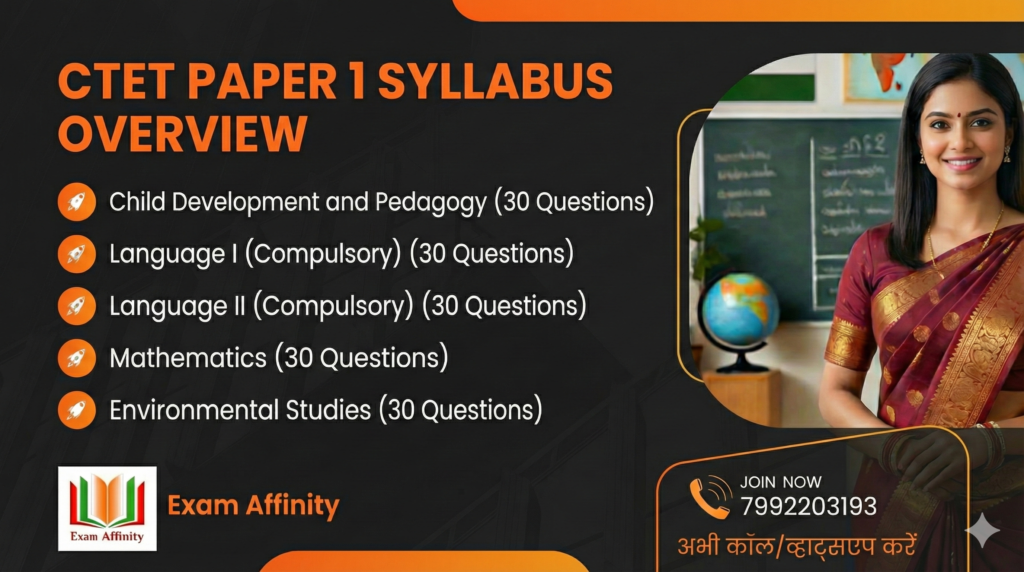
Paper I is meant for candidates who want to teach Classes I to V. It contains five sections, each carrying 30 marks
.
I. बाल विकास और शिक्षाशास्त्र (30 प्रश्न)
Child Development and Pedagogy (30 Questions)
1. (क) बाल विकास – 15 प्रश्न
Child Development – 15 Questions
(प्राथमिक / उच्च प्राथमिक विद्यालय का बच्चा)
(Elementary / Upper Primary School Child)
- विकास की अवधारणा और सीखने के साथ इसका संबंध
Concept of Development and its Relationship with Learning - बच्चों के विकास के सिद्धांत
Principles of Child Development - आनुवंशिकता और पर्यावरण का प्रभाव
Influence of Heredity and Environment - समाजीकरण की प्रक्रिया: सामाजिक दुनिया और बच्चे (शिक्षक, माता-पिता, साथी)
Socialization Processes: Social World and Children (Teachers, Parents, Peers) - पियाजे, कोलबर्ग और वायगोत्स्की: निर्माण और आलोचनात्मक दृष्टिकोण
Piaget, Kohlberg and Vygotsky: Constructs and Critical Perspectives - बाल-केंद्रित और प्रगतिशील शिक्षा की अवधारणा
Concept of Child-Centred and Progressive Education - बुद्धि के निर्माण का आलोचनात्मक परिप्रेक्ष्य
Critical Perspective of the Concept of Intelligence - बहु-आयामी बुद्धि
Multiple / Multidimensional Intelligence - भाषा और विचार
Language and Thought - एक सामाजिक निर्माण के रूप में लिंग; लिंग भूमिकाएँ, लिंग-पूर्वाग्रह और शैक्षिक अभ्यास
Gender as a Social Construct; Gender Roles, Gender Bias and Educational Practices - शिक्षार्थियों में व्यक्तिगत भिन्नताएँ (भाषा, जाति, लिंग, समुदाय, धर्म आदि)
Individual Differences among Learners based on Language, Caste, Gender, Community, Religion - सीखने के लिए आकलन और सीखने के आकलन के बीच अंतर
Assessment for Learning and Assessment of Learning - विद्यालय-आधारित मूल्यांकन, सतत एवं व्यापक मूल्यांकन (CCE)
School-Based Assessment, Continuous and Comprehensive Evaluation (CCE) - शिक्षार्थियों की तैयारी के स्तर के आकलन हेतु उपयुक्त प्रश्नों का निर्माण
Formulating Appropriate Questions to Assess Learners’ Readiness - आलोचनात्मक सोच एवं अधिगम को बढ़ावा देने के उपाय
Enhancing Learning and Critical Thinking
2. (ख) समावेशी शिक्षा – 5 प्रश्न
Inclusive Education – 5 Questions
- विविध पृष्ठभूमि (वंचित एवं हाशिए पर) के शिक्षार्थियों को संबोधित करना
Addressing Learners from Diverse, Disadvantaged and Deprived Backgrounds - सीखने में कठिनाई एवं अक्षमता वाले बच्चों की आवश्यकताएँ
Addressing Children with Learning Difficulties and Impairments - प्रतिभाशाली एवं रचनात्मक शिक्षार्थी
Addressing Talented and Creative Learners - विशेष रूप से सक्षम (दिव्यांग) शिक्षार्थी
Addressing Specially Abled Learners - समावेशी कक्षा की भूमिका
Role of Inclusive Classroom
3. (ग) सीखना और शिक्षाशास्त्र – 10 प्रश्न
Learning and Pedagogy – 10 Questions
- बच्चे कैसे सोचते और सीखते हैं
How Children Think and Learn - विद्यालयी प्रदर्शन में असफलता के कारण
Reasons for School Failure - शिक्षण-अधिगम की बुनियादी प्रक्रियाएँ
Basic Processes of Teaching and Learning - सीखना एक सामाजिक गतिविधि के रूप में
Learning as a Social Activity - बच्चा एक समस्या-समाधानकर्ता के रूप में
Child as a Problem Solver - बच्चा एक वैज्ञानिक अन्वेषक के रूप में
Child as a Scientific Investigator - बच्चों की वैकल्पिक अवधारणाएँ
Alternative Conceptions of Learning - त्रुटियों को सीखने की प्रक्रिया का भाग मानना
Errors as Steps in Learning - अनुभूति और भावनाएँ
Cognition and Emotions - अभिप्रेरणा एवं अधिगम
Motivation and Learning
II. गणित (Paper-I) – 30 प्रश्न
Mathematics – 30 Questions
(क) विषय-वस्तु – 15 प्रश्न
Content – 15 Questions
- ज्यामिति – Geometry
- आकार और स्थानिक समझ – Shapes and Spatial Understanding
- चारों ओर ठोस पदार्थ – Solids Around Us
- संख्या – Numbers
- जोड़ एवं घटाव – Addition and Subtraction
- गुणन – Multiplication
- भाग – Division
- मापन – Measurement
- भार – Weight
- समय – Time
- आयतन – Volume
- आँकड़ा प्रबंधन – Data Handling
- पैटर्न – Patterns
- धन – Money
- वास्तविक जीवन से गणित
Mathematics in Daily Life
(ख) शैक्षणिक मुद्दे – 15 प्रश्न
Pedagogical Issues – 15 Questions
- गणितीय/तार्किक सोच की प्रकृति
Nature of Mathematical and Logical Thinking - बच्चों की सोच एवं तर्क
Children’s Thinking and Reasoning - अर्थ निर्माण एवं सीखने की रणनीतियाँ
Strategies for Meaning Making and Learning - पाठ्यक्रम में गणित का स्थान
Place of Mathematics in Curriculum - गणित की भाषा
Language of Mathematics - सामुदायिक गणित
Community Mathematics - औपचारिक एवं अनौपचारिक मूल्यांकन
Formal and Informal Evaluation - शिक्षण की समस्याएँ
Problems of Teaching - त्रुटि विश्लेषण
Error Analysis - नैदानिक एवं उपचारात्मक शिक्षण
Diagnostic and Remedial Teaching
III. पर्यावरण अध्ययन – 30 प्रश्न
Environmental Studies – 30 Questions
(क) विषय-वस्तु – 15 प्रश्न
Content – 15 Questions
- परिवार और मित्र – Family and Friends
- रिश्ते – Relationships
- कार्य और खेल – Work and Play
- जानवर – Animals
- पौधे – Plants
- भोजन – Food
- आश्रय – Shelter
- पानी – Water
- यात्रा – Travel
- हम जो चीजें बनाते और करते हैं – Things We Make and Do
(ख) शैक्षणिक मुद्दे – 15 प्रश्न
Pedagogical Issues – 15 Questions
- EVS की अवधारणा और कार्यक्षेत्र
Concept and Scope of EVS - एकीकृत EVS का महत्व
Significance of Integrated EVS - पर्यावरण अध्ययन एवं पर्यावरण शिक्षा
Environmental Studies and Environmental Education - सीखने के सिद्धांत
Learning Principles - विज्ञान एवं सामाजिक विज्ञान से संबंध
Relation with Science and Social Science - अवधारणाओं को प्रस्तुत करने के दृष्टिकोण
Approaches to Present Concepts - गतिविधियाँ एवं प्रयोगात्मक कार्य
Activities and Practical Work - चर्चा, CCE एवं शिक्षण-सहायक सामग्री
Discussion, CCE and Teaching Aids
IV. भाषा I – हिन्दी (30 प्रश्न)
(क) भाषा की समझ – 15 प्रश्न
- दो अपठित गद्यांश (गद्य/नाटक एवं कविता)
- समझ, अनुमान, व्याकरण एवं मौखिक क्षमता
(ख) भाषा विकास की शिक्षाशास्त्र – 15 प्रश्न
- सीखना एवं अधिग्रहण
- भाषा शिक्षण के सिद्धांत
- सुनने और बोलने की भूमिका
- व्याकरण की भूमिका (आलोचनात्मक दृष्टिकोण)
- विविध कक्षा में भाषा शिक्षण की चुनौतियाँ
- भाषा कौशल
- भाषा मूल्यांकन
- शिक्षण-अधिगम सामग्री
- उपचारात्मक शिक्षण
V. Language II – English (30 Questions)
(a) Comprehension – 15 Questions
- Two unseen prose passages
- Questions on comprehension, grammar and verbal ability
(b) Pedagogy of Language Development – 15 Questions
- Learning and Acquisition
- Principles of Language Teaching
- Role of Listening and Speaking
- Grammar in Communication
- Teaching Language in a Diverse Classroom
- Language Skills
- Evaluation of Language Proficiency
- Teaching-Learning Materials
- Remedial Teaching
VI. भाषा I – संस्कृत (30 प्रश्न)
(क) भाषा की समझ – 15 प्रश्न
- अपठित गद्यांश
- शब्दरूप
- धातुरूप
- कारक
- उपसर्ग
- प्रत्यय
- संधि
- समास
- विशेष्य-विशेषण
(ख) भाषा विकास की शिक्षाशास्त्र – 15 प्रश्न
- संस्कृत भाषा कौशल (श्रवण, संभाषण, पठन, लेखन)
- संस्कृत भाषा शिक्षण सिद्धांत
- शिक्षण विधियाँ
- शिक्षण-सहायक सामग्री
- मौखिक एवं लिखित मूल्यांकन
- सतत मूल्यांकन
- उपचारात्मक शिक्षण
🧠 Child Development and Pedagogy – 30 Marks
- Concept of development and its relationship with learning
- Principles of child development
- Influence of heredity and environment
- Socialization processes and constructivist learning
- Inclusive education
- Learning and motivation
- Teaching-learning strategies for young children
📚 Language I – 30 Marks
- Reading Comprehension: One prose or drama passage and one poem
- Pedagogy of Language Development:
- Learning and acquisition
- Role of listening and speaking
- Language skills (LSRW)
- Challenges in language teaching
- Teaching-learning materials
- Remedial teaching
📖 Language II – 30 Marks
- Reading Comprehension: Two prose passages (literary/discursive/narrative)
- Pedagogy of Language Development: Same topics as Language I
➕ Mathematics – 30 Marks
- Number system, shapes, and spatial understanding
- Measurements, time, and data handling
- Patterns, money, and geometry
- Pedagogical issues in mathematics teaching
🌍 Environmental Studies (EVS) – 30 Marks
- Family and friends, food, shelter, water, travel
- Things we make and do
- Pedagogical issues in EVS teaching
- Environmental awareness and interrelationship
CTET 2025 Paper II Syllabus (Upper Primary Level)
Paper II is meant for candidates who want to teach Classes VI to VIII. It includes the same structure as Paper I for the first three sections and offers subject options for the fourth.
🧠 Child Development and Pedagogy – 30 Marks
- Growth and development during adolescence
- Learning theories and applications
- Motivation and individual differences
- Inclusive education and children with special needs
- Teaching strategies for middle school
📚 Language I – 30 Marks
- Reading Comprehension: One prose or drama passage and one poem
- Pedagogy of Language Development: Same structure as Paper I, adjusted for upper primary level
📖 Language II – 30 Marks
- Reading Comprehension: Two prose passages
- Pedagogy of Language Development: Same topics as Language I
🔢 Mathematics and Science – 60 Marks (For Math/Science teachers)
- Mathematics Topics:
- Number system, algebra, geometry
- Mensuration, data handling
- Science Topics:
- Food, materials, natural phenomena
- The world of the living, natural resources
- Pedagogical issues in teaching both subjects
🌍 Social Studies/Social Science – 60 Marks (For SST teachers)
- History: Ancient to modern India
- Geography: Resources, environment, human interaction
- Civics: Government, democracy, rights
- Pedagogical issues in SST teaching
सामाजिक अध्ययन / सामाजिक विज्ञान (Paper-II) – 60 प्रश्न
Social Studies / Social Science (For Paper-II) – 60 Questions
A) विषयवस्तु – 40 प्रश्न
Content – 40 Questions
1. इतिहास
History
- कब, कहाँ और कैसे
When, Where and How - प्राचीनतम समाज
The Earliest Societies - पहले किसान और चरवाहे
The First Farmers and Herders - पहले शहर
The First Cities - प्रारंभिक राज्य
Early States - नए विचार
New Ideas - पहला साम्राज्य
The First Empire - दूर देशों से संपर्क
Contacts with Distant Lands - राजनीतिक घटनाक्रम
Political Developments - संस्कृति और विज्ञान
Culture and Science - नए राजा और राज्य
New Kings and Kingdoms - दिल्ली के सुल्तान
Sultans of Delhi - वास्तुकला
Architecture - एक साम्राज्य का निर्माण
Creation of an Empire - सामाजिक परिवर्तन
Social Change - क्षेत्रीय संस्कृतियाँ
Regional Cultures - कंपनी पावर की स्थापना
Establishment of Company Power - ग्रामीण जीवन और समाज
Rural Life and Society - उपनिवेशवाद और जनजातीय समाज
Colonialism and Tribal Societies - 1857–58 का विद्रोह
Revolt of 1857–58 - महिलाएँ और सुधार
Women and Reform - जाति व्यवस्था को चुनौती देना
Challenging the Caste System - राष्ट्रवादी आंदोलन
The Nationalist Movement - आज़ादी के बाद का भारत
India After Independence
2. भूगोल
Geography
- भूगोल: एक सामाजिक अध्ययन एवं विज्ञान
Geography as a Social Study and as a Science - ग्रह: सौर मंडल में पृथ्वी
Planet Earth in the Solar System - ग्लोब
Globe - पर्यावरण: प्राकृतिक एवं मानव
Environment in its Totality – Natural and Human - वायु
Air - पानी
Water - मानव पर्यावरण: बस्ती, परिवहन एवं संचार
Human Environment – Settlement, Transport and Communication - संसाधन: प्राकृतिक एवं मानव
Resources – Natural and Human - कृषि
Agriculture
3. सामाजिक एवं राजनीतिक जीवन
Social and Political Life
- विविधता
Diversity - सरकार
Government - स्थानीय सरकार
Local Government - जीविका चलाना
Making a Living - प्रजातंत्र
Democracy - राज्य सरकार
State Government - मीडिया को समझना
Understanding Media - लिंग की अवधारणा
Unpacking Gender - संविधान
The Constitution - संसदीय सरकार
Parliamentary Government - न्यायपालिका
The Judiciary - सामाजिक न्याय एवं हाशिये पर स्थित समूह
Social Justice and the Marginalised
B) शैक्षणिक मुद्दे – 20 प्रश्न
Pedagogical Issues – 20 Questions
- सामाजिक विज्ञान / सामाजिक अध्ययन की अवधारणा एवं प्रकृति
Concept and Nature of Social Science / Social Studies - कक्षा-कक्ष प्रक्रियाएँ, गतिविधियाँ एवं प्रवचन
Classroom Processes, Activities and Discourse - आलोचनात्मक सोच का विकास
Developing Critical Thinking - पूछताछ एवं अनुभवजन्य साक्ष्य
Enquiry and Empirical Evidence - सामाजिक विज्ञान / सामाजिक अध्ययन शिक्षण की समस्याएँ
Problems of Teaching Social Science / Social Studies - स्रोत: प्राथमिक एवं द्वितीयक
Sources – Primary and Secondary - परियोजना कार्य
Project Work - मूल्यांकन
Evaluation
📝 Candidates must choose either Math/Science or Social Studies based on their subject preference.
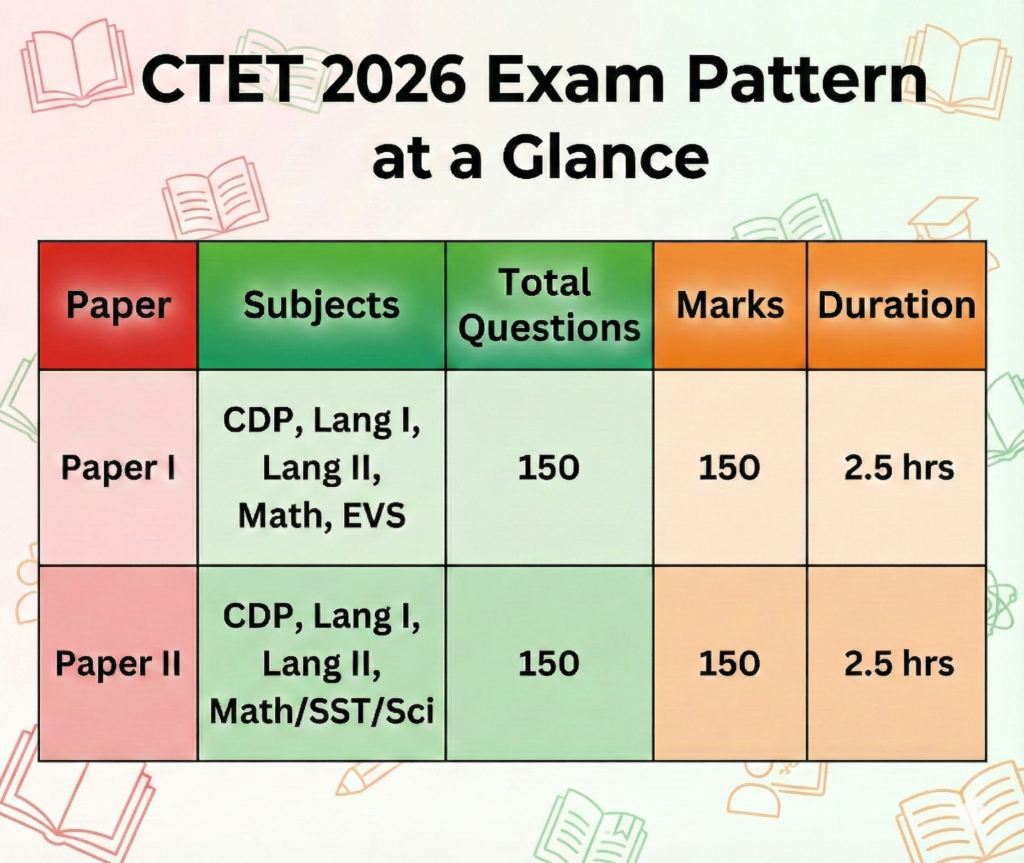
CTET 2026 Exam Pattern at a Glance
| Paper | Subjects | Total Questions | Marks | Duration |
|---|---|---|---|---|
| Paper I | CDP, Lang I, Lang II, Math, EVS | 150 | 150 | 2.5 hrs |
| Paper II | CDP, Lang I, Lang II, Math/SST/Sci | 150 | 150 | 2.5 hrs |
- No negative marking
- MCQ format (1 mark each)
- Minimum qualifying marks: 60% (90 marks)
📥 Download CTET FEB 2026 Syllabus PDF
Looking for the official syllabus in one document?
📄 Click here to download the CTET 2026 Syllabus PDF
Preparation Tips for CTET 2026
- Read NCERT textbooks for Classes I–VIII
- Begin with Child Development and Pedagogy, common to both papers
- Practice reading comprehension daily
- Solve previous year papers and attempt mock tests
- Allocate weekly goals and review performance regularly
Join CTET Coaching in Patna – Exam Affinity
If you’re looking for the best coaching to crack CTET 2025, join Exam Affinity, Patna’s most trusted institute for teacher eligibility exam preparation.
Why Choose Exam Affinity?
- 🧑🏫 Expert faculty for CTET Paper I & II
- 📘 NCERT-aligned study material
- 🧪 Weekly mock tests and performance tracking
- 👨🏫 Personalized doubt-clearing sessions
- 🎁 Free demo class for new students
📍 Address: Qtr. No. 117, Defence Colony, Behind Shivaji Park, Kankarbagh, Patna – 800020
📞 Call/WhatsApp: +91-7992203193 | +91-9334525431
📧 Email: info@examaffinity.in
🌐 Website: www.examaffinity.in
Final Words
Understanding the CTET 2026 syllabus is your first step toward clearing the exam. Stay consistent, follow a study schedule, and practice regularly. With the right guidance and hard work, qualifying CTET in your first attempt is absolutely possible.
🎯 Start your preparation today. Join Exam Affinity and attend a free demo class.
FAQs
The CTET FEB 2026 syllabus is prescribed by CBSE and covers subjects like Child Development and Pedagogy, Language I, Language II, Mathematics, Environmental Studies, Science, and Social Studies. The syllabus is based on NCERT curriculum from Classes I to VIII and remains largely unchanged from previous CTET cycles.
No, the CTET FEB 2026 syllabus is almost identical to CTET 2025. CBSE generally follows the same syllabus pattern, focusing on conceptual understanding, pedagogy, and classroom application aligned with NCERT textbooks.
CTET Paper I syllabus includes:
Child Development and Pedagogy
Language I
Language II
Mathematics
Environmental Studies (EVS)
Paper I is meant for candidates aspiring to teach Classes I to V (Primary Level).
CTET Paper II syllabus includes:
Child Development and Pedagogy
Language I
Language II
Mathematics & Science or Social Studies/Social Science
Paper II is for candidates who want to teach Classes VI to VIII (Upper Primary Level).
Yes, Child Development and Pedagogy (CDP) is common in both papers. However, Paper I focuses on children aged 6–11, while Paper II emphasizes adolescent learners aged 11–14.
Yes, the CTET FEB 2026 syllabus is strictly based on NCERT textbooks for Classes I to VIII. Candidates are advised to prepare directly from NCERT for better conceptual clarity.
You can download the official CTET FEB 2026 syllabus PDF from the CBSE website or directly from the download links provided in this post for Paper I and Paper II.
Yes, as per the latest CBSE notification, the CTET qualifying certificate is valid for a lifetime, and candidates can appear multiple times to improve their score.
CTET syllabus and paper 1st and paper 2nd