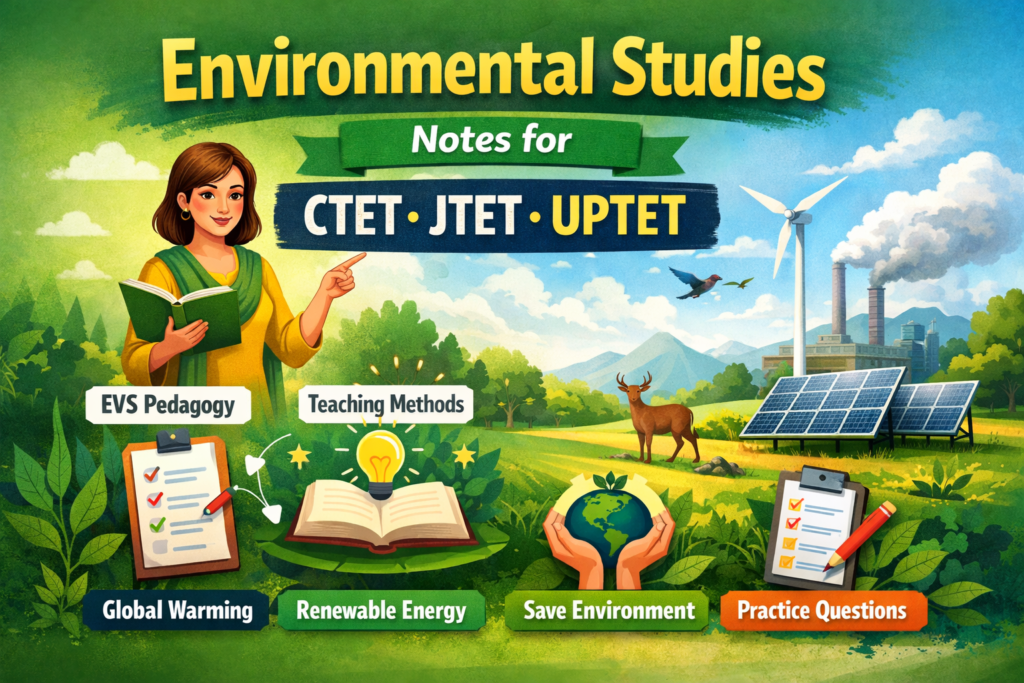
Environmental Studies notes for CTET: The environment comprises water, air, earth, animals, vegetation, and humans, all intermingled to create the surroundings in which life exists. The word “environment” originates from the French term “Environ,” signifying the entirety of one’s surroundings.
Definition
The environment refers to the external surroundings that impact the development or progression of people, animals, or plants, encompassing factors such as their living or working conditions.. Some important definitions of the environment are:
- Ross-Environment could be termed as an external force that affects or influences us.
- Douglas and Holland- ‘The term environment is used to describe all the external forces, influences, and conditions which affect the life, nature, behaviour and the growth, development and maturity of living organisms.’
Types of Environments:
We can typically categorise environments into three types that shape human personality.
- Natural or Physical: This encompasses geographical climate, weather patterns, and physical surroundings where individuals reside. Climatic conditions significantly influence human races, as factors such as sky, air, water, vegetation, elements beneath the earth’s surface, and organisms play crucial roles.
For instance, people from European countries often have fair complexions, while those from Africa typically have darker skin tones. Moreover, the physical environment also impacts an individual’s physique and working efficiency. - Social: An individual’s social, economic, and political circumstances fall within their social environment. This includes groups, communities, societies, committees, and various other institutions formed through human relationships.
- Cultural or Psychological: The psychological environment aids in understanding an individual’s personality. It encompasses all rituals, customs, morals, legal frameworks, and behavioural norms prevalent in society.
Environmental Structure:
The environment comprises both living and non-living components, resulting in a structure that is both physical and biological.
Physical Environment:
We can categorize this into three main components.
(i) Solid, representing the Lithosphere (Earth).
(ii) Liquid, representing the Hydrosphere (water component).
(iii) Gas, representing the Atmosphere.
- We can further divide these components into smaller units such as plateaus, coastlines, mountains, and glaciers.
Biological Environment:
This consists of:
(i) Flora, referring to plants.
(ii) Fauna, referring to animals.
- All organisms within this biotic environment interact, forming social groups and organisational structures at various levels. This interaction contributes to the development of the economic environment.
Scope of Environmental Studies
The initialisation of thinking towards the environment has occurred due to the occurrence of some major incidents. Today, when environmental hazards have put humans into serious trouble only the areas of learning environmental education are increasing. We can summarise its scope as follows:
- Preservation and Protection of Natural resources and their problems include water, soil, forests, minerals, electricity, and transportation.
- The study creates awareness among the people to know about various renewable and nonrenewable resources in the region.
- It also provides necessary information about the richness of biodiversity and the dangers to the species of plants, animals, and microorganisms in the environment.
- It studies varieties of flora and fauna and their protection.
- The study helps us to understand the causes and consequences of natural disasters (floods, earthquakes, landslides, cyclones, etc.) and pollution and measures to minimise the effects, such as radioactive pollution, noise pollution, soil, water, and social pollution.
- Human-Environment relationship.
- Social Issues are related to the environment.
- Policies and Laws related to Environmental Issues.
- Environmental Preservation, Protection, and Improvement.
Hence, it is important now to protect our environment by utilising the available resources and building a sustainable future for the coming generation.
Please enter product(-s) ASIN(-s)!
Learning Principles and Theories
The importance of EVS Pedagogy.
Right from the birth of a child until death, learning continues. Learning is the process of developing new or recasting existing knowledge, behaviours, skills, values, or likings. Learning is not compulsory; it is environmental. It does not take place at all once, but builds upon and is shaped by what we already know. Learning creates changes in living creatures, and the changes are comparatively permanent.
According to J.P. Guildford, “Learning is any behaviour change that results from behaviour”.
According to Charles E. Skinner, “Learning is the process of progressive behaviour adaptations.”
According to Crow and Crow, “Learning is the acquisition of habits, knowledge, and attitudes”.
According to R.S. Woodworth, “Learning consists of doing something new”.
Some important points:
- Learning exists within the school and as well as outside the school environment.
- All learners are naturally motivated to learn and are capable of learning.
- Children learn in several ways through experience, doing things, experimenting, reading, discussion, asking questions, listening, thinking and reflecting, and expressing themselves by speech or writing, both individually and with others.
- Learning is regarded as a process of improvement with practice or training. Children learn many things, which help us to improve our performance.
- Learning is the revision of experience.
- Learning does not exist without a cause and self-activity. In the teaching-learning process, the activity of the learner is more important than the activity of the teacher.
- When the aim and purpose of learning are clear, an individual learns quickly. It is the cause or objective which decides what the learner finds in the learning situations and how he acts. If there is no cause or objective, then learning cannot be seen.
Types and forms of learning:
- Perceptual Learning: This kind of learning is a learning in which students learn by their sense organs, and their brains can understand and record various things, events, incidents, etc.
- Conceptual learning: This kind of learning is about the subject matter in detail, about its principles or ideas, but after learning, students start thinking in abstract terms. Through this, students learn to organise information and facts about anything in a logical structure.
- Associative learning: It is a kind of learning in which a child frames a new memory about an object, entity, event, incident, experience, etc.
- Appreciative learning: In this type of learning, ideas, attitudes, and a mental disposition that are related to a positive feeling of mind play a seminal role. When we appreciate a child for his behaviour, activity, etc. then a positive feeling arises in the mind of the child. Now, a child will tend to repeat this behaviour to be appreciated and feel the same feeling in his mind.
Principles of learning:
Readiness
- It implies a degree of alertness and eagerness. Individuals learn optimally when they are physically, mentally, and emotionally ready to learn, and unable to learn well if they find no reason for learning. Making students ready to learn, creating interest by showing the value of the subject matter, and providing continuous mental or physical challenges are generally the teacher’s tasks.
Exercise
- The principle of exercise states that those things which are repeated are best remembered, and it is the basis of drill and practice. It has been exhibited that students learn best and keep information longer done practice and repetition, and the important part here is that the practice must be sensible. Practice leads to improvement only when it is followed by positive feedback.
Effect

- The principle of effect is based on the expressive reaction of the student and has a direct relation to motivation. The principle of effect states that learning becomes stronger when conducted by a satisfying feeling and that learning is enfeebled when associated with an unsatisfying feeling, every learning experience should have an impact that leaves the student with positive feelings.
Primacy
- The state of being first often creates a strong, almost decided impression. Things that are learned first create a long-lasting impression in the mind that is hard to erase.
Intensity
- The principle of intensity implies that a student will learn more from the real thing than from a substitute.
Requirement:
- The law of requirement states that “we must have something to obtain or do something.” It can be an ability, skill, or anything that may help us to learn or gain something. A starting point or root is required.
Freedom:
- The principle of freedom states that things freely learned are learned in the best way. Contrarily, the further a student is forced, the more difficult it is for him to learn, grasp, and apply what is learned. Compulsion and force are contrary to personal growth. The greater the freedom enjoyed by individuals within a society, the greater the intellectual and moral advancement enjoyed by society as a whole. Since learning is an active process, students must have freedom: freedom of choice, freedom of action, and freedom to bear the results of action—these are the three great freedoms that constitute personal responsibility. If no freedom is granted, students may have little interest in learning.
Thorndike’s three laws of learning and their educational implications:
- Law of Readiness: The primary law of learning is the ‘Law of Readiness’ or the Law of Action Tendency’, which means that learning takes place when an action aptness is generated through initial adjustment or perspectives. If the child is not prepared to learn, learning cannot be involuntarily infused in him.
- Law of exercise: It is the second law of learning of Thorn dike. The Law of exercise means that drill or practice helps in expanding the effectiveness and strength of learning. For example, learning to typewrite, sing, etc. requires repetitions of various motions and actions several times.
- Law of effect: This is the third and last primary law of learning. In this law, the teacher must take into consideration the tastes and attentiveness of his pupils.
Thorndike’s five subordinate laws of learning are:
Law of Multiple-Response: According to this law, an organism changes its responses until suitable behaviour is hit upon. Without different retaliations, the solution might never be acquired. Assume an individual wants to solve a puzzle, then he will try to solve it in different ways rather than repeating the same way.
The law of set or attitude: Learning is conducted by a total set or perspectives of the organism, which regulates not only what the person will do but what will please or displease.
Pre-potency of elements: According to this law, the learner reacts particularly to the vital situation and abandons the other features or elements which may be unrelated.
Law of response by analogy: According to this law organism applies old experiences or accessions while learning a new situation.
The law of associative shifting: According to this law, we may get a response of a learner which he is capable of giving, associating it with other situations to which he is quick to respond.
Albert Bandura’s Social Learning Theory:
Social learning theory is a theory of learning and social behaviour that initiates that new behaviours can be obtained by perceiving and imitating others. The theory is called a bridge between behaviourist and cognitive learning theories because it encompasses recognition, remembrance, and motivating force.
The following steps are involved in the observational learning and modelling process:
Attention: To learn, you need to pay attention. Any interruption may affect the advertency of learning.
Retention: The ability to store information is the main part of the learning process.
Reproduction: Once recognition is paid to the model and keeps possession of the information, it is time to perform the behaviour you perceive.
Motivation: Lastly, for observational learning to be successful, you have to be motivated to imitate the behaviour that has been modelled. Reinforcement and punishment played a vital role in motivation.
Gestalt theory of insightful learning:
According to Gestalt, “Learning is the organisation or re-organisation of behaviour which arises from the interactions of a maturing organism and its environment”.
Insight is the ability to see, hear, or become aware of something through the senses. It is the relationship between at least 3 factors in an agent, a goal, and intervening conditions or barriers. Gestalt theory focuses on the idea of grouping. The components that determine the group are proximity, similarity, closure, and simplicity.
Gestalt laws of learning:
- Law of similarity: According to this law, homogeneous ideas and experiences get related together.
- Law of proximity: Perceptual groups are recommended according to the closeness of their respective parts. Items form groups if they are spaced together.
- Law of closure: This law states that the brain can perceive forms and figures in their complete appearance.
- Laws of continuity: It says the brain can perceive forms and figures in their complete appearance.
- Law of contrasts: Perception or an idea can suggest its contradictory opposite. Like the heat of summer suggests the cold of winter.
Karl Rogers’ experimental learning:
Experiential learning is a dynamic process in which students learn facts through discovery and investigation. It is a student-centred approach, labelling each student’s needs and desires. Learning takes place from both victories and mistakes and helps students in developing new skills, perspectives, and problem-solving techniques.
Rogers inaugurated the idea of two different types of learning in his theory: cognitive and experiential. Cognitive learning involves memorization and learning of facts, such as vocabulary. Experiential knowledge meets the needs and attentiveness of the learners, with a focus on hands-on experience and real-life conditions.
Characteristics of experimental learning:
- Experiential learning involves the personal involvement of the students
- Experiential learning self-initiated learners or students.
- Experiential learning Self-evaluates the students.
- Experiential learning has an inescapable effect on students.
Pavlov’s theory of learning:
Ivan Pavlov was a Russian scientist focused on studying how digestion works in mammals. He detected and noted down information about dogs and their digestive system process.
Classical conditioning refers to a learning procedure in which a biologically powerful stimulus (e.g. food) is paired with a previously neutral stimulus (e.g. a bell). It also refers to the learning process that results from this pairing, through which the neutral stimulus comes to obtain a response (e.g. salivation) that is generally similar to the one obtained by the powerful stimulus.
The procedure of Pavlov’s theory:
Classical conditioning arises when a conditioned stimulus (CS) is paired with an unconditioned stimulus (US). Usually, the conditioned stimulus is neutral, the unconditioned stimulus is a biologically powerful stimulus and the unconditioned response (UR) to the unconditioned stimulus is an uninstructed impulsive response. After pairing is repeated the organism displays a conditioned response (CR) to the conditioned stimulus when the conditioned stimulus is entrusted alone. Thus, unlike UR, the CR is obtained through experience, and it is also less perpetual than the UR.
Educational implications of Pavlov’s theory:
- Conditioning creates fear, love, and hatred towards specific subjects.
- A teacher can bring a wise effect on the Learners through a good method and kind treatment.
- Conditioning helps the child in adjustments to various types of environments.
- The theory of reward and punishment is based on conditioning.
Methods and activities related to environmental studies
Teachers conduct activities like surveys, projects, field trips, and community service to enhance students’ understanding of EVS concepts, while they use sports, games, puzzles, discussions, music, theatre, dance, and drama to promote the holistic development of learners.
Various activities related to EVS teaching:
- Project method
- Source method
- Supervised study method
- Co-curricular activities
Project method:
In a project method environment, teachers allow students to explore and experience their surroundings through their senses and guide them to direct their own learning based on their individual interests. Teachers rely very little on textbooks and emphasise experiential learning instead of rote memorisation. A project method classroom focuses on democracy and collaboration to solve “purposeful” problems.
Principles of Project Method –
Activity: The project involves mental or motor activity
Purpose: The project should be purposeful and fulfil the needs of the pupils.
Experience: The project method provides varied experiences to the pupils, such as manipulative, concrete, mental, etc.
Reality: The project should provide real experience.
Freedom: In the project method, pupils are free to undertake different activities related to the project.
Utility: The activities undertaken in a project should be useful.
Steps of the Project method –
- Creating Situation: In the first step, the teacher creates a perfect situation for the students in the class. He puts up the knowledge about the project method procedure, steps, and uses to the students. Students should feel the need for a project, and teachers should never force it on them. The project should be purposeful and significant.
- Selection of the problem: The teacher helps the students to select the problem and guide them. Students allowed the freedom to choose the topic or problem based on their interests and ability.
- Planning: During the planning process, the teacher acts only as a guide and offers suggestions when needed, while the students carry out the actual planning.
- Execution: The students start their work in this step. They collect the relevant information and materials at first. The teacher should provide the time and right to the students according to their own speed, interest, and ability.
- Evaluation: Evaluation of the project should be done both by the pupils and by the teachers. Here the students evaluate their task. They determine whether the objects are achieved or not.
- Reporting and Recording: It is the last step of the project method in which each and every step of the work are reported. It includes all the information about the project like the proposal, plan and its discussion, duties allotted to different students, etc.
Advantages of project method:
- It helps in developing social norms and social values among the students.
- It provides a lot of opportunities for the correlation of various elements of the subject matter and also for the transfer of training or learning.
- It helps in the growth of knowledge effectively.
- As a result of their close cooperation with social participation helps in developing the spirit of democracy.
Disadvantages of project method:
- The project cannot be planned for all subjects and the whole subject matter cannot be taught by this strategy.
- It is not economical from the point of view of time and cost.
- It is very difficult for a teacher to plan or to execute the projects to the learners and supervise them.
Source Method:
The source method implies the use of original sources and materials while teaching. A source provides first-hand experiences and leads to a better understanding of the subject.
According to the source method, pupils build an account of anything with the help of available sources, documents, accounts, biographies, and literature, etc.
Objectives of source method:
- To develop critical thinking
- To develop skills in collecting data, organizing data, and interpreting it.
- To develop a child’s interest and the right perspectives in Environmental science.
- To enable the pupil to form their own independent judgment through critical analysis of sources.
Advantages of source method:
- The source method in the teaching of EVS gives a touch of realism to the subject.
- The source method satisfies the curiosity of the children about the question by giving insight into the method of EVS.
- The source method develops right-thinking, imagination, comparing and analysing, drawing inferences, self-expression, and discussion.
- This method initiates the pupils in research, which can later prove useful.
- The study of EVS through source method makes the subject more concrete and meaningful.
Disadvantages of source method:
- The source method is too complex and technical.
- It requires trained teachers.
- It is very difficult to access the original sources
Supervised study method:
Supervised study means the study is performed under supervision. In actual practice, when the students engage themselves in some learning activities under the proper supervision of the teacher, the phenomenon is named as a supervised study. It may take the form of an individual or a collective.
Immediate surroundings and community provide many opportunities for supervision. Concrete, tangible, visible, and describable data on cultural, industrial, political, and geographic facts and relationships prove invaluable for the teaching of environmental science. Direct experiences are more effective in the learning process they are also retained for a longer time. Some examples of supervised studies are field trips, community surveys, etc.
Techniques of supervised studies:
- Field trip: A field trip or excursion is a journey by a group of people to a place away from their normal environment. For example, visiting a river or pond to collect information about aquatic life.
- Community surveys: community surveys foster a comprehensive understanding of community structure and processes in their everyday operation, interaction, and complexities.
- Community service projects: community service project involves individual society of integrated mental physical, emotional, and spiritual nature.
Co-curricular Activities:
Co-curricular activities mean activities conducted on or off school premises by clubs, associations, and organizations of pupils sponsored by the Board of Education.
Schools supervise or finance co-curricular activities as programs conducted outside the classroom to provide curriculum-related learning and character-building experiences.
Types of co-curricular activities:
We can categorise co-curricular activities under seven heads:
- Literary activities: It includes reading comprehension, writing competitions, etc.
- Physical development activities: It includes games, sports, etc.
- Aesthetic and cultural development activities: it includes folk dance competitions, folk song competitions, historical tours, etc.
- Social welfare activities – it includes activities like community services, cleaning the society, helping the poor, etc.
- Leisure time activities – it includes music, theatre, etc.
- Excursion activities – like a tour, picnic
- Civic development activities – include activities like public speaking, group discussions, etc.
Importance of co-curricular activities:
- Co-curricular activities provide a first-hand experience to the student.
- Co-curricular activities develop values like physical, psychological, ethical, academic, civic, social, aesthetic, cultural, recreational and disciplinary values.
- It enables the students to express themselves freely through debates.
- Co-curricular activities make children perfect in decision-making.
- Games and Sports help the child to be fit and energetic.
- It makes the child socialised and also develops the feeling of belongingness in them.
- Activities like participation in-game debates, music, drama, etc., help in achieving the overall functioning of education.
Limitations of co-curricular activities:
- Lack of infrastructure is the biggest limitation of co-curricular activities.
- Students are not economically well off to bear the extra expenses.
- These activities are not assessed in the examinations
Concept and Integrated Environment Studies
Concept of Environmental Studies:
The environment consists of the sum of all the physical and biological factors that directly influence the survival, growth, development, and reproduction of organisms.
Based on the components environment can be divided into two parts:
The Physical Environment includes the lithosphere, the Earth and its different physical features, the hydrosphere, water components, and the atmosphere.
The Biological Environment – It includes flora, fauna and various micro-organisms.
According to Douglas and Holland, “Environment is an aggregate of all the external forces, influences, and conditions that affect the life, nature, behaviour, growth, development, and maturity of a living organism”.
Scope of Environmental Studies:
Environmental studies is an integrative subject because it covers all the features of the physical as well as the biological environment. Its relation with so many subjects and realms makes its scope wide. It can be applied in the following realms:
1. Natural Resource Sustainability and Environmental Management:
- EVS helps in managing wildlife, forests, and natural resources.
- EVS also provides the solution to various problems like pollution and the depletion of natural resources.
- An environmental scientist is working for ecological balance, conservation of biodiversity, as well as protection and regulation of natural resources.
2. In the industrial sector, rapid industrialisation has significantly damaged the environment.. So, to protect our environment from further degradation, there is a need to adopt an environmentally friendly process and technology. In this innovative field of technology, biotechnology has shown good promise. Biotechnology is helpful in other avenues of environmental science.
3. In research and development, scholars undertake various projects in the field of environmental studies. They conduct research to control pollution, address global warming, reduce greenhouse gases, and promote the adoption of renewable energy sources.
4. Scope in Human health and sanitation: For a healthy and disease-free life, a pure and hygienic environment is a must, so sanitation is necessary. So, the study of human health and sanitation is an important feature of environmental studies.
5. Scope of EVS in Social development: NGOs and media are making efforts to raise awareness about different issues like pollution, conservation, and awareness which results in making the masses aware of different aspects of the environment.
Objectives of EVS teaching at the Primary level:
- To allow children to understand the importance of developing good habits and hygiene.
- Develops the skill of children to perform tasks in an orderly manner.
- To make them understand simple graphs, maps, flowcharts, and statistical tables.
- To develop the interest of children in the study of nature and surroundings
- To develop creative, observational, and innovative qualities in a child.
Significance of EVS:
- Environmental studies are essential because they provide knowledge about the drinking water, food, air, etc for life.
- Environmental studies help to conserve the ecological balance by providing fundamental knowledge of environmental systems.
- Environmental studies provide the necessary skills to raise the questions and too often obtain answers to some of the environmental problems our planet faces today.
- Environmental studies will make the child aware of the environment in the early stages to contribute to society in a worthwhile manner.
- Concepts from the EVS can be applied to agriculture and in a sustainable production system.
CDP Quizzes: Attempt Here
Environmental Studies and Education :
Environmental education is a process aimed at developing a world population that is aware and concerned about the environment and its associated problems and which has the knowledge, attitudes, commitments, and skills to work individually and collectively towards the solution of current problems and for the prevention of new ones.
The objective of Environment Education:
- Develops the basic knowledge and understanding of the environment and its inter-relationship with man.
- Develops the skills to solve environmental problems.
- Develops the ability to evaluate environmental measures and education programs.
- Develop a sense of responsibility and urgency towards the environment to ensure appropriate actions to solve environmental problems.
- Develop awareness about the environment and its problems.
Environmental Education at Primary Level:
Environmental education at the primary level is as follows:
- The main objective at this stage is to foster inquisitiveness about the world and engage the child in explorative and hands-on activities that lead to the development of basic cognitive and psychomotor skills through language, observation, recording, distinction, classification, conclusion, drawing, illustration, design and fiction, estimation and measurement.
- The atmosphere of the classroom should not stress the child to perform, but allow learning to take place at an individual rate and permit free interaction among children and the teacher.
- EVS provides a child with enough opportunities for exploration of the environment, interacting with it and talking about the environment.
- The curriculum of EVS helps a child to internalise the values of cleanliness, honesty, cooperation, and concern for life and the environment.
FAQs
Environmental Studies notes for CTET, JTET, and UPTET include important topics like EVS pedagogy, teaching methods, learning theories, and environmental education concepts that help aspirants prepare effectively for teaching exams.
Environmental Studies notes for CTET, JTET, and UPTET are important because they provide conceptual clarity, cover frequently asked topics, and help candidates understand pedagogy-based questions asked in teaching exams.
To study Environmental Studies notes for CTET, JTET, and UPTET effectively, focus on understanding concepts, revise regularly, practice previous year questions, and apply pedagogy-based learning methods.
- समास क्या है? हिंदी व्याकरण समास के भेद, परिभाषा और उदाहरण – PDF Notes
 समास हिंदी व्याकरण का एक महत्वपूर्ण विषय है, जिसे CTET, TET, REET, BPSC, SSC, रेलवे, पुलिस, UPSSSC तथा अन्य प्रतियोगी… Read more: समास क्या है? हिंदी व्याकरण समास के भेद, परिभाषा और उदाहरण – PDF Notes
 - BPSC TRE 3.0 Question Paper PDF डाउनलोड करें – TRE 4.0 की तैयारी के लिए महत्वपूर्ण प्रश्नBPSC TRE 4.0 की तैयारी कर रहे अभ्यर्थियों के लिए BPSC TRE 3.0 के प्रश्नपत्र एक महत्वपूर्ण अभ्यास सामग्री हो… Read more: BPSC TRE 3.0 Question Paper PDF डाउनलोड करें – TRE 4.0 की तैयारी के लिए महत्वपूर्ण प्रश्न
- CTET Paper 1 Previous Year Question Papers with Answer Key PDF – 2018 to 2026Preparing for CTET Paper 1 and looking for previous year question papers in one place? You are at the right… Read more: CTET Paper 1 Previous Year Question Papers with Answer Key PDF – 2018 to 2026
- CCSU B.Ed 1st Year Question Papers 2026 – Download June 2026 Exam Papers PDFAre you looking for CCSU B.Ed 1st Year Question Papers 2026? You are at the right place. Exam Affinity brings… Read more: CCSU B.Ed 1st Year Question Papers 2026 – Download June 2026 Exam Papers PDF
- CTET 2026: 22वें संस्करण के लिए आवेदन का फिर से मौका, 25 अगस्त से 1 सितंबर तक खुला पोर्टलCTET 2026: केंद्रीय माध्यमिक शिक्षा बोर्ड (CBSE) ने केंद्रीय शिक्षक पात्रता परीक्षा यानी CTET के 22वें संस्करण के लिए आवेदन… Read more: CTET 2026: 22वें संस्करण के लिए आवेदन का फिर से मौका, 25 अगस्त से 1 सितंबर तक खुला पोर्टल