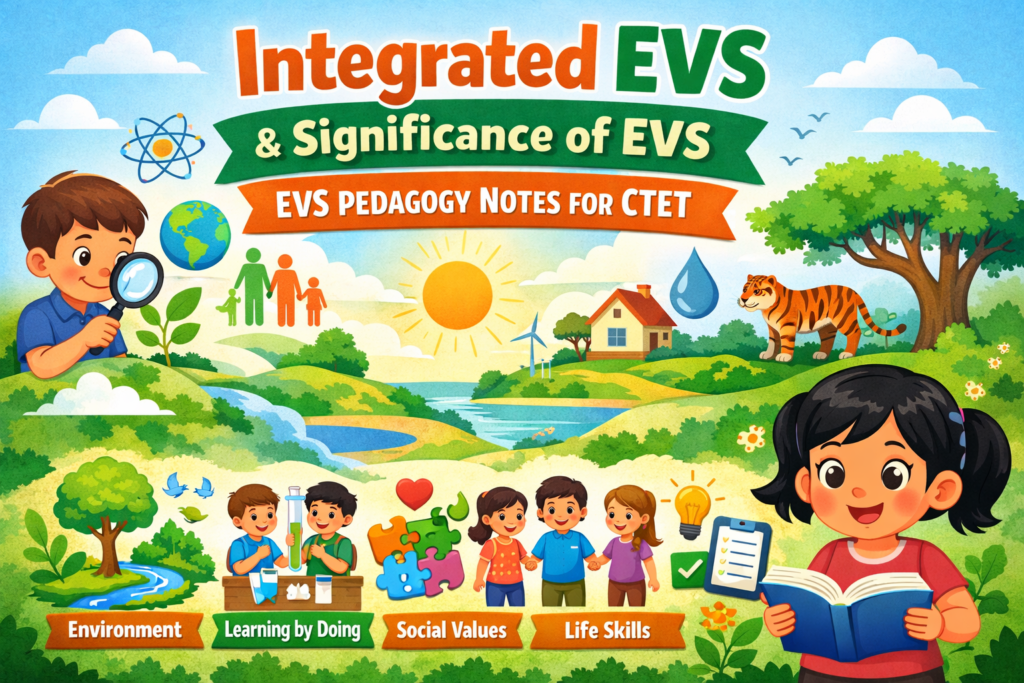
Environmental Studies (EVS) at the primary level is designed as an integrated and child-centred subject that combines concepts from science, social science, and environmental awareness. As recommended by the National Curriculum Framework (2005), EVS helps children understand their surroundings in a holistic, meaningful, and experience-based manner.
At the foundational stage (Classes I and II), EVS is not taught as a separate subject. Instead, its ideas are integrated into language, mathematics, stories, and poems, making learning natural, relatable, and stress-free.
Integrated Approach to Learning
Integrated EVS connects different areas of knowledge and focuses on the child’s immediate environment. It avoids isolated facts and definitions and instead promotes understanding through connections and experiences. The EVS curriculum is organized around six themes:
- Family and Friends (including plants and animals)
- Food
- Water
- Shelter
- Travel
- Things We Make and Do
These themes ensure comprehensive and contextual learning, covering all aspects of a child’s daily life.
Focus on Experiential and Child-Centred Learning
EVS emphasises learning by doing rather than rote memorisation. Children are encouraged to:
- Observe and explore their surroundings
- Ask questions and think critically
- Participate in activities and simple experiments
- Express their ideas and experiences
This approach develops curiosity, creativity, and problem-solving abilities.
Use of Simple and Familiar Language
The content of EVS is presented in simple, informal, and child-friendly language. It avoids technical jargon and uses real-life examples and situations, making it easier for children to understand and engage with the subject.
Connection with Real Life and Environment
EVS is closely linked to everyday life and local surroundings. It includes topics such as:
- Water, food, shelter, and travel
- Forests, animals, and plants
- Pollution, fuel, and conservation
This real-life connection makes learning meaningful, practical, and relevant.
Development of Environmental Awareness and Values
EVS plays a key role in developing:
- Awareness about environmental issues
- Responsibility towards nature and resources
- Empathy for living beings
- Respect for diversity and community life
It helps in shaping environmentally conscious and socially responsible individuals.
Holistic Development of the Child
In fact, the ultimate aim of EVS is the overall development of the child, including:
- Cognitive development through understanding and reasoning
- Emotional development through empathy and sensitivity
- Social development through interaction and cooperation
- Physical development through activities and participation
Development of Life Skills and Foundation for Future Learning
In addition, EVS helps children develop essential life skills such as:
- Observation and analysis
- Decision-making and problem-solving
- Communication and expression
Furthermore, it lays a strong foundation for future learning in science and social science, thus ensuring continuity in education.
Question 1: A teacher asks students to observe water usage at home and discuss saving methods. This promotes:
A. Rote memorization
B. Theoretical knowledge
C. Experiential learning
D. Teacher-centered learning
Question 2: In a classroom, EVS is taught through stories, poems, and discussions instead of definitions. This approach reflects:
A. Traditional teaching method
B. Child-centered and integrated learning
C. Exam-oriented teaching
D. Subject isolation
Question 3: A teacher includes topics like pollution, forests, and animals using local examples. This shows:
A. Bookish knowledge
B. Irrelevant teaching
C. Connection with real-life experiences
D. Focus only on exams
Question 4: Students discuss different food habits in families. This activity develops:
A. Mathematical skills
B. Memorization ability
C. Social awareness and respect for diversity
D. Writing skills only
Question 5: In Class II, EVS concepts are taught through counting fruits in math and stories in language. This indicates:
A. Separate subject teaching
B. Lack of planning
C. Integrated approach to EVS
D. Only language learning
- समास क्या है? हिंदी व्याकरण समास के भेद, परिभाषा और उदाहरण – PDF Notes

- BPSC TRE 3.0 Question Paper PDF डाउनलोड करें – TRE 4.0 की तैयारी के लिए महत्वपूर्ण प्रश्न
- CTET Paper 1 Previous Year Question Papers with Answer Key PDF – 2018 to 2026
- CCSU B.Ed 1st Year Question Papers 2026 – Download June 2026 Exam Papers PDF
- CTET 2026: 22वें संस्करण के लिए आवेदन का फिर से मौका, 25 अगस्त से 1 सितंबर तक खुला पोर्टल