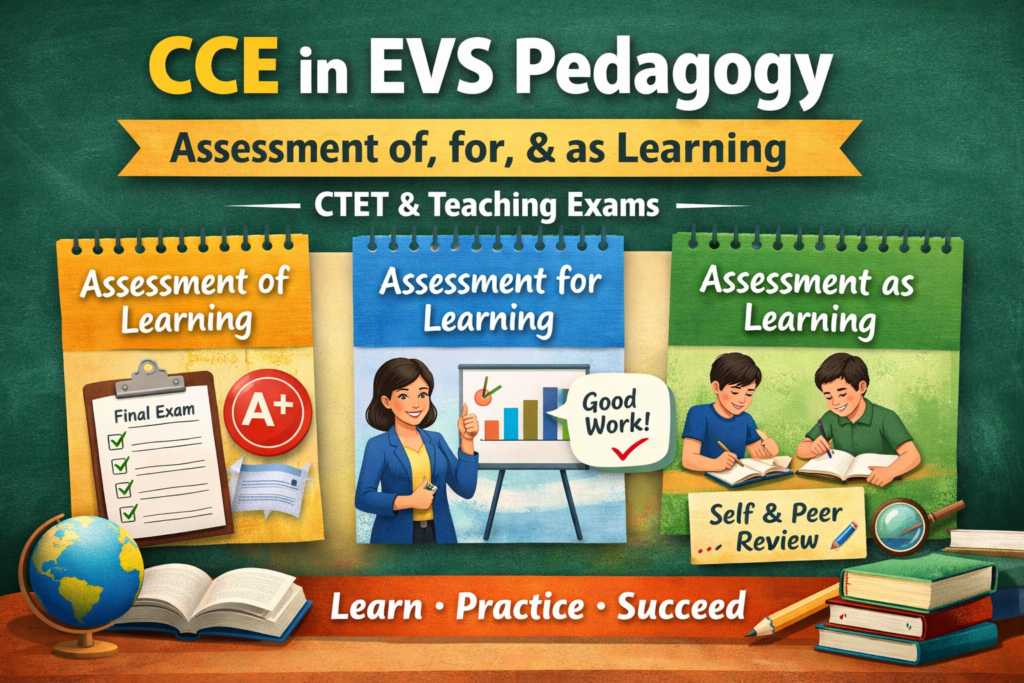
Introduction to CCE in EVS Pedagogy
Continuous and Comprehensive Evaluation (CCE) is a system of assessment introduced under the Right to Education Act, 2009 in India. It was adopted by state boards and the CBSE for Classes VI to X.
In simple terms, CCE aims to make evaluation regular, inclusive, and stress-free. Instead of relying only on final exams, it focuses on continuous assessment throughout the year.
Meaning of CCE
CCE is a school-based evaluation system that covers all areas of a child’s development. It mainly focuses on two aspects.
First, continuous evaluation means assessment is done regularly during the academic session. As a result, learning gaps can be identified early.
Second, comprehensive evaluation includes both scholastic and co-scholastic areas. In other words, it looks at both academic performance and overall personality development.
Aims of CCE
The major aims of CCE are as follows:
- To assess the overall development of the child
- To reduce exam stress among students
- To make evaluation regular and systematic
- To support creative and effective teaching
- To identify learning problems and provide timely correction
- To develop learners with better skills and abilities
Objectives of CCE
CCE improves teaching and learning in many ways. For instance:
- It makes the process learner-centered
- It connects evaluation with classroom teaching
- It ensures fair and continuous assessment
- It gives students a chance for self-assessment
- It uses feedback to improve learning outcomes
Features of CCE
CCE has several important features. Firstly, it is continuous and periodic. Secondly, it focuses on the overall development of the child.
Moreover, it includes both scholastic and co-scholastic aspects. Scholastic areas deal with subject learning, while co-scholastic areas include life skills, attitudes, and values.
In addition, different tools and methods are used for proper assessment.
Functions of CCE
CCE plays an important role in education. For example:
- It helps teachers plan better teaching strategies
- It identifies students’ strengths and weaknesses
- It makes students aware of their progress
- It tracks changes in behavior and attitude
- It helps predict future academic performance
Aspects of CCE
CCE includes two major aspects.
(A) Scholastic Assessment
This includes subject-related performance such as tests, classwork, and activities.
Further, it is divided into two types:
Formative Assessment
- Conducted during the learning process
- Provides continuous feedback
- Helps improve teaching and learning
- Encourages student participation
Similarly, it supports correction and improvement.
Summative Assessment
- Conducted at the end of a unit or term
- Measures overall learning outcomes
- Compares performance with standards
(B) Co-Scholastic Assessment
This focuses on non-academic areas. For example:
- Life skills
- Attitudes and values
- Co-curricular activities like art, music, and sports
Thus, it ensures the development of the child beyond academics.
Benefits of School-Based CCE
A school-based CCE system provides many benefits. For instance:
- It reduces exam pressure
- It makes evaluation regular and meaningful
- It helps in early detection of learning gaps
- It encourages creative teaching methods
- It develops important life skills
Characteristics of School-Based CCE
CCE has some key characteristics. To begin with, it is continuous and comprehensive.
Furthermore, it focuses on learners’ overall growth. In addition, it prepares them to become responsible citizens.
In addition, it promotes interaction among teachers, students, and parents. As a result, learning becomes more effective.
Types of Assessment in CCE
There are three types of assessment in CCE.
- SUMMATIVE (Assessment of Learning)
- Focuses on measuring learning outcomes
- Mainly controlled by the teacher
2. FORMATIVE (Assessment for Learning)
- Focuses on improving learning
- Provides feedback and guidance
3. Assessment as Learning
- Encourages self and peer assessment
- Develops independent learning skills
| Type of Assessment | Focus Area | Key Feature | Example |
|---|---|---|---|
| Assessment of Learning | Measures learning outcomes | Improves the learning process | Final exams, unit tests, term-end exams |
| Assessment for Learning | Improves learning process | Provides feedback and guidance | Controlled by the teacher, used for grading |
| Assessment as Learning | Develops independent learning | Involves self and peer assessment | Teacher feedback on classwork, quizzes, and assignments |
Tools and Techniques of Evaluation
CCE uses different tools for assessment. Broadly, these are of two types:
Standardized Tools
- Objective and reliable
- Include intelligence and aptitude tests
Non-Standardized Tools
- Flexible and teacher-made
- Include observation and checklists
Common Assessment Tools
Some commonly used tools are:
- Portfolio – Shows student progress over time
- Anecdotal Records – Short notes on student behavior
- Checklists – Simple yes/no evaluation
- Rating Scales – Measure level of performance
- Assignments – Practice-based tasks
- Observation – Study of behavior in real situations
- Questions – Assess understanding and thinking
- Document Analysis – Evaluation of written work
📘 Download CCE EVS Pedagogy Notes PDF
Get complete Continuous and Comprehensive Evaluation (CCE) notes for EVS pedagogy. Perfect for CTET & TET preparation.
Download PDF NowCTET EVS Pedagogy Practice Questions on CCE (With Answers & Explanations)
Question 1: A teacher conducts small quizzes during the lesson and gives immediate feedback. This is:
A. Assessment of learning
B. Summative assessment
C. Assessment for learning
D. Final evaluation
Question 2: A teacher takes a final test after completing a chapter. This is:
A. Assessment of learning
B. Assessment as learning
C. Formative assessment
D. Diagnostic assessment
Question 3: Students check their own answers after a test. This reflects:
A. Teacher-centered learning
B. Assessment of learning
C. Assessment as learning
D. Summative assessment
Question 4: A teacher observes students during group work and records behavior. This is:
A. Only scholastic assessment
B. Co-scholastic assessment
C. Final examination
D. Standardized testing
Question 5: A teacher changes teaching method based on student responses. This shows:
A. Assessment of learning
B. Assessment for learning
C. Summative evaluation
D. Traditional testing
Question 6: A student keeps a record of work and progress over time. This is:
A. Checklist
B. Rating scale
C. Portfolio
D. Anecdotal record
Question 7: A teacher writes short notes about student behavior. This tool is:
A. Assignment
B. Anecdotal record
C. Questionnaire
D. Standard test
Question 8: A checklist is used to assess whether a student can perform a skill. This is:
A. Summative assessment
B. Subjective evaluation
C. Observation-based tool
D. Only academic testing
Question 9: CCE reduces exam stress because:
A. It removes exams
B. It focuses only on marks
C. It spreads assessment throughout the year
D. It avoids teaching
Question 10: A teacher evaluates both academics and life skills. This reflects:
A. Only summative assessment
B. Only scholastic evaluation
C. Comprehensive evaluation
D. Standardized testing
- समास क्या है? हिंदी व्याकरण समास के भेद, परिभाषा और उदाहरण – PDF Notes

- BPSC TRE 3.0 Question Paper PDF डाउनलोड करें – TRE 4.0 की तैयारी के लिए महत्वपूर्ण प्रश्न
- CTET Paper 1 Previous Year Question Papers with Answer Key PDF – 2018 to 2026
- CCSU B.Ed 1st Year Question Papers 2026 – Download June 2026 Exam Papers PDF
- CTET 2026: 22वें संस्करण के लिए आवेदन का फिर से मौका, 25 अगस्त से 1 सितंबर तक खुला पोर्टल